


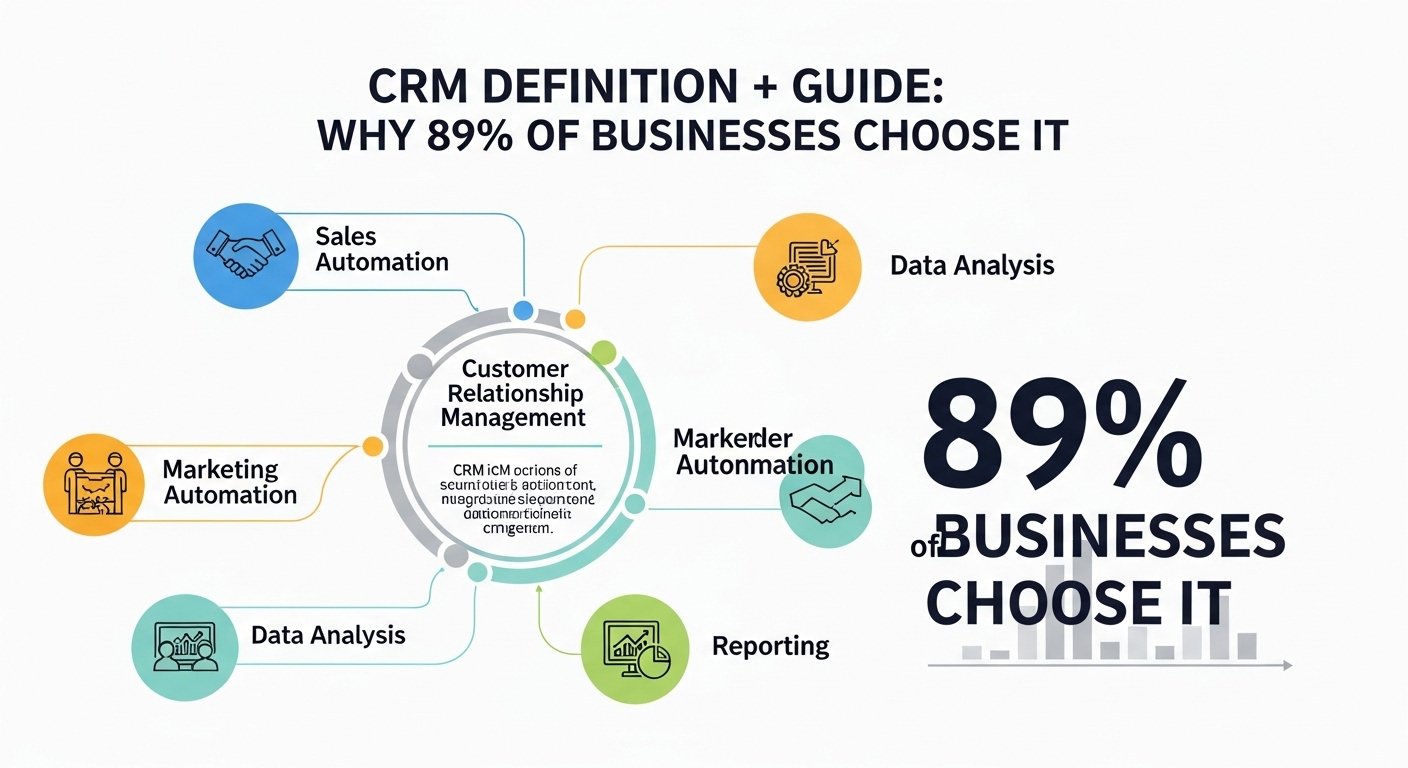

So you’ve been hearing about CRM everywhere. Your business friends keep talking about it. Consultants keep bringing it up. But if you are not in tech, there is a good chance you still do not know what a CRM actually is or whether it is worth the hype. Modern CRM systems are increasingly powered by AI technology. If you want to understand the broader context of what is artificial intelligence and how it is transforming business software, it is worth reading that too. Let’s clear this up properly.
What CRM Stands For
CRM stands for customer relationship management. At the simplest level, it is software that helps businesses stay organized about customers, leads, conversations, and follow-ups instead of relying on memory, scattered spreadsheets, or random email threads.
What Is CRM? A Practical Definition
A CRM is a system, usually software, that stores customer information in one place. That includes contact details, purchase history, previous conversations, notes, sales activity, and support interactions. Instead of different team members keeping separate records, everyone can work from the same shared view.
That sounds simple, but it solves a huge problem. In many businesses, customer information lives in too many places. One person has notes in email. Another keeps a spreadsheet. Someone else just remembers details from memory. A CRM removes that confusion and creates one system for the whole team.
CRM Meaning in Business
The CRM meaning in business is broader than just software. It refers to the practice of managing customer relationships and interactions in a structured way. In other words, it is not just about having names in a database. It is about building a system around how your business communicates, sells, supports, and follows up.
When people ask what a CRM is in the real world, they are usually talking about the software tool that makes this process practical. Without that tool, most businesses end up relying on memory, individual habits, and inconsistent processes.
Define CRM in a Way That Actually Makes Sense
Imagine you are running a business with fifty customers. One asked about pricing last Tuesday. Another has not ordered in six months but used to buy regularly. Another is close to renewing a contract. Another complained about delivery delays last month.
Now imagine every person on your team can see all of that instantly without digging through email or asking around. That is what CRM makes possible. Everyone works from the same information, which means fewer mistakes, better communication, and smarter follow-up.
How CRM Software Actually Works
CRM software handles a few core jobs. It stores customer information, tracks interactions, supports follow-up, and generates reports so businesses can understand what is happening. Many newer systems also include automation and AI-powered insights. If you want the broader technical context, it helps to understand how does AI work because many modern CRM platforms are adding AI features for forecasting, summaries, and data enrichment.
Let’s say someone visits your website and fills out a contact form. The CRM can automatically capture the person’s details, interest, and source. When a salesperson follows up, they already have context. The customer does not need to repeat everything.
When that person becomes a customer, their purchase and communication history can also live inside the CRM. Sales, support, and marketing teams can see the same timeline. That means fewer blind spots and a better customer experience.
Understanding CRM Systems
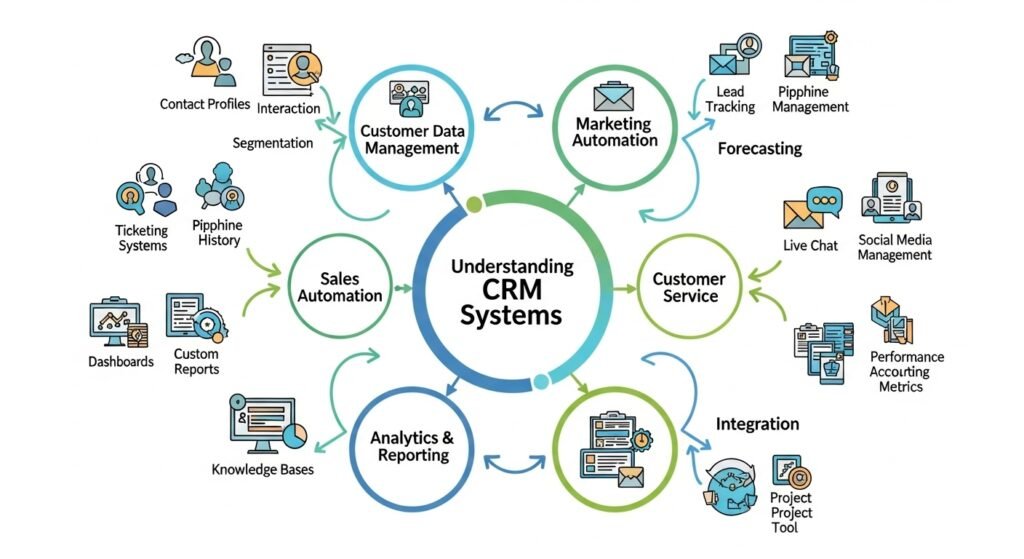
CRM systems come in different forms. Some are enterprise-level tools that take months to implement and cost a lot. Others are lightweight platforms that small businesses can start using in a single day.
The core function is still the same:
- store customer data
- track interactions
- help teams stay organized
The difference is in complexity, pricing, flexibility, and how much setup is required. Some teams want simplicity. Others need powerful customization and deeper reporting. Tools like Softr CRM often appeal to businesses that want a simpler middle ground.
Cloud CRM vs Traditional Systems
Cloud CRM is now the standard for most businesses. These tools live online, which means you log in through a browser, data syncs across devices, and there is no need to manage your own servers.
That is one reason cloud CRM became so popular. It is simpler to use, easier to scale, and usually requires less technical maintenance. For businesses comparing models, cloud CRM is worth understanding because it explains why so many companies moved away from older on-premise systems.
CRM Software for Small Business
CRM software for small business usually needs to be easier to learn, cheaper to maintain, and faster to set up. Small teams do not need a bloated platform that requires a consultant for every change. They need something they can actually use.
That is why many small businesses start with simpler systems and upgrade later if they outgrow them. The goal is not to buy the biggest CRM. The goal is to choose one that matches your sales process, team size, and growth stage.
What Does CRM Stand For? Breaking It Down
Customer relationship management sounds formal, but each word matters.
Customer
This is the person or company you are trying to serve, sell to, or retain.
Relationship
CRM is not just about one transaction. It is about the ongoing connection over time, including every touchpoint, question, issue, and opportunity.
Management
This means handling those relationships intentionally. Not by luck. Not by memory. By using a system that makes follow-up and decision-making more reliable.
Why CRM Matters for Business Growth
CRM matters because customer relationships directly affect revenue, retention, and efficiency. Businesses that manage those relationships well are usually more organized, more proactive, and easier to work with.
When a CRM is used properly, a few things start to improve:
- sales teams close more deals because they have better context
- support teams resolve problems faster because history is visible
- managers spot trends earlier because the data is centralized
- marketers segment audiences more accurately
- businesses reduce missed follow-ups and lost opportunities
That is why CRM is not just an admin tool. It is a growth tool.
What Is CRM Software?
CRM software is the system that makes organized customer management possible. Without it, companies often depend on personal habits, memory, disconnected notes, or spreadsheets.
Here is what CRM software usually helps with:
| Feature | Why It Matters | Real Impact |
| Centralized customer database | No fragmented information | Everyone sees the same history |
| Interaction history | Context matters | Better conversations |
| Automated follow-ups | Improves consistency | Fewer leads get lost |
| Sales pipeline tracking | Visibility into deals | Better forecasting |
| Reporting and analytics | Smarter decisions | Clearer performance insights |
| Mobile access | Useful for field teams | Access anywhere |
| Email integration | Reduces double entry | Less admin work |
| Task management | Priorities stay visible | Better accountability |
CRM Meaning in Modern Business
CRM used to be mostly associated with sales. Today it is much broader. Modern CRM platforms often support sales, customer service, marketing, retention, and reporting all in one place.
That means the modern CRM meaning includes:
- support ticket visibility
- campaign segmentation
- lead tracking
- customer retention signals
- cross-team coordination
So when businesses talk about CRM today, they are often talking about company-wide customer intelligence, not just a sales database.
Best CRM Software and How to Choose
The best CRM software depends on your business, budget, team size, and workflow complexity. There is no one perfect answer for everyone.
Salesforce CRM
Salesforce CRM is one of the biggest names in the market. It is powerful, flexible, and built for large or complex organizations. It is also more expensive and more complicated than many small teams need.
Zoho CRM
Zoho CRM often sits in a middle space. It is more affordable than enterprise tools but still offers a wide set of features, which makes it popular with growing businesses.
HubSpot CRM
HubSpot CRM is popular because it connects sales, support, and marketing fairly well. The free version also makes it attractive to small businesses starting out.
Pipedrive
Pipedrive is especially appealing to sales-focused teams because it matches how many salespeople naturally think about deals and pipeline movement.
If your business is smaller, your best choice is usually something affordable and easy to implement rather than the most advanced platform on the market.
What Is Salesforce CRM and Why It Gets So Much Attention

Salesforce CRM is often treated as the default enterprise option because it was one of the earliest major cloud-based CRM providers. It helped define the modern software-as-a-service model for CRM and became deeply embedded in large organizations.
That does not mean it is the best fit for every company. But it explains why Salesforce is so often mentioned whenever CRM comes up.
What Is a CRM System for Your Actual Business?
When you strip away the jargon, a CRM system is simply a tool that helps your business remember everything important about customers so your team can work more intelligently.
That matters in real situations:
- when an employee leaves and customer knowledge does not disappear with them
- when a salesperson enters a meeting already knowing the history
- when multiple departments need the same customer context
- when managers want visibility instead of guesswork
That is the real practical value of CRM.
What Is CRM in IT Context?
In IT, CRM is often discussed more from the technical side. Teams want to know how it integrates with email, accounting systems, support platforms, APIs, and automation tools. The business goal is still the same, but technical teams focus more on implementation, custom fields, workflows, and system connections.
Many newer CRM platforms also use machine learning to automate data entry, forecast behavior, or suggest next steps. That makes CRM part of a broader connected business stack rather than an isolated tool.
Common CRM Implementation Mistakes
Most CRM failures are not caused by bad software. They happen because implementation is poor.
Forcing Adoption Without Buy-In
If teams do not understand why the CRM matters, they will resist it, avoid it, or enter bad data.
Treating It Like a Reporting Tool Only
If the CRM exists only for management reports and does not help people do their real work, adoption usually drops fast.
Not Integrating It Into Workflows
If the real work still happens entirely in email, spreadsheets, or chat, the CRM becomes an afterthought instead of the system of record.
Choosing the Wrong CRM
A five-person company does not always need an enterprise platform. And a complex business will struggle with a tool that is too basic. Choosing the wrong fit creates pain from the start.
How CRM Connects to Real Business Growth
CRM matters because customer relationships affect almost every important business metric. Good CRM use can shorten sales cycles, improve customer retention, strengthen support, and help marketing become more targeted.
That is where CRM starts to matter beyond operations. It influences growth. It helps you identify better customers, keep strong ones longer, and respond faster when something is at risk.
In niche industries, specialized CRM strategies matter even more. For example, CRM solutions for commercial real estate show how customer management can be adapted to a specific sector instead of treated as one-size-fits-all.
Final Thoughts
On the surface, CRM can look boring. Just another business tool. But in practice, it becomes the backbone of how organized companies handle customers, opportunities, and follow-up.
You can run a business on memory and email for a while. Some people do. But it usually creates inconsistency, missed context, and slower growth. The companies that use CRM well are usually more coordinated, more scalable, and less dependent on individual memory. That is the real reason CRM matters.