


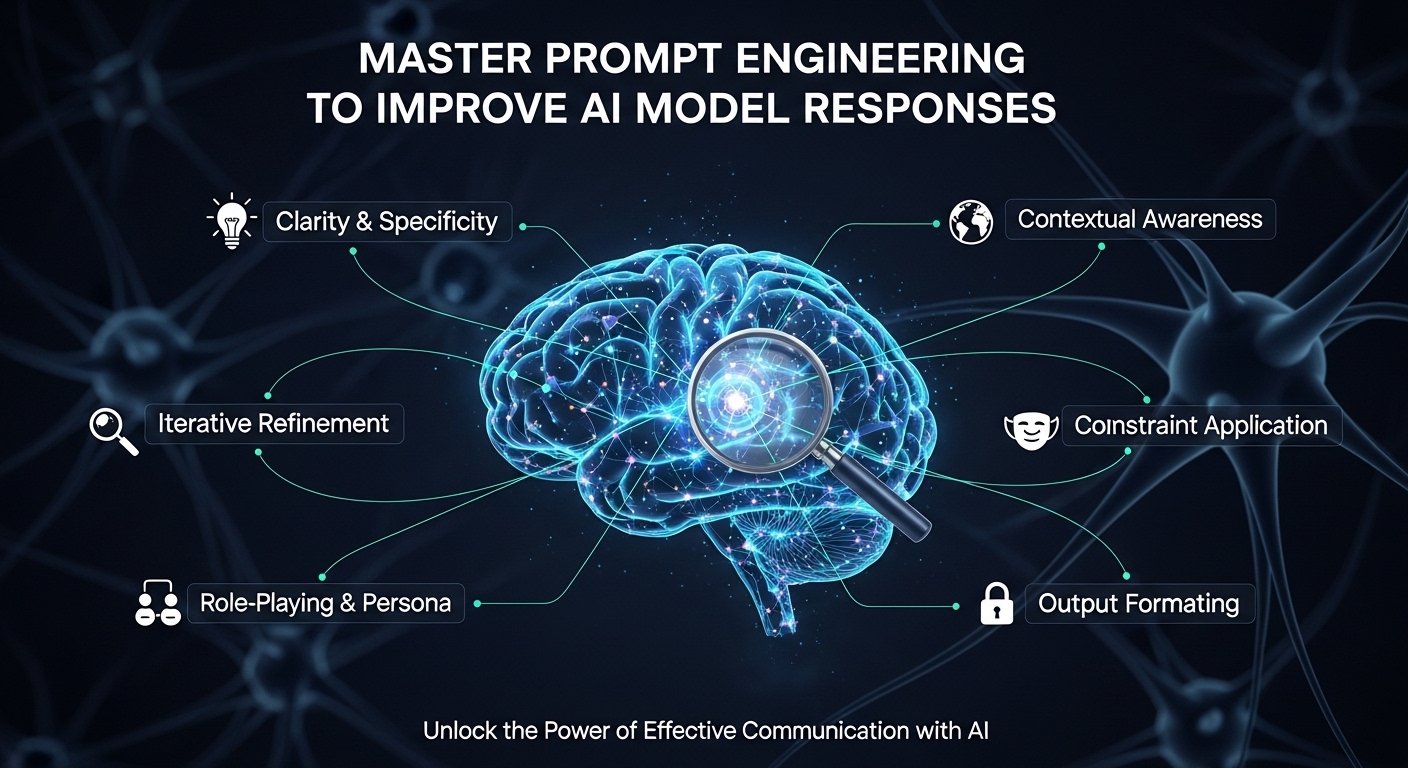

Prompt engineering, you say. It merits a little more than a curious chuckle, doesn’t it? But, as Artificial Intelligence is rapidly evolving and transforming multiple fields, the skill of prompt engineering is rising in importance. Whether you’re implementing chatbots, handling AI instruments, or using natural language processing systems, prompt engineering remains the crucial element for obtaining your desired outputs. This post below identifies what prompt engineering really means, how it’s done, and why it’s such a major skill in our AI-centric world.
Editorial note: This article was reviewed by TheArticleSpot’s editorial team for clarity, source accuracy, and relevance. AI tools may have supported outlining, editing, formatting, or research organization, but final review and publication decisions are handled by a human editor. Tool features, pricing, and availability can change, so readers should verify important details on the official provider website before making a final decision.
What is prompt engineering?
In brief, prompt engineering refers to the craft of constructing and designing the inputs (prompts) to guide AI models like GPT or Claude in generating highly accurate, useful, and contextually relevant responses.
Is prompt engineering worth learning?
It’s a definite yes. AI is continuously being integrated into business, marketing, and technological activities; hence, knowing how to design accurate prompts is a must to harness AI tools’ potential fully.
How does prompt engineering work?
Prompt engineering is dependent on gaining a comprehension of the ways an AI model interprets input, and then modifying the inputs accordingly so as to elicit from the model output which is in line with the desired direction. It is essentially like instructing a highly intelligent yet, at times, unpredictable assistant.
Prompt Engineer in the Context of AI
A prompt engineer is a role dedicated to the creation of effective, understandable, and contextually suitable prompts for AI modeling in order for the latter to produce the intended output. Due to the ongoing AI adoption in various domains such as customer service, content generation, data analysis, etc., prompt engineering is a skill that is trending towards rising demand.
Having said that, possessing the skills of a prompt engineer isn’t limited to mere prompt typing. It requires the knowledge of mechanisms of AI models’ processing of information and understanding how the models respond to different types of language, tone, and structures. On top of that, prompt engineers should have the dual perspective of a user and a trainer to ensure that the AI model’s comprehension is aligned with what the prompt is communicating the model to do.
Simply passing the AI mere words and wishing for success is never the method. Prompt engineers with a deep understanding know that a small change in wording can have a profound effect on the AI response.
Guidelines for an Effective Prompt

Producing an effective prompt is a matter of simplification and clear expression of a complex query or task to something within the grasp of the AI. Clarity, conciseness, and creativity in the breakdown of the given question or task are the components of excellent prompt creation.
When dealing with language models such as GPT or Claude, one must make sure that prompts provide sufficient information and context. If one is requesting a blog post, an entirely vague prompt such as “Write a blog post about AI” will probably result in a generic one. However, if the prompt were explicitly stated as “Write a blog post of 1000 words about how to increase the efficiency of AI models in business application through prompt engineering,” then the AI can come up with a much more focused and relevant response.
Right here lies the importance of prompt engineering. Essentially, it is quite like steering the AI in such a way that it literally understands what you want, so it doesn’t go off track or mistakenly perform the task.
Prompt Engineering Course: Excellent First Step
For those interested in prompt engineering skills, a prompt engineering course might be ideal. Such courses typically introduce the fundamental concepts of the AI models’ communication and processing of languages, as well as providing practical examples of effective prompt creation.
Moreover, a few prompt engineering courses will cover strategies for creating prompts that are tailored to a particular AI model, how to work with different versions of AI, and how to adjust AI results for business purposes. In short, it is an excellent avenue for gaining a comprehensive understanding of how AI models operate and how you can best employ them in your projects or business.
Tu Jinhao’s Prompt Engineering: Moving Further into AI
In the prompt engineering domain, occasionally you come across Tu Jinhao, the individual who made a significant impact on prompt engineering in AI. Tu Jinhao’s Prompt Engineering Thinking is a well-known method putting an accent on designing prompts in such a way that the AI’s workload is minimized while the AI’s efficiency is maximized.
One of his main ideas is harnessing the knowledge of AI’s limitations in order to design prompts that fully exploit the capabilities of the tool. Should you decide to get into the nitty-gritty of prompt engineering, keeping up with Tu Jinhao’s Prompt Engineering Thinking would be very advantageous.
Why Bother with Prompt Engineering?
First and foremost, it allows you to get more precise outputs from AI. A properly composed prompt can effectively direct the AI and save you time on reviewing and fixing its answers. Prompt engineering lets you do the input refinement once and get the output that you demand instead of the continuous cycle of output refinements.
Further, it enables one to be more efficient when dealing with complicated tasks. Content generation, data processing, or customer service – a well-executed prompt is a considerable time-saver. Prompt engineering not only helps automate tasks but also streamlines business operations that involve processing large volumes of information very quickly.
While AI can make errors, a prompt engineer can minimize the gap between AI output and user expectations. This is especially handy in customer services where the provision of accurate and contextually relevant information is paramount.
How Prompt Engineering is Executed in Real Life
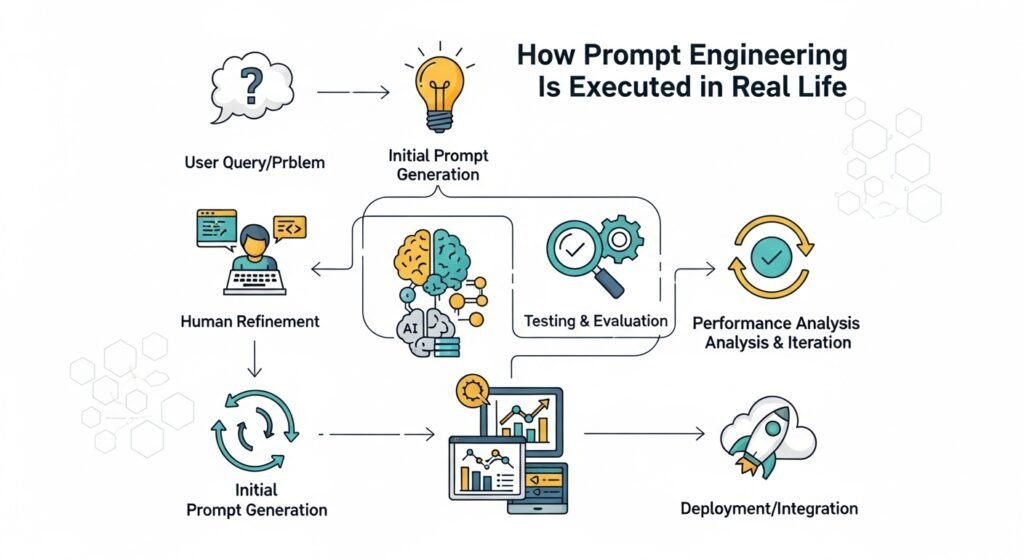
For example, in customer service, AI can be used to automate responses for common queries. But, in order to initiate the correct response from the AI, you will need a very specifically-worded prompt requesting the needed information. The prompt “What shipping options do you offer for Australia?” will work better than “generate information for me on shipping.”
Content generation is another example of the application of prompt engineering where the desired tone or focus of writing can be directed in results by guiding the AI. A prompt like “Create a blog post about AI” will produce very generic and broad content, whereas “Prepare a blog post illustrating the advantages of prompt engineering in enhancing AI responses for small businesses” will give the AI the necessary direction.
In market research, where there is huge data processing and extracting useful insights, a prompt like “Analyze and summarize the latest market surveys about consumer sentiment in the tech industry” makes a significant difference in the quality and relevancy of the ideas presented.
Major Blunders to Take Care of in Prompt Engineering
Even though prompt engineering may be tremendously effective, one can easily commit errors that will result in unsatisfactory AI outputs. Here are a few:
- Being overly general: Your prompt lacking adequate detail will result in the AI not knowing what you actually want. Always ensure you supply both details and context.
- Prompt overload: However, overdoing a prompt by making it overly complicated or overloaded with information is another end of the spectrum. It can confuse AI and, therefore, the response it generates will be less pertinent.
- Unwillingness to iterate: At the core of prompt engineering is a process of trial and error. Prompt refinements and adjustments based on outputs should be embraced and encouraged.
Prompt Engineering Models: A Comparative Study

To get the best of one’s abilities in prompt engineering, it is very necessary to identify the AI model the work is being done with. Different models, like GPT, Claude, and others, may interpret prompts in their own ways.
For example, Claude is better at mimicking human responses and is more loyal to the instructions given. However, GPT might be more creative and have a better handle on the writing task. Knowledge of these models’ strengths and weaknesses will certainly help you to come up with the best prompts.
If you want to test how different models respond to prompts, analyzing Tu Jinhao’s methods of Prompt Engineering might provide you with hints on how to fine-tune your results depending on the model you are using.
Complete FAQ Section
1. What is prompt engineering?
Prompt engineering is the method by which precise inputs are designed with the purpose of driving AI models to come up with responses that meet the requirements.
2. Why is prompt engineering important?
Proper prompt engineering is what yields AI results that are accurate, relevant, and fitting to the context. Without it, AI might misinterpret tasks.
3. Can I learn prompt engineering?
Indeed, there are prompt engineering courses available which can equip you with the necessary skills to produce effective prompts and familiarize yourself with different AI models.
4. How does Tu Jinhao’s Prompt Engineering Thinking help?
Tu Jinhao’s technique is one of improving prompt efficiency by carefully designing prompts that enable the AI to understand and perform tasks exceptionally well.
5. How do I create a good prompt for AI?
Most importantly, a good prompt should be simple, clear, and direct with sufficient background given to the AI to comprehend the task. Unfocused prompts will only lead to generic output.
6. Is prompt engineering useful for businesses?
Definitely. It allows companies to acquire precise AI responses, automate their processes, and increase their efficiency whether it be in customer service, content creation, or data analysis.