

Magnesium is a nutrient that people don’t usually consider until they start to feel symptoms such as sleep problems, muscle cramps, and unusual fatigue. That’s when they might suddenly find themselves checking supplement labels at midnight. The topic of magnesium glycinate vs citrate quickly comes up, and honestly, it can be somewhat confusing at first.
Let’s take it slowly and go through the matter—plainly, without exaggeration.
What Is Magnesium Good For, Really?
It would be very helpful to understand the importance of magnesium before even considering the different forms of it. The mineral is not just a trendy nutritional supplement, rather, it is a fundamental mineral that is involved in the functioning of hundreds of processes in the body.
Magnesium helps in:
-
muscle relaxation
-
nerve signaling
-
energy production
-
blood sugar regulation
-
heart rhythm
-
bone health
This is not marketing pitch. This is plain physiology.
However, a lack of magnesium may not always be so evident. It can sometimes just be a whisper—poor sleep, twitchy muscles, headaches, low stress tolerance. A lot of minor things getting stacked up.That is the reason why the magnesium supplements come in various forms. Different people have different needs.
Magnesium Supplement Forms (Why There Are So Many)

If you go to a local drugstore or online, it offers magnesium pills, magnesium powder, capsules, liquids, and so on. Then you come across the following:
-
magnesium glycinate
-
magnesium citrate
-
magnesium oxide
-
magnesium chloride
-
magnesium threonate
-
magnesium L-threonate
It may seem too much, but there is a reason. Magnesium naked, is poorly absorbed. It has to be coupled with other things. The “something” determines the effect it has on the body. Some forms are absorbed better. Other forms affect digestion. Still, others target the brain more, which is why they’re often discussed in relation to social anxiety disorder and nervous system regulation.
That is when the real differences come.
Magnesium Glycinate (Why It Is Popular)
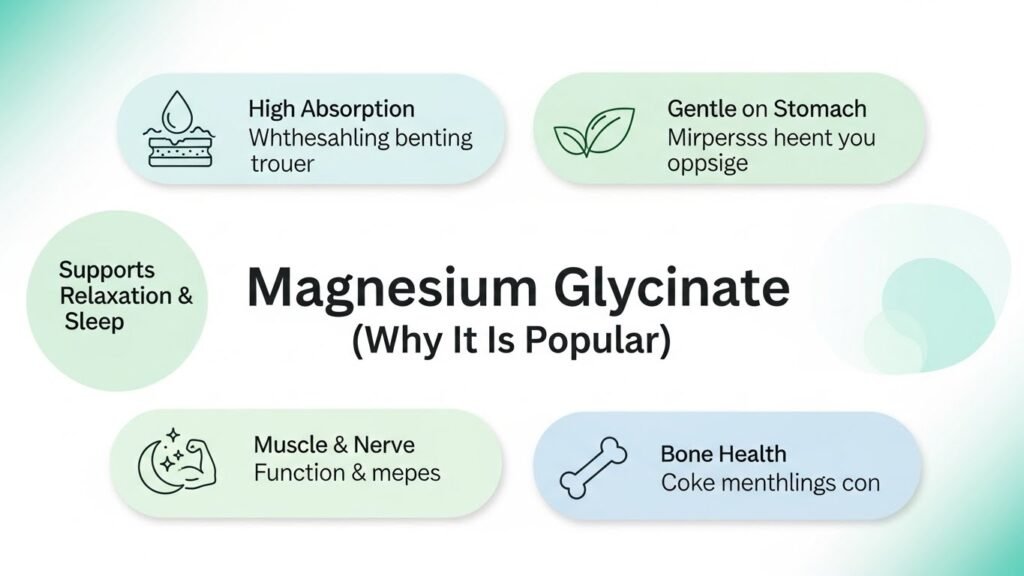
When people talk about magnesium glycinate benefits, they mostly talk about tolerance and calm. This form is known for:
-
being very gentle on the stomach
-
being highly absorbable
-
causing less diarrhea
-
helping relaxation and sleep
That is the main reason why magnesium glycinate is often mentioned as a sleep aid. Since it doesn’t overstimulate digestion and it doesn’t rush through the gut, it kind of… settles in.People who suffer from anxieties, chronic stress, muscle tension, or disrupting sleep often go for this form.
Magnesium Glycinate and Magnesium Absorption
Binding to glycine is important. It helps magnesium to be taken in through amino acid pathways rather than rough digestive ones. This is why a combination of magnesium glycinate and other magnesium forms is usually considered to be ‘smoother’ compared to other forms.The chances are very slim that you will get stomach cramping or urgency. Which, actually, is quite important.
Magnesium Glycinate Side Effects (They Are There)
No supplement is a flawless one.
Some possible side effects of magnesium glycinate are:
-
mild drowsiness
-
blood pressure which is too low (with high doses)
-
nausea when taken on an empty stomach
Nevertheless, among many forms, it is considered the best-tolerated magnesium supplement.
Magnesium Citrate
Magnesium citrate is basically what you get when magnesium is combined with citric acid. Although it is quite well absorbed, it acts very differently in the body.
Magnesium citrate help in:
-
ending constipation
-
getting rid of a sluggish bowel
-
fast magnesium storage
Magnesium citrate draws water into the intestines, which is the main reason why it can be used as a laxative in such cases. Even in some hospitals, it is used as a bowel prep.One side of it could be helpful, the other is very inconvenient.
Magnesium Citrate vs Glycinate (Digestive Reality Check)

This part is where the comparison gets down-to-earth.
-
Magnesium citrate: it is a quick and digestive-focused type of magnesium
-
Magnesium glycinate: it is a calm, steady, and systemic type of magnesium
If the main thing you want to achieve is getting through the digestion process, then choosing citrate would be a reasonable step. Otherwise, if you wish to get sleep, muscle relaxation, or be free from stress, then the use of citrate might only worsen your condition.Most people would agree that 3 a.m. wake-ups resulting from suddenly getting an accusative effect of your supplement are not what you really wanted after all.
Magnesium Glycinate vs Citrate — A Clear Comparison
Let’s look at one more way to compare the two.
| Feature | Magnesium Glycinate | Magnesium Citrate |
|---|---|---|
| Absorption | High | High |
| Digestive impact | Gentle | Can cause diarrhea |
| Best for sleep | Yes | Not ideal |
| Best for constipation | No | Yes |
| Stomach tolerance | Very good | Mixed |
| Daily use | Yes | Depends |
This is what the issue of magnesium glycinate vs citrate sounds like at its center. It is not a question of which one is “better” but which one fits your purposes better.
Does Magnesium Help Sleep? (Short Answer: Often, Yes)
Magnesium on the sleep topic is one of the most sought-after reasons behind supplement trial. So—does magnesium help sleep? For many people, it does. Especially in case of deficiency or stress.
Magnesium participates in the regulation of:
-
melatonin production
-
calming of the nervous system
-
muscle relaxation
At the same time, it is very essential to remember that the form plays a role in this process.
Magnesium Glycinate for Sleep
Magnesium glycinate for sleep is so effective because:
-
glycine is a known relaxing agent
-
it does not trigger digestion
-
it is perfectly in line with a night routine
What most people find is a pattern of deeper sleep or fewer times of waking during the night. Not dramatic. Just… steadier.
Where Magnesium Threonate Fits In
Magnesium threonate is also known as magnesium L-threonate. It differs once again since it is specifically engineered to cross the blood-brain barrier more efficiently.
Magnesium L-Threonate vs Other Forms
The following is what that form is most likely associated with:
-
brain health support
-
enhancing memory
-
increasing concentration
It is rarely chosen for muscle cramps or digestion. Besides, it is often more expensive.Some people do even a combination of magnesium threonate in the morning and magnesium glycinate at night. No medical advice — just a common real-human-world approach.
Other Magnesium Forms (Quick Context)
Wrapping things up:

Magnesium Oxide
-
cheap
-
not well absorbed
-
most common use is as a laxative
Magnesium Chloride
-
fairly good absorption
-
sometimes is toppled into baths or used on the skin
-
not the greatest taste
These versions are around but it seems that they are not generally considered the best magnesium supplements for daily use.
Magnesium Tablets vs Magnesium Powder
It is a matter of taste and choice.
-
Magnesium tablets: very easy to use and carry around
-
Magnesium powder: not only gives you control over your dosage but it is also absorbed quicker
If you are going to change the amount gradually, powder forms of magnesium glycinate or citrate will be very handy.
Best Magnesium Supplements (What Actually Matters)
Put branding aside for a moment. What makes the best magnesium supplement usually are these characteristics:
-
a clearly labeled form (not just “magnesium blend”)
-
third-party testing
-
a reasonable dose (not extreme)
-
minimal fillers
You see? Consistency is far more important than perfection.
Benefits of Magnesium Over Time
The benefits of magnesium supplementation may not be immediate.
Some people say:
-
their muscle cramps have significantly decreased
-
they experience better quality and longer duration of sleep
-
they handle stress better
-
they have more stable energy levels throughout the day
It is barely noticeable at first. Slowly. That is probably the reason why some people quit taking it too soon.
Magnesium Bisglycinate and Magnesium Glycinate — Same Thing?
Basically, yes.
The terms magnesium bisglycinate and magnesium glycinate are used interchangeably to denote the same chelated form. In some cases, labels will use one term while in others, they will use the second term. The main point is that magnesium is bound to two glycine molecules.
So, there is no need to get tangled up in that section.
Magnesium Glycinate vs Citrate — One More Time, Briefly
Glycinate would be a better fit if you need calm, sleep support, muscle relaxation.
Duly, if your body needs to have things moving—citrate does exactly that.
That’s basically it. Without exaggerating it.
(Main keyword used second time here.)
How to Choose Without Overcomplicating It
Answer some questions of yours:
-
Is my problem constipation or digestion?
-
Or is it rather sleep, stress, muscles, or nerves?
Where you’re headed is the direction indicated by your answer.
Begin with a low dose. Gradually increase it. Be aware.
FAQs (People Also Ask)
1. What is magnesium good for daily use?
Magnesium is essential for the proper functioning of the muscles, nerves, sleep, energy production, and stress regulation when it is taken regularly.
2. Is magnesium glycinate better than citrate?
It is all about what your goal is. If you want sleep and tolerance, then glycinate would be the one. And if you want digestion, then it is citrate.
3. Can magnesium supplements cause side effects?
Sure. Diarrhea is the most common side effect when taking citrate. Glycinate is generally a lot gentler.
4. Does magnesium help sleep every night?
Definitely, for the majority of people, magnesium does help to have a better sleep; they have noticed it over a while. However, it doesn’t mean that those results have to be instant.
5. Which magnesium is best for long-term use?
Long-term daily supplementation is often preferred in the form of magnesium glycinate.