
The majority of health-related journeys aren’t generally associated with flashing lights or a dramatic phone call for help. Most of the time, they’re quiet. Such as a hospital discharge, a typical dialysis session, a therapy appointment in another part of town. The point is, someone needs to get from one place to another safely, calmly, and without being rushed or stressed. This is where non-emergency transportation comes in daily healthcare context, mostly unnoticed, yet very important.It hardly ever makes headlines. It doesn’t run red lights or speed along the streets. But it is what keeps thousands of patients daily on track for medical care. If it weren’t for it, a vast majority of treatments simply wouldn’t get done at the right time.
Introduction
Non-Emergency Transportation is a term that covers travel that is medically supported and arranged for patients who are not in an emergency state but still need to be assisted by professionals when moving from one medical facility to another. Supported today by modern transportation technology, the scope of this transportation extends to hospital discharges, visits to specialists, rehab sessions, and trips for treatments which are carried out over a period of time.
By nature, non-emergency transport differs from emergency transport in that it emphasizes comfort, safety, and continuity of the journey, thus helping patients lead normal lives by providing them with a reliable link to medical care.
How Non Emergency Patient Transport Works

Every medical transfer that runs like clockwork has careful planning behind it. It is usually the hospital, clinic, aged care facility, or the patient’s family that initiates the booking. The transport provider reviews the patient’s condition, mobility, and the need for any medical equipment to determine the type of vehicle and staff to assign. Many transport officers undertake formal training like cert 3 non emergency patient transport, which equips them with safety and handling skills, infection control, communication, and basic patient monitoring techniques—while also working closely with providers and patients who rely on health insurance in Australia to manage medical transport and care costs.
Once the trip starts, the staff remain vigilant throughout the trip checking for any changes in the patient’s condition or discomfort. Most importantly, they cater to the needs of the patient very gently and attentively.
Difference Between Emergency and Non-Emergency Transport
Emergency medical transportation is reserved for cases where the patient’s life is in danger. Some of these instances include heart attacks, major injuries, and respiratory problems where the patient needs immediate clinical intervention.The emergency services have to work under great pressure and therefore respond within very limited time frames. On the other hand, non-emergency medical transport refers to scheduled or partly scheduled journeys where although being on time matters, it is not a life-or-death situation.
Examples of these journeys include dialysis sessions, discharges from hospital, or transfers from one medical facility to another.Ambulances meant for emergency are being used for routine transports which is draining the public resources and also hindering the critical care of others. The right thing to do is to find a patient transport service which can help in maintaining the equilibrium of the healthcare systems.
Role of Specialist Ambulance Services
A patient in one of these states requires more than what basic transportation offers but at the same time, they don’t need a full-blown emergency vehicle or crew.These patients may be post-operative, dealing with neurological disorders, or on inhalation therapy. They would be the target group of specialist ambulance service providers.
They offer a combination of clinical expertise and scheduled transport. These carriers use advanced monitoring devices and their medical team members can intervene promptly if there is a sudden deterioration of the patient.This level of care is a good compromise between leading to an unnecessary emergency while at the same time being able to maintain a high-level and continuous medical supervision.
Patient Transport Home from Hospital
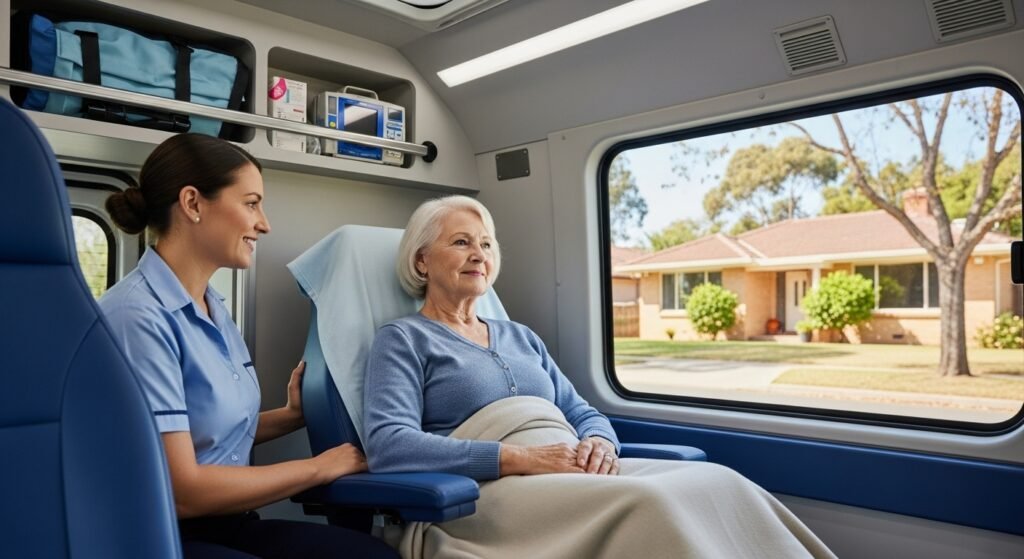
A very popular use of patient transport is the return of patients from hospital to their homes.Following operations or sickness, many people may feel weak and in a daze or just physically not up to the task. A trip on public transport can sometimes be dangerous and there also may be no family members to help them.
Professional patient transport home from hospital is a service that ensures that patients get to their homes safely while at the same time a certain level of medical supervision is maintained.This results in less stress on the patient, lower risk of complications and overall recovery goes smoother. Many patients even find it hard to imagine their healing process without this service being part of it.
Benefits That Often Go Unnoticed
The result of patient transportation is seldom apparent as it is only when patients experience the adverse situation of having to rely on unreliable transport that its importance is truly appreciated.Reliable transportation ensures that treatments aren’t missed. Recovery is enhanced and the patient is less emotionally traumatized. Hospitals get help with a faster turnover of patients from the bed. Therefore, better bed availability.Both the immediate and long-term benefits to all parties involved from these small. But significant advantages coming together lead to very large system improvements eventually.
Real-World Examples from Daily Healthcare
The vast majority of patients rely on a transport system to be able to carry out their treatments which can be a life-saving drug to them.Patients with kidney failure take their trips to the dialysis center at least three times weekly and depend on crews that are punctual and familiar with their needs.Those who are on rehabilitation are also at therapy sessions that without a helper’s presence would be impossible.Stroke patients, those with mobility restrictions, and residents in long-term care facilities all require a very structured transport system.These types of trips are seldom the subject of discussion. However, they sustain the quality of life silently.Treatment plans would be impossible to carry out without them due to the impracticalities involved in getting to appointments.
Common Mistakes Patients and Families Make

One mistake made frequently is when people believe their simple taxi or a ride-share app can stand in place for a professional transport.Apart from lacking medical equipment and trained staff, such services also have no liability cover.Another frequent mistake is not making a booking well ahead, especially for repeated treatments resulting in difficulty in scheduling.Sometimes the families undervalue the requirement of equipment like oxygen or a wheelchair. As a result, they find themselves at the last minute and therefore, delays occur.In several cases, individuals panic and call emergency services when they should have arranged non-emergency transport. While it is a natural reaction, it adds to the system’s burden unnecessarily.
National Patient Transport Systems and Regulation
Alongside the private sector providers, national level patient transport programs exist in Australia as well as in several other advanced countries.Such programs set standards for staff training, vehicle safety, infection controls, and personnel verification.Adhering to these regulations bolsters patient safety but it also results in an increase of operational expenses.Hence, there are differences in prices and service availability in various localities.The purpose of regulation is not to put limitations on access but to ensure that both vulnerable patients are safe and the whole process remains consistent.
Ambulance Australia and the Broader Landscape
Emergency response is the main focus of public ambulance services in Australia. These are the teams that respond to heart attacks, accidents, natural disasters, etc.Non-emergency journeys are gradually being handled by private or collaborating agencies.Such a dual model offers the flexibility for both sectors to focus on their respective areas of expertise.Public systems focus on crisis response while private services focus on continuity of care.In other words, they are two sides of the same coin that together make up the entire healthcare transport network offering services for both emergency and regular needs.
Cost Structures and Payment Models
How much it will cost to transport a patient depends on how far they need to be taken, what kind of equipment and staff are required, and how complex the situation is.Sometimes, the patients get financial support from their insurance, veterans, or government programs. Other people pay out of their pockets.
Here’s a rough idea of how the costs may be structured:
| Service Type | Typical Cost Range |
|---|---|
| Basic transport | Low to moderate |
| Stretcher transport | Moderate |
| Specialist support | Higher |
| Long-distance transfer | High |
The prices fluctuate a lot so it is very important that providers be transparent and that there is communication between providers and clients ahead of time.
Training and Professional Standards
The standard of patient transport service is largely determined by the knowledge and skills of its personnel.Officers are taught various facets of the job including patient handling, first aid, communication, and mental health recognition.Certification puts one in possession of the required know-how but practice is what really hones one’s judgment.
Skilled personnel are aware of the importance of identifying early signs of changes in patients’ conditions, handling difficult situations calmly, and knowing when it is necessary to refer the patient for higher care.Such emotional intelligence, combined with clinical expertise, teaching is just as important as the provision of equipment and care.
Comparing Non-Emergency Transport Globally
Patient transport isn’t given the same treatment across all countries.Insurance policies dictate access in the US, while contracts with the public health sector tend to be the order of the day in the UK.Australia sees its public-private hybrid systems as being the way forward.Australia’s model is a very flexible one but still, a lot of work has to go into coordination.No single blueprint works perfectly. Besides cost, access and quality are the main considerations for each one’s variations.
Technology and Scheduling Improvements
Patient transport services today are increasingly being done via the use of various digital technologies.Among the benefits that these innovations bring are the increase in the trustworthiness of the service, and the accountability of the services through mechanisms such as GPS tracking, automated scheduling, electronic patient records, and mobile dispatch systems.These tech solutions aid in smoothing out the rough spots by trimming down wait times and facilitating the exchange of information.Nonetheless, tech is unlikely to fully replace humans.What patients really appreciate is being explained in a simple manner, receiving the services with a good amount of patience, and being treated with dignity and respect above all else.
Who Should Consider Professional Patient Transport
Typical candidates for professional patient transportation include residents with limited mobility, patients with serious illnesses, people who suffer from dementia or mental disorders, patients with breathing difficulties, and even post-surgery patients who have not regained their strength.Essentially, it also caters to anyone who’s physically incapable of traveling alone without jeopardizing their safety.Taking advantage of the transport services is not in any way a sign of one’s becoming dependent on somebody else or that one is losing one’s faculties.Rather, it goes to show that one is taking caring of one’s health in a prudent manner, and at the same time, one is also aware of one’s limitations.
The Emotional Side of Medical Transport

When one travels for medical reasons, one’s vulnerability is significantly magnified.
There are situations when the person might feel emotionally exposed, extremely tired, insecure. In fact, a series of appointments can induce what is termed as emotional fatigue.The good ones really get where they come from.They are very communicative and thus help the patients calm down and understand what is happening and why.In addition, they provide emotional support and reassurance.What used to be mere small gestures have now been recognized as significantly contributing to one’s dignity and easing one’s anxiety during times of great distress.
Non Emergency Transportation in Aged Care
Elderly people living in aged care rely greatly on pre-arranged transport to go to their medical appointments.As far as individuals with dementia, or who are naturally anxious, are concerned, regularity and a sense of closeness are especially crucial for them.Providers are carefully hand-selected by the facility to ensure that there is no lapse in service.This is accomplished through the establishment of a routine that is comforting to the patient and will help him/her cooperate with the medical appointments.
How Healthcare Systems Depend on These Services
Apart from patient transport not running like clockwork due to unforeseen occurrences, there are always contingencies in the healthcare systems that are designed to deal with such eventualities.
At such times, not only does the bed stay occupied, but the appointment also flies. However, there are costs involved besides the hassle.
In this way, non emergency transportation is akin to a piece of the infrastructure.
Whilst not inherently desirable, it is nevertheless crucial for the existence of things around.
Full FAQ Section
Is non-emergency transport covered by insurance?
Whether or not the insurance covers the transport depends largely on the policy cover and the definition of medical necessity. There are some plans that do offer full or partial reimbursement.
Can patients book transport themselves?
A lot of providers allow direct bookings from patients and families without the need for a referral from a hospital.
Do these services operate all day and night?
Depending on the location, some services operate 24/7 while others only operate during their scheduled working hours.
Is medical staff always present during transport?
It is the trained transport officers who are normally present, but in situations where the patient is very complex, more experienced staff will be assigned.
Can family members travel with the patient?
Most providers permit a companion to be with the patient during transport. However, it is always best to check the provider’s policy in this regard.
Medical transport is not something that most people dwell on until they have a need for it. And then, it takes center stage for just about everything; the appointments, the recovery, the day-to-day living, trusting strangers to look after you when you are at your most vulnerable.
When it works well, it disappears just as silently as it came. Little, reliable, and dutiful. And, perhaps, that is how it should be.