
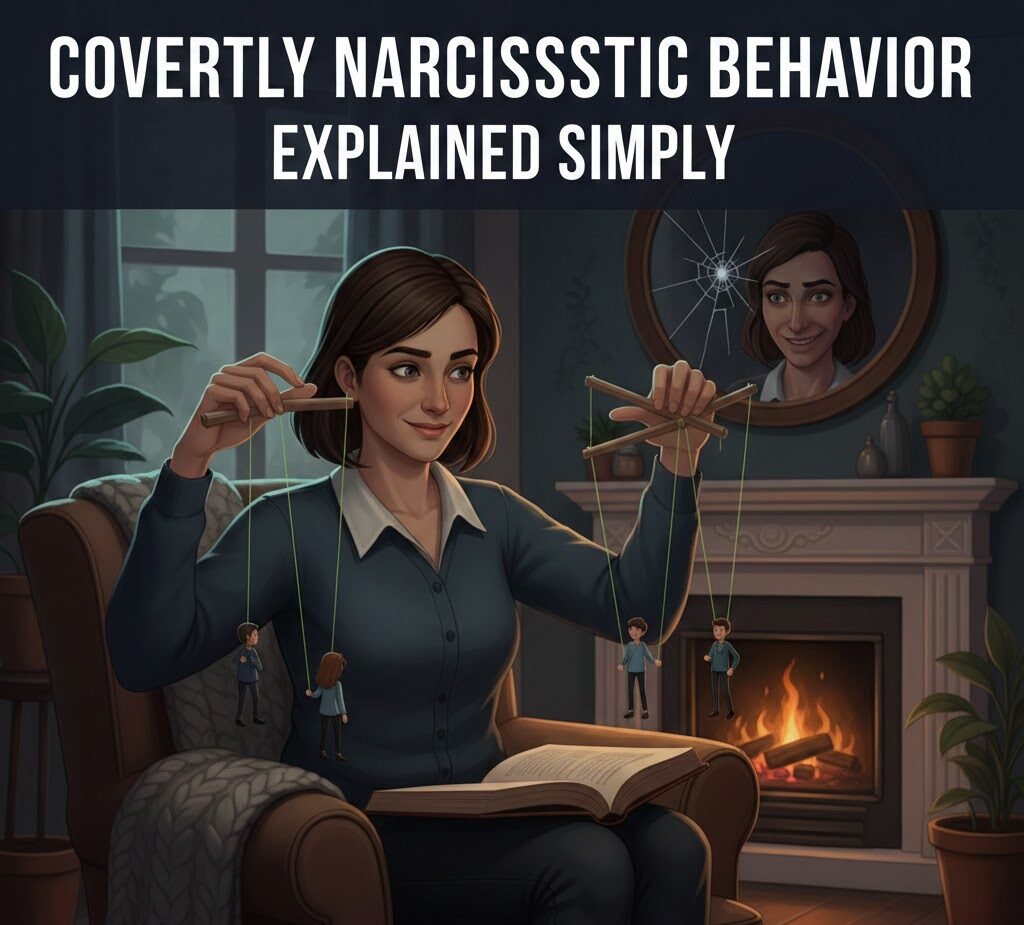
Sometime in life, many people experience an uneasy feeling about something but cannot simply put their finger on it. The behavior doesn’t seem off-the-charts or aggressive. It is somewhat quieter. Subtle. Almost rational. That’s usually where the pattern of a covertly narcissist is hidden.
The Real Meaning of a Covert Narcissist
One of the reasons why people wonder what is a covert narcissist is the common misinterpretation of such a person. A covert narcissist does not display the typical grandiose behavior such as boasting or being visibly arrogant. Rather, these individuals embrace sensitivity and may even at times act as if they are misunderstood and innocent victims.
On top of that, they’re not very vocal about the self-praise that they think they deserve, and hence it results in a certain level of quiet withdrawal and palpation of exasperation which such people possess at various times.
Covert Narcissist Versus Overt Narcissist: A Comparison
In the context of identifying a person exhibiting narcissism, an overt narcissist always seems to call the shots with their loud and domineering behavior that attracts attention. In contrast, covert narcissism operates by concealing the internal struggles behind one of victimhood, silence, or self-righteousness. Simply put, while a narcissistic egoist always demands admiration from others, a hidden one only speculates for it in silence; their discontent and bitterness grow without words. Such anger, instead of erupting into a passionate confrontation, is “leaked” through less visible means such as passive-aggressive behavior.
Reasons Why Covert Narcissists Are Difficult to Spot
Instead of completely ignoring social norms, covert narcissists skillfully bend them, making their behavior appear to be quite understandable on the surface and thus difficult to identify the underlying patterns. Unaware of the reason, you might be frequently left with a sense of discomfort, guilt, or unwarranted responsibility after meeting such individuals—feelings that are often confused with issues like social anxiety disorder rather than recognized as a response to subtle emotional manipulation. This perplexity is often the single biggest indication. The damage caused by their actions is not so evident as to being easily protectable, yet it gradually piles up over time.
Typical Core Covert Narcissist Personality Traits
The traits that define a covert narcissist do not emerge simultaneously but rather slowly, especially in intimate relations. These include a slight lack of empathy, unconscious chronic self-centeredness disguised under a veil of self-doubt, and shutting down emotionally when one’s needs are ignored.
They might look devastated at first when criticized but, at the same time, it turns out to be quite difficult for them to face the criticism genuinely. It seems že if it is a matter of accountability, they are frightened.
Relationship with Covert Narcissists: In-Tune to Their Characteristics

This type of personality factored into an emotional imbalance at its core. They are self-centered The conversations always revolve around them. The “giving” is one-directional. The vulnerability gets transformed into an emotional competition between the partners rather than a connection.Partners tend to feel invisible while at the same time being expected to constantly provide assurance. The longer it goes on, the heavier the relationship becomes. Not tumultuous. Just emotionally draining.
Unintentional Actions of Covert Narcissists: Some Strange Behaviors
Many small, seemingly insignificant behaviors without conscious awareness, when counted together, are indeed weird things that covert narcissists do. Not showing affection at all, giving help but expecting something in return, sulking instead of expressing one’s feelings. Towards the emotional distancing, they might call it “needing space” but at the same time, demonstrating a negative reaction when the other person decides to take the space. These shifting dynamics often mirror how authority and control quietly operate within larger systems, much like the unspoken influence seen in institutional structures such as the health department. The rules get altered quietly, depending on who is the one with emotional power.
Using Emotional Withdrawal to Gain Control of the Situation
Silence frequently serves as a weapon in their arsenal. It is because they want to use the withdrawal tactic to put the blame on their partner rather than them in the first place. Besides, it forces the other person to guess what went wrong, ask for forgiveness, or come after the resolution eagerly.As a result, the pattern usually has the other person constantly explaining themselves and making an extra effort, and also carrying the emotional labor that was never fairly shared from the start.
Families and Covert Narcissistic Patterns
Within the family environment, the behaviour displayed by a covertly narcissistic individual is often perceived as normal. This is particularly true when the behaviour is described as a reaction to the person being sensitive, under stress, or sacrificing.
The family adapts to the changed circumstances rather than questions them Demands of family members become bothersome. Emotional expression is often diverted or shifted. Moods are “read” rather than boundaries being talked about.
Emotional Enmeshment with a Covert Narcissist Mother
A mother described as a narcissist would put on an act of being deeply involved. She would be seen as very caring and concerned. However, the affection, care and love would be conditionally given and come along with demands. The children could be made to feel as though they were the cause of the mother’s emotional distress. The idea of becoming independent would be so intimidating that it would be equated with a betrayal. If the love is not conditional in any way, it is nevertheless very lesson of the love that the live has.
The Subtle Influence of Covert Narcissists Who Are Parents
Covert narcissists as parents are rarely visibly abusive. However, emotionally unstable relationships breed confusion. Compliments seem infrequent or given with an ulterior motive. Negativity is often taken very personally. The children are often emotionally mature to a fault and overly empathetic towards other people’s feelings but at the same time they also struggle to identify and cope with their own emotions. They realize that by staying small, agreeable or invisible they can avoid getting hurt.
Reasons Why Covert Narcissism Remains Undetected
Majority of the time the behavior is not interpreted as ill-intentioned or cruel because it does not shout or yell at an individual. Besides, covert narcissism impairs one’s ability to distinguish between normal and abnormal stress responses. This is why covert narcissism almost always goes unnoticed and unchallenged.
People tend to make excuses for someone’s horrible behavior or empathize with their situation. They also tend to downplay their own distress, and very slowly, their protective barriers are eroded in the absence of a definitive instant of awareness.
Covert Narcissists’ Emotional Guilt)
Over time, the others subconsciously accept the responsibility for the emotional results that, in fact, had nothing to do with them in the first place.
Victim Identity of Covert Narcissists
Many covert narcissists genuinely perceive themselves as victims. This is not always used as exploitation but rather self-defense. Identifying oneself as a victim is a way to maintain the positive self-image. Unluckily, things never develop in such a case. Feeling like under attack only leads to accountability problems and at one point, feedback is perceived as rejection. And so, the repetitive cycle keeps on going.
Why Feeling Shame Is a Reminder of Your Covert Narcissistic Behavior
Unlike overt narcissists, covert ones are often deeply ashamed. That shame feeds defensiveness. They use it to hide themselves from the world And want to be confirmed in their worth, but they also fear being unmasked. They are longing for closeness but avoiding through their tough exterior. This duality explains most of their actions.”
Reasons Behind How You Feel Drained After Interactions
One of the biggest complaints from people is that they feel emotionally tired, but they cannot pinpoint why. Talking just drags on. Giving all the support but not getting any in return. Every bit of work goes to waste. Such emotional drain is not accidental. It happens when empathy flows in one direction, and the other side always leaves without any reciprocation.
Covert Narcissism and Social Anxiety – What’s the Difference?

It would be a big mistake to confuse covert narcissism with social anxiety or introversion. People with anxiety constantly seek safety while narcissists are always validating. An anxious person is worried about how his actions affect others; a covert narcissist is anxious about recognition. Thus behavior patterns may overlap, but motivations are very different.
Is It Possible for Covert Narcissists to Change?
Change comes from being self-aware. But the problem is that many times, when a person does some introspection, he/she becomes very much afraid of losing an important part of his/her personality. A good number of covert narcissists do decide on getting therapy, especially if their relationship with their partner comes to an end.
Nevertheless, change is just a matter of taking ownership instead of blaming. But in the absence of that transformation, one can expect that old patterns will resurface in a different way.
Setting Your Emotional Boundaries
You do not have to have a confrontation to create distance between you and a person. What helps a lot is clarity and consistency. Do not excessively justify your acts. Rather, look for underlying patterns instead of guessing people’s motives.
Boundaries are not punishments but information. In fact, they often disclose more than words ever could.
The Importance of Giving a Name to a Pattern
It helps a lot to put a label on the experience which is to give a name to a pattern. It enables people to have faith in the very thing they have noticed. Diminishing forgiveness or self-blame is another advantage.
Having knowledge of the phenomenon called “covert narcissism” means to be aware of the concept of human beings who are capable of doing harm without making a noise. It is not about labeling people.
Seeking Professional Advice and Support
It is possible that you are re-examining your relationships. You feel constant perplexity. You endure a feeling of guilt that never seems to end. Lots of help is available if you ever find yourself in such a situation where things are so confusing and burdensome for you.
Seeing a therapist cannot be interpreted as your attempt to diagnose others. It could be your way of feeling more in control and grounded.
Allowing It to Diminish Naturally
There are certain behaviors that are so loud that one does not hesitate to walk away from such a situation or a person immediately. Others merely whisper. They stick around. Gradually make you feel exasperated bit by bit. It is essential to realize that difference. After this, things usually change–quietly, but permanently.
FAQs – People Also Ask
What is it that makes a narcissist covert?
Quietly through their silence, guilt, withdrawal, and self-pity they express narcissistic personality traits instead of overtly dominating others and controlling them</p>
Are covert narcissists conscious of the fact that they behave this way?
Some are partially aware. Most are not, especially when their behavior is shame-driven.
Could a covert narcissist be a kind-hearted person, at least sometimes?
Yes, they may be selectively empathetic, especially when it supports their good self-image.
Is it true that covert narcissism is the same as being introverted?
No, introversion is related to one’s source of energy, while narcissism to validation and entitlement.
How can one recover from a relationship with a covert narcissist?
Boundary building, restoring self-trust, and getting help that is guided through the part of one’s emotional responsibility that is in fact not one’s own are the most effective ways to heal.