

It is really interesting how those common beliefs from your childhood which you inherited from your parents, and then you carry them into adulthood, still remain and eventually they start to sound like facts. “Does coffee stunt your growth?”—This question has been around for a very long time. Some people just absolutely believe it. Some few just ridicule it. Most people don’t know for sure, but they’ve heard that so often that they start to doubt.
The Myth That Somehow Stays Alive
There are falsehoods that fade away without creating significant noise. Then there are falsehoods like can drinking coffee stunt your growth, which through some miracle are still alive even after the existence of Google, health studies, and that the answer is just one tap away. Children get this information from parents. Parents got it from their parents. Teachers told it to students to discourage them from consuming caffeine. And it spread without making much noise, like a rumor that nobody verifies but everyone repeats.
What is really humorous here? Nobody actually remembers the source. It is just there. Like it was always there.
One can even see a grandma somewhere firmly stating, “Don’t drink coffee, beta, it will make you short.” While, in fact, her five-foot-four cousins who never drank coffee are quite tall. But logic doesn’t do away with myths. They exist because they sound plausible.
Why People Started Asking “Will Drinking Coffee Stunt Your Growth?”

Well—coffee has caffeine in it. And caffeine has always been portrayed as some weird thing that parents are afraid of, but they themselves drink 8 cups of it. So any product with caffeine is something that children should not be given. That is enough to start a myth.
Then take into consideration the long-standing worry that caffeine might interfere with calcium absorption. In the 1980s and 90s, a few initial studies suggested that caffeine could have a slight impact on bone density. The studies were too weak to make any definitive conclusions. But the rumor got stuck more than the scientific facts.
People connected two points that should not have been connected:
Caffeine → might affect bones → bones support growth → so caffeine stunts growth?
By this means myths are created. Not from facts—just from someone’s guess and another one’s repeat.
Does Caffeine Stunt Your Growth? (Why the Myth Feels “Right” to People)
Even if research does not back up the allegation, the concept seems to be reasonable to a lot of people. That is the difficult part. Myths are not always ridiculous—they often have a vibe that makes them sound scientifically possible.
Why?
- Kids and teens are still growing
- Caffeine is stimulating
- Parents want kids to sleep early
- Anything that affects sleep gets blamed
- Sleep affects growth
- Therefore coffee becomes the villain
Not due to any proof. Just an instinctive linking of ideas.
Besides, parents certainly don’t want kids to be extremely active due to caffeine all night. Using “it stunts your growth” is more convincing than “I just don’t want you up till 2 AM.”
The Real Issue Behind the Myth: Sleep
If there is any connection—any smallest thread—it is this:
Caffeine can interfere with sleep.
Sleep is very important for growth.
Hence the indirect notion sounds quite plausible.
However, this is about sleep schedules rather than bone development. A teenager who is over-stimulated and drinking iced lattes at midnight will not become shorter. What will happen is that the teenager will be tired the next day and will be likely to have a bad mood the day after.
In the case where the question “will drinking coffee stunt your growth?” is asked everywhere, the answer, which is less about height and more about habits, is given.
Myth vs Reality Breakdown
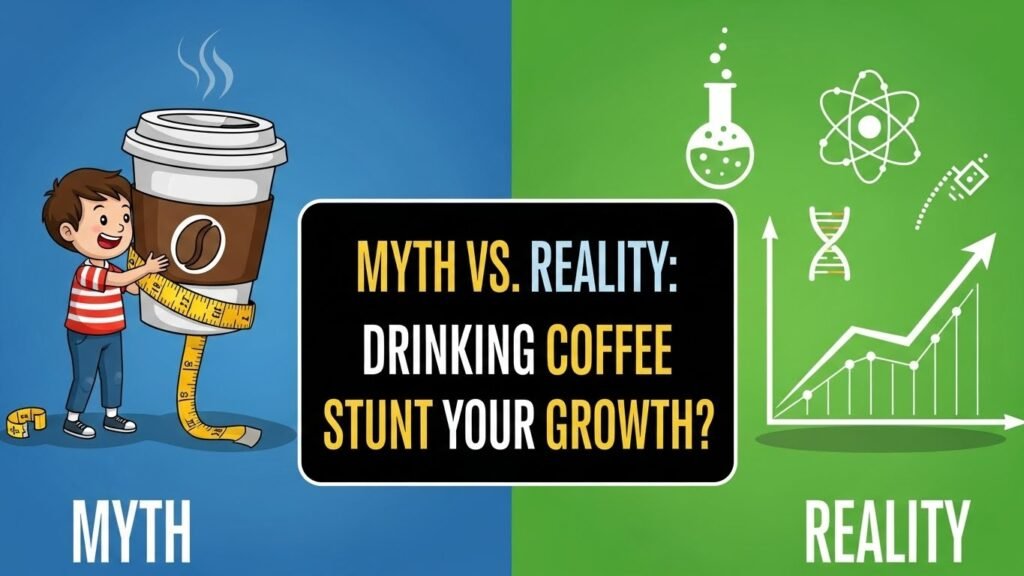
| Topic | What People Think | What Research Shows |
| Coffee reduces height | Common childhood warning | No evidence, no impact on growth plates |
| Caffeine weakens bones | Believed for decades | Minor effect offset by calcium; not linked to growth |
| Teens shouldn’t drink coffee | “It stunts growth” explanation | True for sleep reasons, not height |
| More coffee = less height | Repeated myth | Unsupported scientifically |
| Caffeine affects bone development | People assume so | Studies show no stunting effect |
Understanding Where Fear Comes From
Caffeine is kind of this powerful thing—part energy, part forbidden thrill. Adults can’t live without it. Teenagers want to get their hands on it. Kids are not allowed to be near it. So, culturally, caffeine becomes a boundary. And with boundaries usually come exaggerated warnings in the same package.
Besides that, height is a sensitive matter. People worry about genes, nutrition, hormones, and timing. Put coffee in there and it becomes a culprit just because it was there at the wrong time.
Fear fills in the gaps where facts are absent.
A Look at Cultures and Coffee Beliefs
Different cultures have different rules when it comes to coffee.
- In some European countries, children consume in small amounts, and nobody gets alarmed.
- In North America, caffeine is almost equated with alcohol in treatment– teenagers must avoid it at all costs.
- In South Asia, parents mostly say “not good for children” without giving a reason.

Part of the limitation is cultural. Part of it is habit. And there is also part of the myth left.
While all this is going on, the search query is in the middle of it: does caffeine stunt your growth? People from different continents asking the same thing and not knowing the reason for it.
The Science People Thought Existed… But Doesn’t
Most people think that there was a big and old study that confirmed the myth. However, if you really investigate medical literature, you will discover:
- Major pediatric associations do not support the idea.
- No growth-related research links caffeine with height reduction.
- No cases in which coffee has changed someone’s final height have been documented.
However, myths do not disappear only because science says so. They vanish when people stop repeating them.
Let’s Address Sleep Again
There are some teenagers who metabolize caffeine at a slower rate than adults. Their body is not yet accustomed to stimulants. Therefore even a small amount can extend their period of wakefulness. If someone consumes energizing drinks on a daily basis, a pattern of poor sleep may develop.
Poor sleep has a negative impact on the person’s mood, learning capabilities, appetite and general health. But not on height.
Still, parents observe a tired child, accuse the coffee, and thus the myth gets a new life.
Sleep disruption is what the real villain is, who is quiet, sneaky, and believable.
Caffeine and Bone Density: The Part That Confused Everyone
This is the story of how the myth came about:
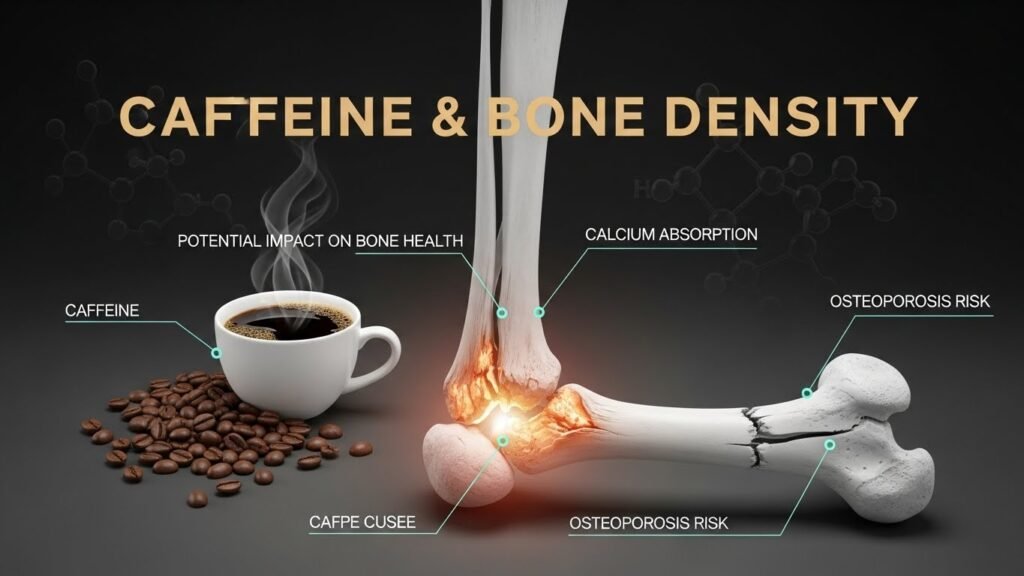
Initial studies demonstrated that caffeine slightly increased calcium loss—by about two or three milligrams. Very small. Something that could easily be replenished by taking two small bites of yogurt. However, the media transformed it into a dramatic headline.
Suddenly people started to say that caffeine “weakens bones.” Not significantly. Not clinically. Just in a sensational way.
The transition from “weakened bones” to “shorter height” took one conversation, then another, then a whole generation became believers.
Let’s Talk About Growth Plates
Human growth is achieved through the ends of the long bones—growth plates. Nothing in caffeine’s pharmacology supports the idea that it interferes with these plates. Not directly even not indirectly. Not even theoretically in normal dietary amounts.
If coffee were to have an impact on growth plates, adults would be warned as well. But no adult is told to avoid coffee for bone development.
The myth is only applicable to children, which already suggests that its origins are cultural rather than scientific.
Why the Question Still Trends Today
The web works in a weird way. Some inquiries are eternal:
- “Is sugar addictive?”
- “Does cracking knuckles cause arthritis?”
- “Is coffee bad for growth?”
Mostly because parents are constantly looking for confirmation. Teenagers look for it because they want it to be allowed. Adults look for it because they want the answers from the past.
The question stays alive because it is felt as something that we should know. Even though the research has given an answer years ago.
How Coffee Actually Affects the Body
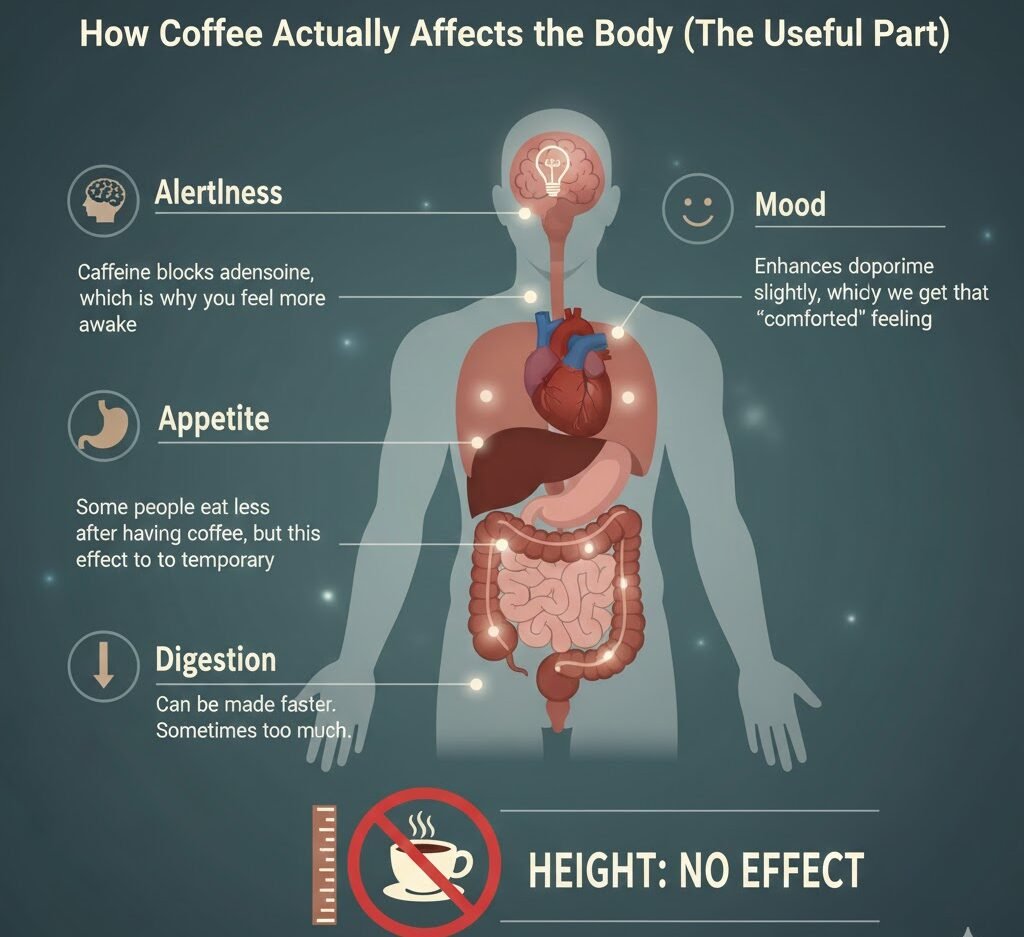
Alertness
Caffeine blocks adenosine, which is why you feel more awake.
Appetite
Some people eat less after having coffee, but this effect is temporary.
Digestion
Can be made faster. Sometimes too much.
Mood
Enhances dopamine slightly, which is why we get that “comforted” feeling.
None of these bodily processes have anything to do with height.
Parents, Teens, and the Ongoing Caffeine Debate
Parents’ concerns are:
- sleep disruption
- irritability
- headaches
- energy crashes
- addiction to stimulants
Meanwhile, teens are concerned about:
- being taken seriously
- staying awake for late-night study
- wanting “adult” drinks
- social pressure from coffee culture
On different issues, both sides are indirectly talking about one cup of coffee, but for different reasons.
A Gentle Truth: It’s Mostly About Moderation
Moderation. That tedious word which solves most of the health debates.
A small coffee? Most of the time okay.
Several energy drinks? Most probably not okay.
A strong coffee at midnight? Definitely not the right thing to do.
Coffee every morning for a 9-year-old? No. That is a parenting decision rather than a scientific growth issue.
Balance can answer questions that myths cannot.
Caffeine Sources Teens Consume
| Drink | Average Caffeine | Growth Impact | Real Concern |
| Coffee (8 oz) | 80–100 mg | None | Sleep issues |
| Black Tea | 40–70 mg | None | Habit-forming |
| Energy Drinks | 150–300 mg | None | Heart rate, sleep |
| Soda | 30–40 mg | None | Sugar intake |
It becomes evident that the problem is not with height but with the consumption patterns.
The Search Isn’t Scientific… It’s Emotional
The tricky part is here: when people put the question Does coffee stunt your growth into the search engine, they want a yes/no answer. Something simple. Something final.
However, human health myths are not simple. They are based on old fears, misunderstood science, and parental instincts. The keyword is a representation of a question that people have had since they were children and still ask when they grow up.
The use of the phrase one more time—since you wanted to be limited—is just to say that when somebody asks: Does coffee stunt your growth? The real question is not about coffee. It is about reassurance.
And maybe a little bit of nostalgia.
The Social Side of Coffee: Why Kids Want It So Badly
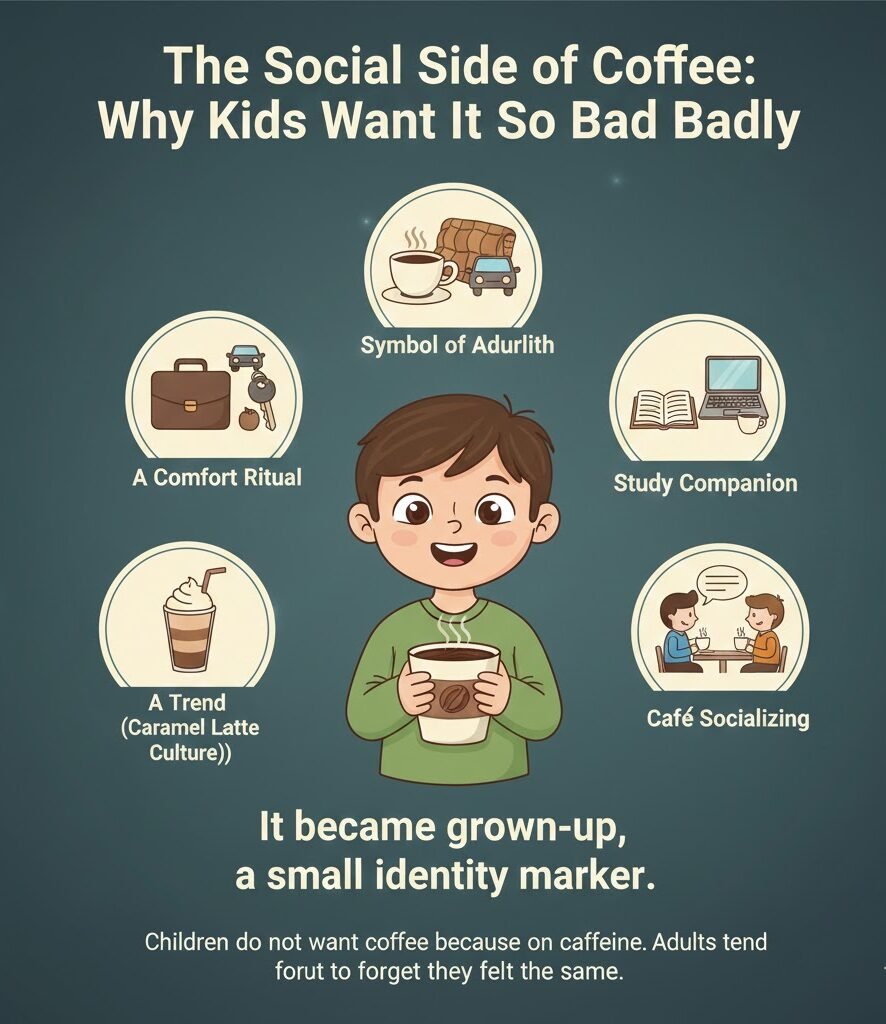
Coffee ceased to be only a drink. It became:
- a comfort ritual
- a symbol of adulthood
- a study companion
- a trend (hello caramel latte culture)
- part of café socializing
Children do not want coffee because of the caffeine in it. They want it because it seems to be grown-up. A small identity marker.
Adults tend to forget that they felt the same at one time.
The Emotional Weight of the Myth
This myth is not about height. It is about parents who want to protect their kids from things that they themselves do not understand. Coffee, in this case, is a metaphor for “things kids shouldn’t rush into.”
Consequently, the myth becomes emotional—as all myths do.
Real Factors That Affect Growth
| Factor | Impact on Height | Notes |
| Genetics | Very high | Most important factor |
| Nutrition | High | Protein, calcium, vitamins |
| Sleep | High | Growth hormones peak during sleep |
| Exercise | Moderate | Supports bone development |
| Illness | Moderate to high | Chronic diseases affect height |
| Coffee | None | Does not influence growth |
This is what parents should be worrying about, yet everyone is focusing on coffee because it’s easier.
So Why Doesn’t the Myth Fade?
Quite simply, it is because myths seem more comfortable than the unknown. It is a lot easier to tell a child “coffee will make you shorter” than to try to explain bone physiology. It is easier to put the blame on a drink rather than understanding growth charts.
People go for the simplest version of the story.
Even when it is not correct.
A Soft Ending, Letting the Thought Drift Off…
Coffee was not the one who made people short. That is the part which is clear. The myth stays for reasons that have very little to do with health and quite a lot with memory, culture, and the easy comfort of just repeating what you heard once. And maybe that is the reason why the question still seems worth asking. Even after all the science settled it quietly years ago…
letting it taper off.
FAQs (People Also Ask)
- Why people think that coffee stunts growth?
Caffeine and bone health myths from the past that caused confusion which has been going for decades. - Can caffeine cause growth stunting in any way?
No. The research shows that there is no connection between caffeine and decrease in height. - Are teens allowed to drink coffee?
Yes, but only in moderation. Sleep disruption, however, is a matter of concern. - Does coffee decrease calcium levels?
Only by a very small amount, which is easily compensated for by a normal dietary intake. - What really influences height?
Genes, sleep, hormones, nutrition, and general health—not coffee.