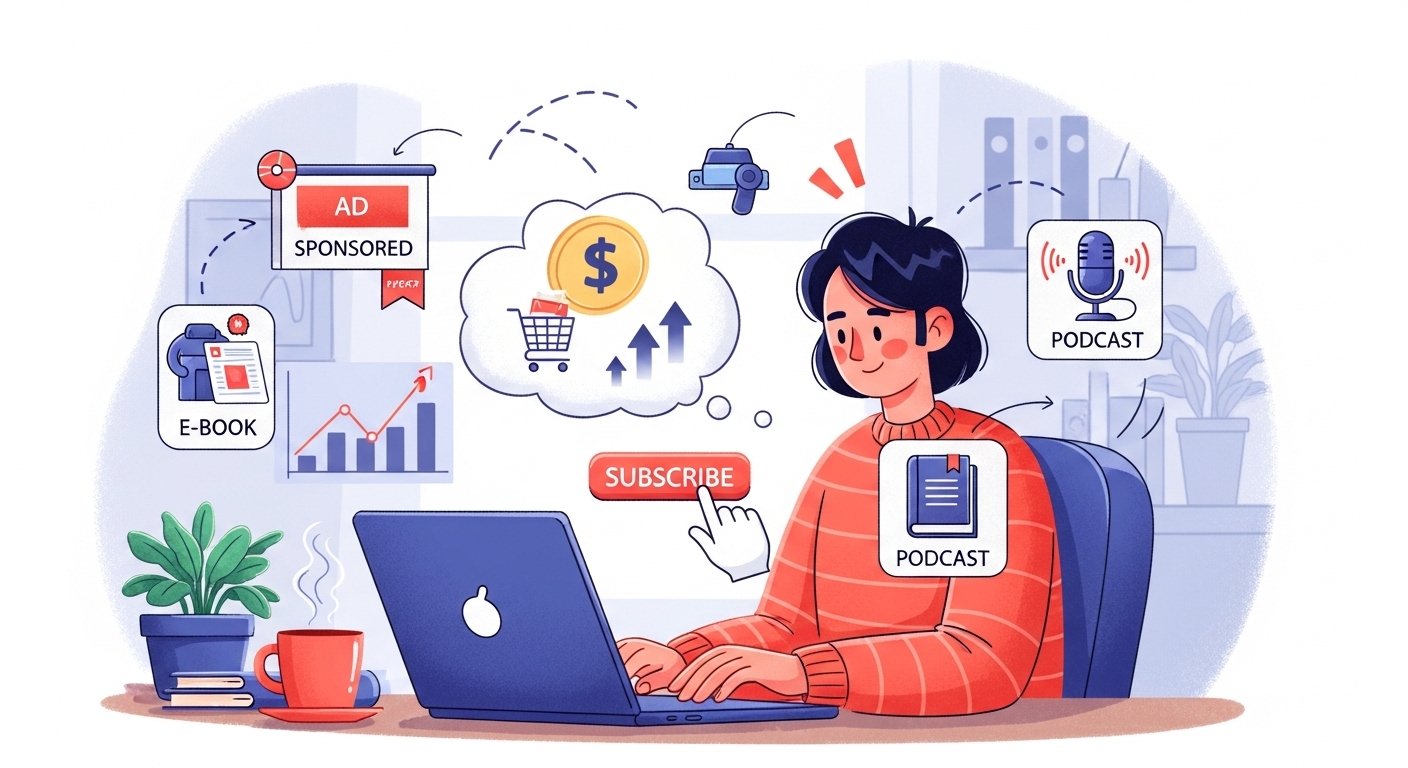
I need to be upfront about something. Three years ago I was sitting in a cubicle doing data entry for a logistics company and the highlight of my week was when the vending machine had those spicy chips in stock. Now I pay my mortgage by writing on the internet. If that sounds fake, I don’t blame you. It sounded fake to me too, even while it was happening.
But here I am. And I want to tell you how it works because there’s so much garbage advice out there about “making money online” that it makes me want to throw my laptop into a lake.
Before you ask:
Can you actually make money blogging? Yeah. I do. Enough to quit the cubicle job and not go back.
Do I need to be some incredible writer? No. I’m proof of that. I write like I talk, which my English teacher would not approve of.
What’s the catch? Time. It takes longer than you want it to. That’s the catch. There’s no other one.
How I accidentally turned writing into a paycheck
I didn’t set out to do this professionally. I just liked writing about stuff I was into — note-taking systems, productivity tools, that kind of thing. Nerdy stuff. I’d post on Medium, maybe get a few hundred reads, feel good about myself, and move on.
Then one article did way better than I expected. Like, weirdly better. Thousands of reads in a week. People started emailing me asking questions. And something clicked in my brain — oh, there are people out there who actually want to read about this. Not millions of people. But enough.
So I kept writing. And somewhere along the way I stopped treating it like a hobby and started treating it like a thing that could maybe, possibly, if I didn’t screw it up, turn into actual income.
Spoiler: it did. But not the way most blogging advice tells you it will.
Everyone tells you to do ads. Don’t listen to them.
Okay, do ads if you want. I’m not your mom. But here’s what nobody mentions — display ads pay almost nothing unless you’re getting insane traffic. We’re talking like $0.40 per click. Maybe. On a good day. I tried it for a while and after three months I’d earned enough to buy a mediocre dinner for two. Not even drinks included.
Same deal with the Medium Partner Program. It’s fine. I still use Medium. But relying on it as your income is like trying to fill a swimming pool with a garden hose. Technically possible. Practically miserable.
The newsletter subscription model is a bit better but it’s still pocket change for most people starting out.
Here’s what actually worked for me, and I know it sounds annoyingly simple: I built an email list, and then I sold stuff to that list. That’s it. That’s the whole thing.
The email list thing (I know, I know, everyone says this)
Yeah, every blogging guru on earth talks about email lists. I used to roll my eyes at it too. But they’re right and I was wrong, so here we are.
What changed my mind was seeing the numbers. I’d write a blog post, it’d get a bunch of reads, and then… nothing. Those readers just disappeared. They read the thing, maybe nodded along, and closed the tab forever. Gone. I had no way to reach them again.
An email list fixes that. Someone reads your stuff, likes it, signs up for your free thing (I’ll get to that), and now you can actually talk to them again. It’s not complicated. It’s just — you’re building a relationship instead of shouting into the void and hoping someone hears you twice.
I don’t even call mine a “newsletter” because honestly that word puts me to sleep. I set it up as a free course. Five emails over two weeks teaching people the basics of the topic I write about. People sign up because they’re getting something useful, not because they want another email cluttering up their inbox every Tuesday.
What I actually sell
Digital courses, mostly. I’ve got a couple of ebooks. I do some coaching calls, which I enjoy more than I expected to — turns out I like talking to people about this stuff one-on-one.
Everything I sell goes directly to my email list. Not through some marketplace. Not through ads. I write an article, people find it through Google or Medium, some of them sign up for the free course, and then a percentage of those people eventually buy something.
The conversion rate is not huge, by the way. I want to be honest about that. Most people on my list never buy anything. And that’s totally fine. But when you’ve got thousands of people on the list who actually care about what you’re writing, even a small percentage buying a $50 course adds up to real money.
That’s how I crossed $100k last year. Not from one big thing. From a lot of small sales to people who trusted me because I’d been showing up in their inbox with useful stuff for months.
Blog posts are weirdly immortal
One thing that still surprises me — I have articles from two years ago that still bring in traffic every single week. They rank on Google, people find them, read them, some sign up for the email list, and the whole cycle starts again. I didn’t touch those posts. They’re just sitting there doing their job.
Try that with a tweet. Or an Instagram story. Social media content has the shelf life of a banana. Blog posts, if you write them well and they rank for the right keywords, are more like canned goods. They just keep going.
That’s the part that finally convinced me this was a real business and not just a lucky streak. The compounding effect. Every good article I publish is another entry point for new readers. The more articles, the more entry points, the more email signups, the more eventual sales. It builds on itself.
Where I actually publish and why
I spread things across three platforms and each one does something different for me.
Medium was where I started and I still post there regularly. The audience is already built in, which is great when you’re new and nobody knows who you are. Downside is you don’t own the platform and the algorithm can be moody. One month you’re getting recommended everywhere, next month crickets. I don’t rely on it but I’m glad I use it.
Substack is where I send my email stuff. It’s basically a blog and email tool mashed together. The audience there is smaller than Medium but the people who use Substack are readers. Like, real readers who actually open emails and click links. The engagement is noticeably better.
WordPress is home base. This is where the long SEO articles live, the ones designed to rank on Google for years. I have full control over everything — design, monetisation, content. If Medium shut down tomorrow I’d be annoyed but I’d survive. WordPress is the foundation.
Honestly, if I was starting from zero today, I’d probably begin on Medium or Substack to get some eyes on my writing, then move to WordPress once I had enough momentum to justify the extra effort.
Stop trying to be clever. Just be useful.
I wasted months early on trying to write these big comprehensive guides covering every angle of a topic. Ten thousand words. Twelve subheadings. Looked impressive. Nobody read them.
What works — and I had to learn this the hard way — is one idea per article. That’s it. One clear, specific, useful idea. Write it well. Don’t pad it. Don’t try to be the Wikipedia entry for your topic. Just answer one question better than anyone else has.
My best-performing articles are not the longest ones. They’re the ones where someone searches a specific question, lands on my post, and thinks “oh, that’s exactly what I needed.” Short, focused, useful beats long and exhaustive every time. At least in my experience.
The part nobody wants to hear
It took me about eight months before I made any real money from this. The first few months were basically me publishing into the void and wondering if I was wasting my time. There were weeks where I’d check my stats obsessively and see like 14 readers. Fourteen. Some of whom were probably bots.
I almost quit twice. Not dramatically — just the slow kind of quitting where you keep pushing your writing schedule back and finding excuses. “I’ll write tomorrow.” “I don’t have any good ideas this week.” You know the drill.
What kept me going, honestly, was that I actually liked writing about my topic. It wasn’t a chore. If you pick something you’re only writing about because you think it’ll make money, you’ll burn out before the money shows up. Pick something you’d write about for free. The money comes later, but it has to be sustainable long enough for “later” to arrive.
Alright, wrapping up
I’m not going to pretend this is some guaranteed path to riches. It’s not. Plenty of people start blogs and give up. Plenty of people build email lists that never convert. The internet is littered with abandoned WordPress sites from 2019.
But if you actually like writing, and you can find a topic where people are hungry for good information, and you’re willing to show up consistently for longer than feels reasonable — yeah, it works. It worked for me. It works for a bunch of people I know.
Start writing. Pick one topic. Build the list. Sell something people actually want. And give it way more time than you think it needs.
That’s it. That’s the whole playbook. It’s not sexy. But it pays the mortgage.
Stuff people ask me a lot
How do you actually make money from a blog? Build an email list by giving away something free and useful. Then sell digital products — courses, ebooks, coaching, whatever — directly to that list. Ads and affiliate stuff are bonus income, not the main thing.
How long before you see money? Took me about eight months to make anything worth mentioning. Could be faster if you already have an audience somewhere. Could be slower if your topic is super competitive. It’s not quick no matter what.
Are ads worth it? As a side thing, sure. As your main revenue, no. The payouts are tiny unless you’re pulling massive traffic. Don’t build your business plan around display ads.
Medium or WordPress — which one? Both, ideally. Medium for reach when you’re starting out, WordPress for long-term SEO and ownership. If I had to pick just one it’d be WordPress, but starting there with zero audience is rough.
How do you get people on your email list? Write something genuinely helpful. Then offer something free that goes deeper — a mini course, a template pack, a resource guide. People will sign up if what you’re offering is actually worth having. Don’t overthink it.