Honestly, I thought machine learning was a difficult concept reserved for sci-fi movies until I considered it from the perspective of how we humans learn.
Last year, I attempted to teach my nephew the alphabet. I first presented the letter A and told him its name. Then the next time, I showed him a different styled A and then another one. After he had enough exposure to A’s, he was capable of distinguishing A’s even when they looked different or appeared to him in an unfamiliar way. There was no need for me to describe every possible type of A. His brain simply recognized the pattern.
That’s pretty much what machine learning is. Only, instead of a child learning letters, a computer is learning patterns from samples. And instead of a brain, it’s algorithms that do the work.
The Problem With The Conventional Method
Consider how people used to give computers instructions. You would write down the code specifying each step. For instance, if you want your program to determine whether a photo belongs to a cat or a dog, you will have to code the rules yourself: “If the animal has whiskers, it is probably a cat. If it has a longer snout, it is probably a dog.” Then someone will find an exception, and you will need another rule. And so on.
What is the problem? You cannot write rules for everything. Cats vary in colors, sizes, and shapes. Some are hairless. A few are very fluffy. Attempting to specify rules for every single case is certainly very tiring and most of the times, the rules you end up writing are inaccurate anyway.
Machine learning is the one which actually makes a difference here.
Instead of handing over the rules to the computer, you provide it with examples. Thousands of labeled images – “This is a cat, this is a dog, this is a cat.” The algorithm identifies the regularities in those examples on its own. Once it has been exposed to enough samples, it will be able to look at a new image it has never seen before and make a fairly accurate determination as to whether the image is that of a cat or a dog.
You’re not writing the program that gives the result. You are allowing the machine to find the pattern.
The Process Elucidated (Skipping The Math Part)
My explanation is not intended to give you a headache as most of the times people make machine learning sound as though it is a complex matter when in fact it is not.
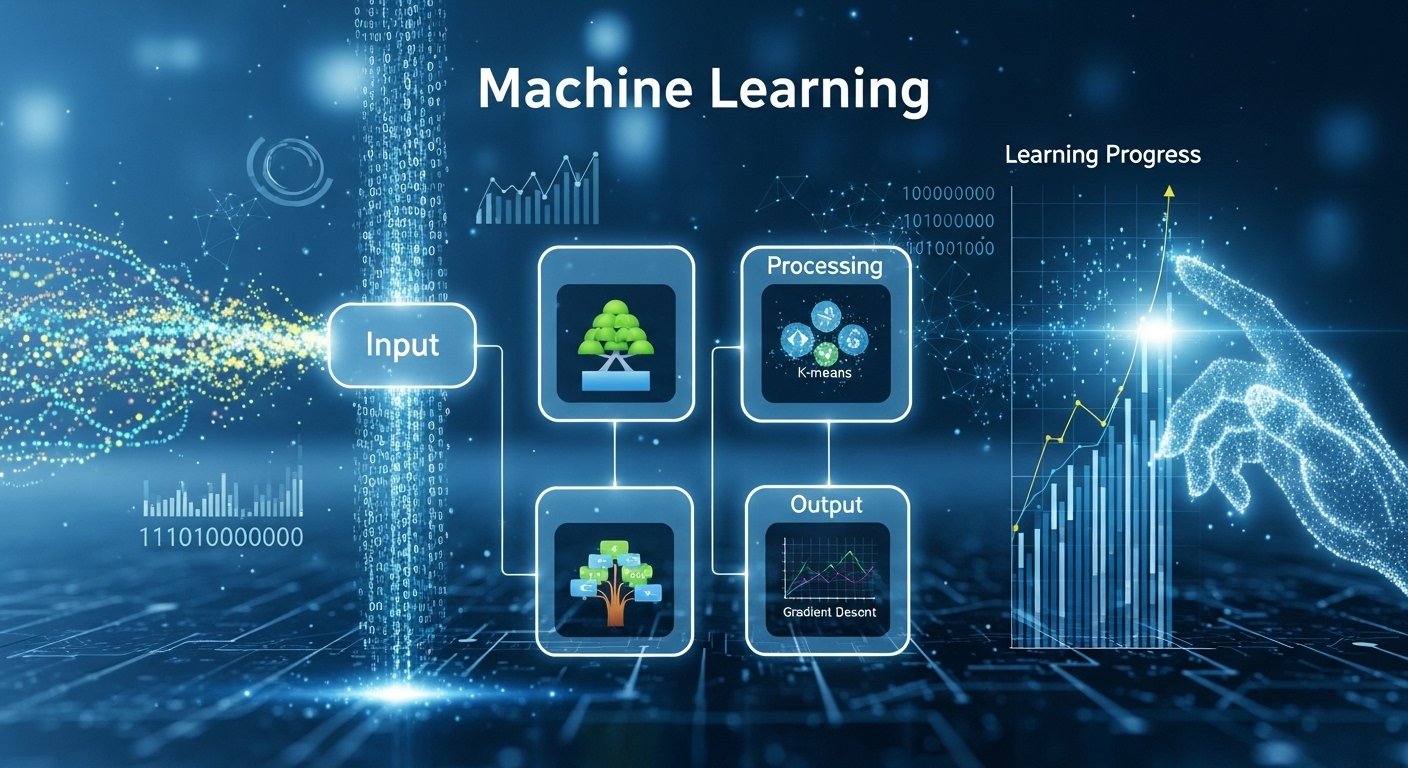
Machine learning generally incorporates three stages:
Firstly, giving it data. Lots of data. You know, thousands or millions of examples. If you want the machine to identify cats, you have to provide it with thousands of cat images as well as thousands of non-cat images. Data means everything to the computer. Disorderly data will lead to learning in an incorrect fashion.
Secondly, the program searches for a recurrent pattern. This is where the “learning” takes place. Through repeatedly going over the data, the computer alters its internal configurations depending on its success or failure rate at guessing. You can equate it to a person learning to throw darts – their first few throws tend to be wild but eventually after they get it right in terms of angle, force, and release, they manage a decent shot. The algorithm is doing the same thing but instead of darts, it is working with data.
Third, it predicts the outcome. As soon as it has identified the patterns, providing it with new information it has never encountered before will result in the generation of a guess that is informed. It will not be flawless, but its performance won’t fall short of satisfactory. Here is the awesome bit – it is enhanced by the amount of data that you supply.
The Everyday Locations Where You’re Already Employing This (Especially When You Don’t Even Realize)
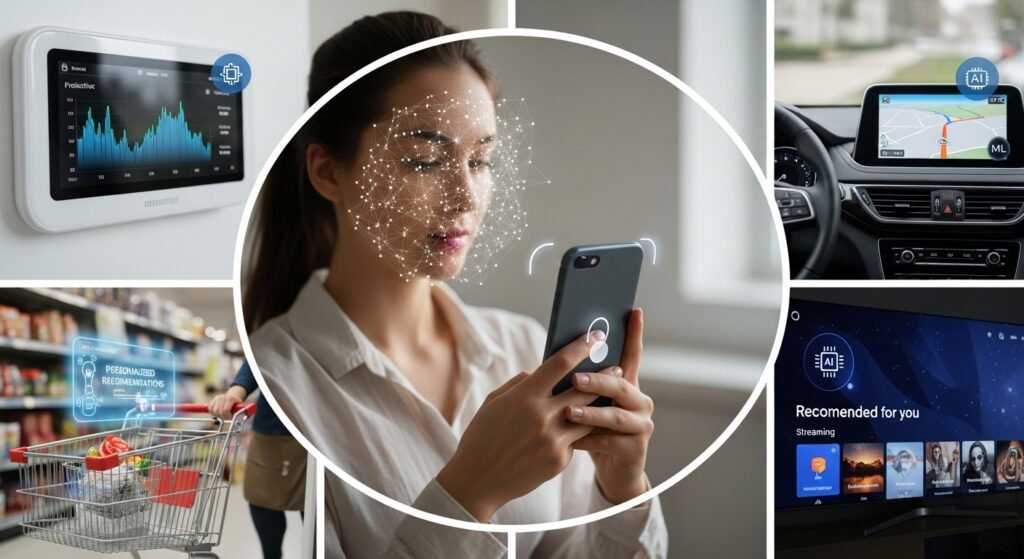
This is not some far-off futuristic technology. Machine learning is already all around you.
Spam filtering in your email. It was not loaded with every possible spam message before you ever got to use it. Rather, it learnt to classify emails as spam or not by processing millions of emails. It can now identify that a newly arrived phishing email resembles previous spam emails and therefore, it blocks it. On the occasions it makes mistakes (like when it marks legitimate emails as spam), it still learns from the mistakes.
Netflix movies recommendations. Netflix does not have people to sit and watch your movies, then decide what you might like next. It employs machine learning to analyze the viewing and rating history of millions of users, similar to you. It has discovered a pattern – “people who watch crime documentaries and nature shows also tend to watch mysteries” – and now the recommendations follow this pattern.
Unlocking your phone with your face. When you are configuring face unlock, you are not giving it a list of features concerning your face. You are showing it samples of you (and sometimes, other people). It is learning what features make your face distinguishable. This is the reason why it functions even when your face is at different angles or the lighting is different.
Autocomplete on your phone using machine learning. It has analyzed thousands of texts and messages to learn what words typically follow other words. When you type “How are…” it suggests “you.” Not because it was programmed that way but because it learnt the language patterns.
Why Machine Learning Is A Cause Of Panic For Companies
If anything, it is a solution, not a problem. But why is it that machine learning be so disruptive for businesses?
It is because it enables one to be able to do things that were either impossible or prohibitively expensive.
For example, for the bank, real-time detection of fraud is a reality nowadays. Disregarding rules approach (“if someone buys in Tokyo and New York in one hour, flag it”), machine learning is based on learning what normal spending looks like for each person and catching strange deviations. It gets accustomed to your habits. It learns.Hospitals employ it for the double purposes of speed and accuracy, analysing medical images in a manner that even doctors who are working to their limits cannot match. Doctors are not to be replaced but, with their help, it has been made possible for doctors to work on the cases requiring their utmost expertise.
Retailers depend on it in order to ascertain the products that they ought to keep in stock taking into consideration various factors such as season, local events, weather, purchase history without having to make guesswork. Therefore, they allow data to decide for them.The common denominator is that these are all cases where the variables and exceptions are way too many for humans to be able to code through them manually. Machine learning manages such complexity with ease.
Things That Might Go Wrong
First of all, I would be failing you if I did not tell you that this technology cannot do magic and that it has a number of issues for sure.
Poor data can spoil the whole thing. If your training data is biased, your algorithm will be biased. There was an instance where a hiring algorithm was declining applications from competent women because the training data mostly consisted of men in those positions. It was the bias in the algorithm that learned, not the reality of who could do the job well.
The amount of data matter a lot. You can’t teach a computer with three examples. You need hundreds, thousands, sometimes millions. That’s a complicated and expensive process of acquiring and collecting.
It can be a black box. Sometimes, an algorithm makes a decision, and even those who developed it cannot perfectly explain why. It discovered a pattern that works, but the pattern is too complex for people to describe. This can be good if the algorithm is recommending movies. It is not so good when it comes to deciding whether someone owes a loan or not.
The machine keeps learning, which can be good or bad. By constantly providing it with new data, it will adapt. That is very beneficial. On the other hand, however, it can “forget” things or be led astray if the new data is substantially different from the old data.
The Prospects
Machine learning is good for a lot of things. People are calling it the next frontier – deep learning – which is basically several layers of algorithms which learn from each other. That’s what makes those AI image generators which seem to be everywhere so great and why chatbots are frighteningly good at natural conversations.
In fact, it is a matter of fact that we as a society have not yet entirely figured out implications of this. These systems are very powerful and useful, but at the same time, they are becoming complicated to such an extent that it is hard to control. The more we depend on them, the more it is essential to know their strengths, as well as their weaknesses and failings.
Last Words
Machine learning is not magic. It is not sentient. It is not conspiring. It is a collection of computers that identify patterns in the data and employ these patterns to make predictions about new data.
Change in the way businesses operate, our interaction with technology, and our ability to solve problems previously unsolvable is taking place due to this technology. Sometimes it is for the better and sometimes it is the ways that we need to be careful of.
However, the fundamental idea is that you give a computer enough examples and then skip the part of pattern discovery and finally it makes intelligent guesses about things it had never seen before – Almost in the same way as my nephew who recognized the character A. Simply put, with billions of calculations and a lot more complexities involved.
The future is most likely going to be made by those who understand this and those who don’t. So understanding at least the basics? That’s not optional anymore. It’s useful.
Full FAQ Section
1. What is machine learning?
Machine learning is a subset of artificial intelligence that enables computers to learn from data and improve over time without being explicitly programmed. It identifies patterns and uses them to make predictions or decisions.
2. How does machine learning work?
Machine learning works by feeding algorithms large amounts of data. The system analyzes this data, identifies patterns, and uses these patterns to make decisions or predictions based on new, unseen data.
3. What are the different types of machine learning?
There are three main types of machine learning: supervised learning, where the system is trained with labeled data; unsupervised learning, where the system tries to find patterns in unlabeled data; and reinforcement learning, where the system learns by receiving feedback from its actions.
4. How is machine learning used in business?
Machine learning is used in business for various purposes such as predictive analytics, customer segmentation, fraud detection, product recommendations, and even automating customer service with AI-powered chatbots.
5. Can machine learning replace human workers?
While machine learning can automate certain tasks, it is unlikely to replace human workers entirely. It excels in repetitive tasks, data analysis, and decision-making based on patterns, but creativity, emotional intelligence, and complex problem-solving still require human involvement.
6. What are the risks of machine learning?
The risks of machine learning include bias in the data, which can lead to biased predictions, privacy concerns when handling sensitive data, and the potential for the model to “learn” inappropriate patterns. Also, the complexity of machine learning models can make them difficult to interpret.
7. Is machine learning the same as artificial intelligence?
While machine learning is a subset of artificial intelligence, they are not the same. AI refers to machines simulating human intelligence, while machine learning is specifically focused on algorithms that enable machines to learn from and make predictions based on data.