
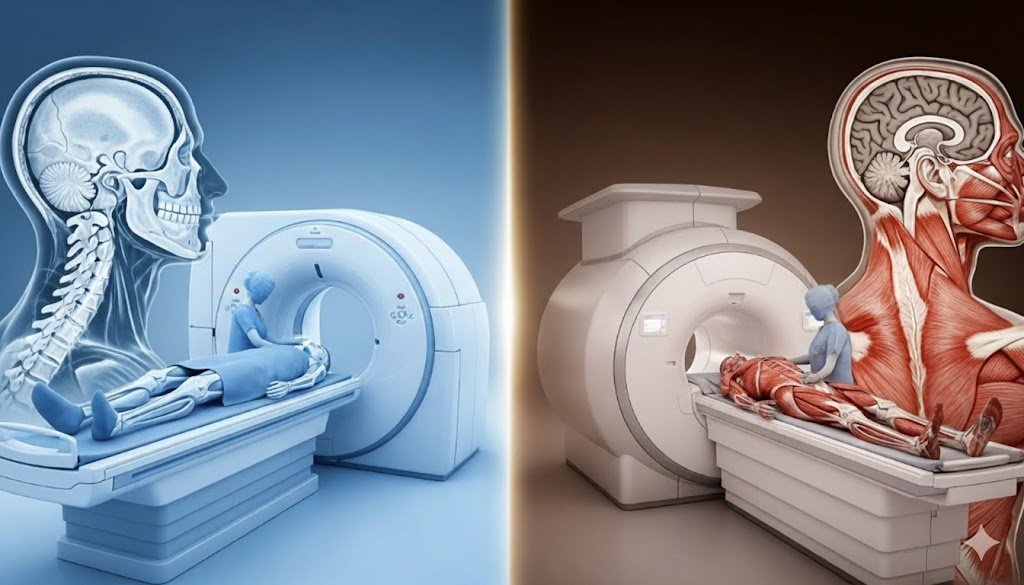
Doctors are constantly mentioning these scans and, suddenly, you become concerned or at least interested. On your referral paper, you can see CT scan vs MRI and you don’t understand which one you’ll be receiving.
This article is about the real stuff—the technology, the hospitals, the procedures—especially here in Australia where your imaging might be done.
CT vs CAT Scan vs MRI: Why It Gets Confusing
The main point is that CT and CAT scan are different names for the same technology. Old term, new acronym. They are the same device. Same X-ray based imaging.
By contrast, MRI is a completely different type of technology. Unlike CT scans, it uses no X-rays and no radiation. Instead, powerful magnets and radio waves create detailed images inside your body. This difference matters, especially because radiation dose becomes an important consideration when multiple scans are required.However, MRI scans generally take longer to perform. In addition, they can be louder and, at times, feel more cramped. That said, the level of soft-tissue detail they provide is exceptional.
Meanwhile, CT scans remain a very fast, efficient, and commonly used procedure in Australian hospitals. As a result, MRI scans often take more time to access and are less widely available, particularly outside major cities.
CT Scan Machine vs MRI: How They Actually Work
Essentially, a CT scan machine is a huge donut with a hole in the middle where you lie down while a motorised table moves you through. X-rays come from different directions to give layers of images, which are then combined into 3D images.
The method is very effective for:
- Bones
- Lungs
- Bleeding
- Trauma
Most scans take approximately 10–30 minutes, depending on which area is scanned and whether or not contrast dye is used.
Although MRI devices may look similar to CT scanners, they operate in a completely different way. Instead of X-rays, they use powerful magnets and radio waves to produce images. During the scan, coils are placed around the specific part of your body being examined, and as a result, the machine produces loud knocking or buzzing noises while the data is collected. Because of this detailed process, the scan can take anywhere from 20 minutes to over an hour.
X-Ray vs MRI vs CT Scan: When Each Makes Sense
It may seem that one should just be chosen over the other, but in reality, each of the instruments serves a very particular function:
- X-ray – quick look at bones and chest. The visualization is not very detailed.
- CT scan – a step up in the detail level that arrives nearly instantly. Useful in cases of fractures, internal bleeding, lungs, and abdomen.
- MRI – a thorough examination of soft tissues such as ligaments, brain, spinal cord, joints.
They are not competing with each other. Physicians employ the one that gets them the result the fastest or most reliable.
Brain CT Scan vs MRI: Emergency vs Detail
If a person is brought to Nepean Hospital or Royal Prince Alfred Hospital with a head injury, doctors would almost certainly order a brain CT scan initially. These major hospitals in NSW have CT scanners available 24/7 as part of emergency imaging services.
Within seconds, a CT scan can find:
- Bleeding
- Fractures
- Swelling
If a doctor needs further detail for a small tumor, inflammation, or subtle changes, they would order an MRI scan, which is more sensitive than CT—especially in cancer-related cases handled at specialized centers like MRI vs CT scan for cancer diagnosis at INMOL Cancer Hospital. The choice is not simply which one is better. It is about time, clinical urgency, and the specific diagnostic goal the doctor is trying to achieve.
Brain MRI vs Brain CT Scan: When You’re Not in a Rush
MRI is capable of revealing:
- Early stroke patterns
- Multiple sclerosis lesions
- Tiny irregularities
It takes longer, but it can clarify what CT hinted at—without introducing radiation. This is why neurologists usually prefer MRI for complex brain issues.
MRI vs CT Scan for Cancer: How To Handle It
Cancer treatment in Australia relies on both CT and MRI.
- CT scans are used first to stage cancer (lungs, abdomen)
- MRI is used for soft tissue cancers such as:
- Brain
- Prostate
- Certain liver lesions
- Brain
These scans are combined to build the full picture. Services are available Australia-wide through Medicare-subsidised hospitals and private radiology clinics.
CT Scan vs MRI Lungs: Why CT Takes the Lead
MRI struggles with lungs due to air interference. Doctors prefer CT scans for:
- Lung nodules
- Infections
- Early lung cancer
Australia is introducing low-dose CT lung cancer screening programs in 2025 for high-risk patients.
CT Scan vs MRI for Kidney Stones
Kidney stones are:
- Quickly
- Accurately
identified by CT scans. MRI is generally not used for stones.
MRI vs CT Scan for Abdomen
- CT – appendicitis, bowel obstruction, trauma
- MRI – liver, bile ducts, pancreas, reproductive organs
Doctors often use both at different diagnostic stages.
CT Scan vs MRI for Knee Injury
- CT – fractures
- MRI – ligament damage, cartilage tears, ACL issues
MRI is superior for soft tissue injuries.
CT Scan vs MRI Images: What You Actually See
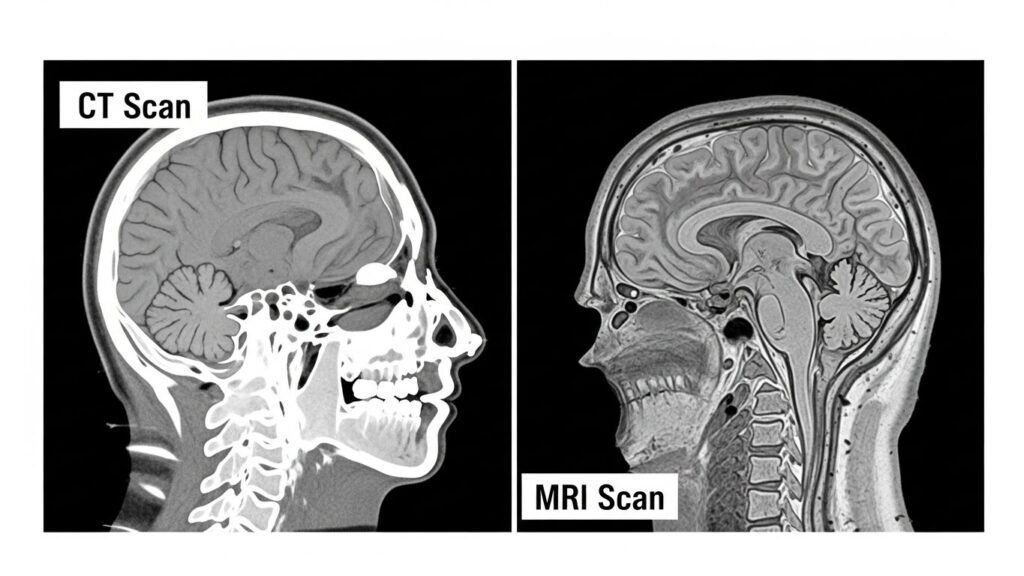
CT images highlight:
- Bones
- Air cavities
- Sharp edges
MRI images show:
- Muscles
- Ligaments
- Organ layers
It’s not about which looks nicer. It’s about solving a puzzle.
CT Scan vs MRI: Which Is Better?
There is no single “better” scan.
- Need speed or emergency → CT
- Need soft tissue detail → MRI
- Avoid radiation → MRI
- Lungs or stones → CT
It’s about using the right tool.
Full Body CT Scan vs MRI: Do You Really Need One?
- Full-body CT – quick overview, radiation exposure
- Full-body MRI – detailed, costly, time-consuming
Optional scans are not Medicare-covered. Doctors rarely recommend them without cause.
Australian CT and MRI Procedures: What to Expect
Across Australian imaging clinics:
- Referral required
- Fasting may be needed for contrast
- MRI safety screening for metal
- Ear protection provided
- No pain involved
Results usually arrive within 1–2 days.
Real Australian Hospital Examples
- Royal Prince Alfred Hospital – CT & MRI services
- Nepean Hospital – 24-hour emergency imaging
- Canberra Hospital – full diagnostic imaging
- Ingham Hospital – expanding regional CT access
- Queensland – increased funding for imaging equipment
Radiation Safety and Practical Stuff in Australia
- CT uses ionizing radiation
- MRI uses magnets only
- Medicare MRI machines require accreditation
- Safety screening is standard
Why You Might Get Both Scans
One scan provides direction. The other adds depth. This layered approach is standard in Australian medical imaging.
FAQs (People Also Ask)
1. Do I need a doctor’s referral for CT or MRI in Australia?
Yes. In most cases, both hospital and private imaging clinics require a referral before you can book a CT or MRI scan. Without it, scheduling is usually not possible.
2. Are MRI scans safe if you’re pregnant?
Generally speaking, yes. However, especially during early pregnancy, it is important to discuss the scan with your doctor, because safety data during the first trimester is limited.
3. How long does a CT scan take?
Typically, a CT scan takes between 10 and 30 minutes. That said, the exact time depends on the body part being scanned and whether contrast dye is required.
4. Can MRI be used for brain injuries?
Yes. In fact, MRI is often used when more detailed soft tissue analysis is needed, particularly after an initial CT scan has already been performed.
5. Are scans covered by Medicare in Australia?
In many cases, yes. CT and MRI scans are often Medicare-subsidised when they are medically necessary and properly referred. However, optional full-body scans are generally not covered.