
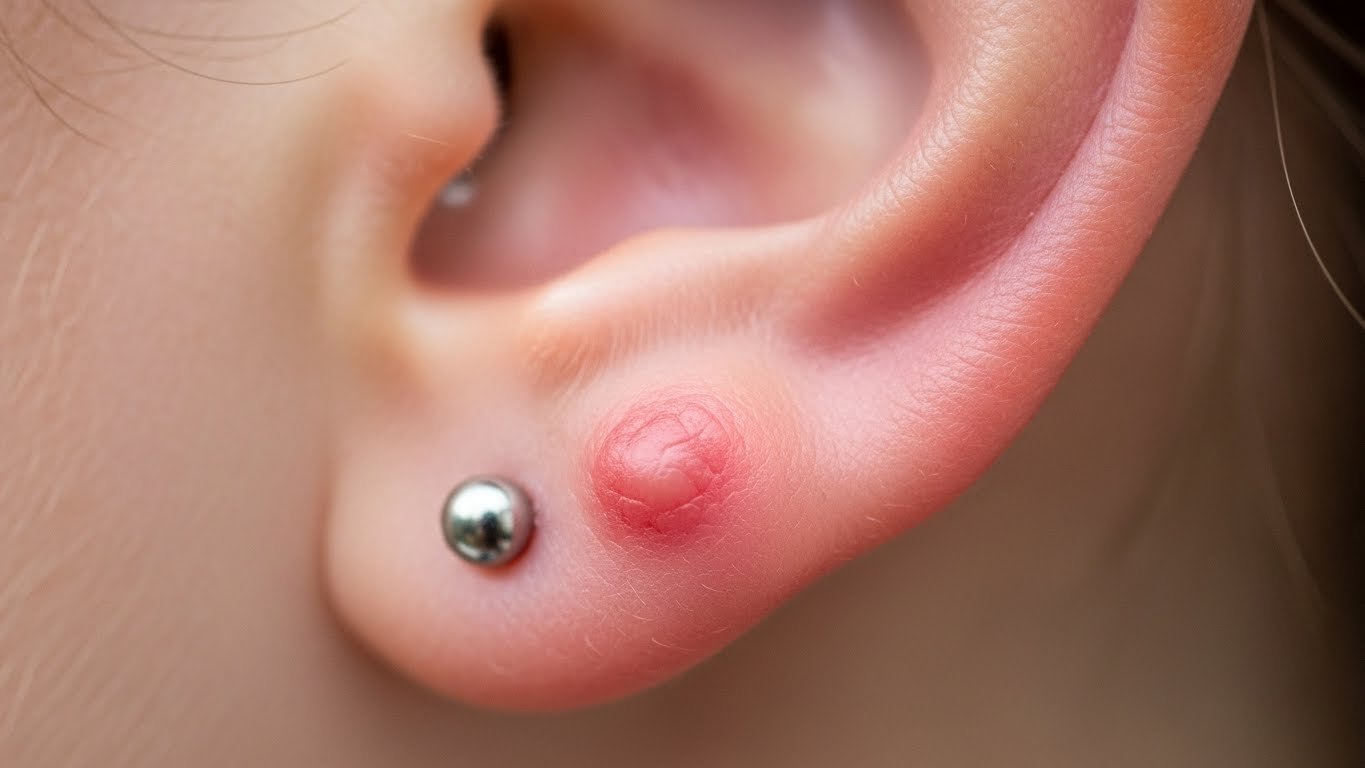
Sometimes, a piercing bump can come out of nowhere and take over your whole reflection. It may not even hurt all the time, but it certainly lowers your self-esteem. And once it is there, the first thing that goes through your mind is why and how to get rid of it.
Why Piercing Bumps Happen in the First Place
A piercing is technically an injury to your skin that is controlled and minimized by the professional doing the piercing. Even a perfect one still makes your body react and the immune system will be the first to respond. Swelling, redness, and small raised areas or bumps can be the normal healing response of your skin to new piercing hardware. If the skin and contact with the metal get out of hand, a bump will develop.
The majority of the bumps are not infections or chronic diseases. They are in fact your body’s response to irritation. It can be caused by the material of jewelry, your movements, the way you clean the piercing, or a combination of a few minor mistakes over a period of time.
Piercing Bump vs Keloid: Why the Difference Matters
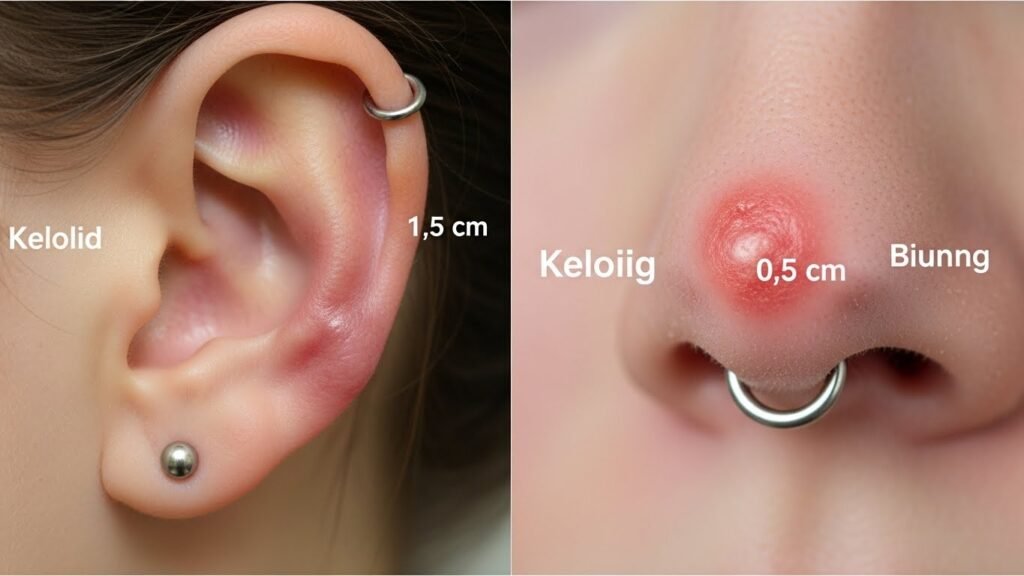
It is common to confuse a piercing bump with keloid even though they vary in appearance significantly. People frequently mistake these two because a bump usually happens in the area just around the piercing and can be reduced in size by proper care, while a keloid grows beyond the site of the initial injury.
Keloids are familial and skin-type related. If you have never had keloids, the bump you have is likely not a keloid. This is significant because the symptoms of an irritated piercing are similar to spots like keloids that, if not treated properly, can worsen.
Keloid vs Piercing Bump: What Skin Behavior Reveals
Differentiate keloids from bumps by monitoring their growth over time — that is how one can tell the difference between the two “concepts” in a “keloid vs piercing bump” debate. Spots that are irritated can change/cycle, i.e., one day they are smaller, another day they look redder/more inflamed. However, after a short while, keloids only slightly expand and remain firm for the most part.
Another indication is the existence of pain to touch. An irritated bump is usually more sensitive to any sort of pressure or friction. On the other hand, keloids do not really mind. Getting rid of an irritation, which is actually a keloid, will lead to a worsening rather than improvement in the situation.
Nose Piercing Bump and Why the Face Is Tricky
Nose piercing bump is more likely to get bumps than others and mostly keep quiet about them. Since the nose is in almost constant motion, it is not in the nose itself that causes the problem but rather the little movements you make without realizing. Also, keep in mind that the nose area is constantly being rubbed by glasses, masks, and hair, asm well as every time you change your sleeping position.
Additionally, the skin on the nose is greasy and consequently more susceptible to bacteria than the other body parts. As a result, the combination of the two makes recovery somewhat unpredictable.
Bump on Nose Piercing vs Irritation Bump Nose Piercing
Just because you have a bump on your nose piercing doesn’t necessarily mean it’s infected. Usually, an irritation bump nose piercing is a consequence of the movement and pressure coming from the nose. The bumps are red or the same color as the skin, and they hurt a little when you touch them, but they don’t cause you a lot of pain.
Infections can be identified by such symptoms as heat, pus, and redness which spreads. The irritation hatch stays in place. Distinguishing between an infection and irritation can save a lot of trouble and unnecessary treatments.
Nose Piercing Bump Care That Actually Helps
One of the best things you could do for a nose piercing bump is to care for it in a way that makes it as unnoticeable as possible. Boring care routines usually work best when it comes to nose piercing bump care. Basically, it is all about less touching, less product, and less panic. A little bit of patience and some gentle saline rinse are more effective than the harshness of the strongest remedies.
People tend to underestimate how important the position in which you sleep is. After all, it is quite common for the bump to be kept in an irritated state indefinitely due to the pressure that one may exert onto it overnight.
How to Get Rid of Nose Piercing Bump Without Rushing It
One of the questions that are often asked among the community is how to get rid of the nose piercing bump. The most important thing to remember is to be consistent. Due to the delicate nature of the skin on the nose, it communicates its needs slowly. The secret to a speedy recovery is to be patient until the skin fully heals.
Usually, a reduction in the amount of rubbing against the skin and maintenance of cleanliness afterward will bring about a slow but sure change for the better. When a bump diminishes gradually instead of suddenly vanishing, that’s a fantastic indication. No one can deny that healing should be as natural as possible and free of any drama.
How to Get Rid of Nose Piercing Bump Overnight: Reality Check
While wishing to know how to get rid of a nose piercing bump overnight may be tempting, one should be aware that it is almost entirely a fantasy. Unless there is a severe infection or accumulation of fluid under the skin—something that would typically require deeper evaluation similar to choosing between a CT scan vs MRI—the bump itself will not usually be gone after one night’s sleep. Moreover, anything promising immediate benefits tends to be more irritating in the long run. So cooling inflammation gently may reduce redness by morning, but take for granted that the real healing still takes time.
Saline Solution for Nose Piercing Bump: Why It Works
Saline solution for nose piercing bump is effective because it is in harmony with the skin’s natural chemistry. It removes dirt without damaging the delicate skin, moisturizes without blocking pores. It kills germs without shocking the skin.
What is more important, is to ensure consistent usage rather than over-usage. Skin favors calm and quiet lifestyles. Thus, a gentle rinse once or twice a day is better than a harsh cleaning three or four times.
Bump Inside Nose Piercing and Why It Feels Worse
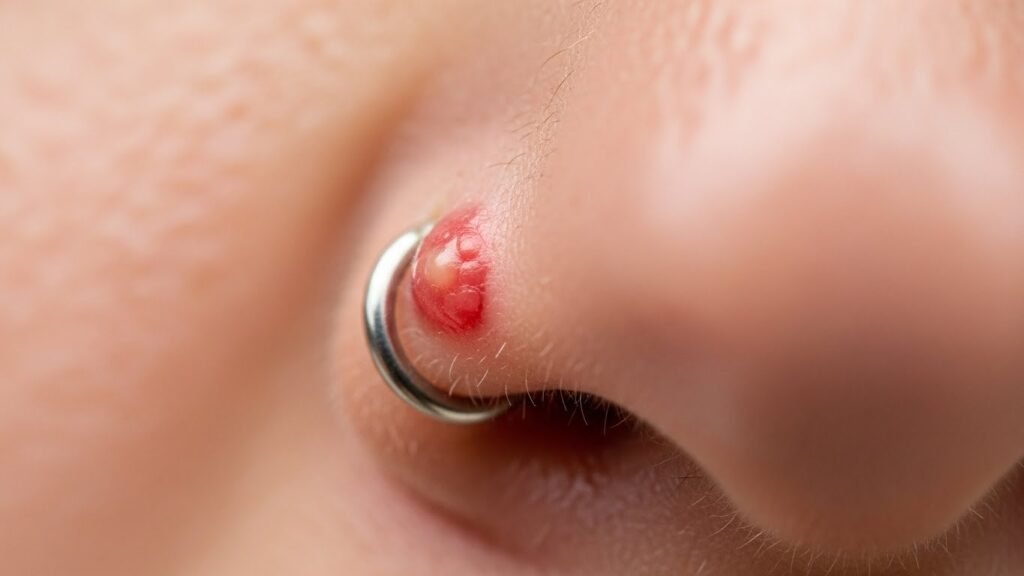
A bump inside nose piercing does not seem to be as bad as one outside, but usually, it is more uncomfortable. The nasal passage is lined with delicate mucosa that swells easily and this is why the internal bump is actually more distressing. Also, the constant airflow can act as another irritant.
Nevertheless, these spots can be treated effectively with saline solutions of a gentle nature and by limiting the movement of the jewelry.
Piercing Bump on Nose vs Keloid Nose Piercing Bump
What is going on inside of a piercing bump on nose versus a keloid nose piercing bump is two different skin conditions. An irritated spot tends to swell and flicker in size whereas a keloid stays hard and enlarges steadily in an outward direction.
If the bump appeared within weeks of piercing and your bump is fluctuating, most likely it is irritation. If, however, your bump keeps growing months later without any alteration, you may be dealing with something else.
Ear Piercing Bump and Why Ears Are Sensitive
Contact is considered the biggest factor as to why an ear bump appears easily. Your hair can scratch it. Your headphones can cause it. Even your phone’s screen can contribute to it. Furthermore, when you sleep, your pillow can exert pressure on the bump. Hence, in all these instances, friction has a great role.
The problem with cartilage is that there is less blood flow going there, which is the main reason for a partial healing process in much slower. And that’s why your ear bump can be a real pain in the long haul even if it’s done properly.
Cartilage Piercing Bump and Slow Healing Reality
Cartilage is one of the parts of the body that piercings stay irritated in for a longer period of time. It heals very slowly and is also very prone to inflammation. Because even a well-healed piercing can be very irritating if the position is not right when you sleep.
The problem/difficulty with healing is more related to the inability of the body to simply not destroying the existing structure through inflammation.
Helix Piercing Bump and Pressure Triggers
It is sleeping habits that often lie behind a helix piercing bump. The side of the head on which the sleeping person’s favourite side usually corresponds to the ear with the bump. That repeated pressure keeps the irritation alive.
Apart from this, one can quietly reduce irritation by these small but effective changes such as switching sleep sides or using travel pillows without having to change the existing care routines.
Bump Behind Ear Piercing and Back-Side Friction
Except you may not be familiar with a bump behind ear piercing when it is bothering you. Your hair can be pulled, your mask straps can rub the skin, and indeed your helmet straps can also do the same, and all these conjure friction at the backing.
Besides that, without going any further, you can expect this problem to be resolved pretty soon if you take good care of your ears hygienically and adjust the length of your accessories.
Bump at Back of Ear Piercing vs Infection Concerns
Sometimes, a bump at back of ear piercing may not be nothing more than the effects of excessive pressure. The former kind of bumps is warm to the touch but the temperature does not really go up to the point that they are actually feverish.
The distinguishing feature between the two is their warmth or coolness, on the one hand, and whether or not there is discharge.
Belly Button Piercing Bump and Clothing Pressure
The very likely cause of a belly button piercing bump is clothing pressure and the movement of the area. Waistband, sitting position, tight clothes – everything contributes to the problem of perpetually stressed area.
Navels … because of motion and moisture … naturally attention must be paid first to reducing stress before applying any product.
Bump Navel Piercing vs Bump Belly Button Piercing
Bump Navel Piercing and Bump Belly Button Piercing are different terms that refer to the same problem. So both cases describe the problem that a person with a piercing has and it is mostly related to the body’s reaction to the foreign body (jewelry) and not infection.
Here, loose clothing and patience will be of more help than do-it-yourself cleaning. Too much attention can worsen the situation and, thus, it should be avoided at all costs.
Bump in Belly Button Piercing and Moisture Problems
Wetness is the enemy of a bump in a belly button piercing, as it is the breeding ground for it. Excessive sweating, damp weather, and even sweat trapped inside the clothing are all factors that delay wound healing.
After doing the cleaning, it is necessary to get the area dried properly. Your skin will heal much better if you can give it a chance to breathe.
Piercing Irritation Bump vs Infection
Some of the signs of an irritation including redness, swelling, and tenderness could be spreading to pain. On the other hand, infections may be accompanied by elevated temperature, drainage, and increased discomfort.
However, most of the bumps are irritation bumps. On the other hand, treating irritation as an infection will only cause setbacks.
Do Piercing Bumps Go Away on Their Own?
Do piercing bumps go away? Mostly they do. Especially if the source of the irritation is removed. When given the opportunity, skin will always want to heal.
The timeframe depends on the location and the kind of care. The bumps on the nose and ears can disappear in a matter of weeks. However, cartilage and navel bumps can take a longer time.
Piercing Bump Treatment That Doesn’t Overdo It
Less is more when it comes to the treatment of piercing bumps. Carefully selecting your saline drops, making less contact, and securing your jewelry have more benefits than complicated routines scientifically proven.
Skin is a great healer. It’s all about balance. Too much of something disrupts the balance and therefore, the healing process.
Piercing Bump Solution Myths to Avoid
Often, the opening of a piercing bump solution is accompanied by a list of ingredients that only include oils and other home remedies in it. These are the types of products that usually end up irritating your skin rather than helping it.
Quite simply, if it stings, burns, or excessively dries out your skin, then it is most likely that the product is actually working against your healing process and not for it.
Bumps From Piercing and Emotional Frustration
The bumps caused by the piercing do not only bother the body physically, but they also disrupt the confidence. They are constantly being looked at and even if one keeps to oneself, anxiety about the healing process creeps to one’s mind.
It is just a part of the whole experience of being frustrated with the evolution of one’s healing. Healing is not a straight path. The progress is usually very slow, boring in fact, most of the time.
How to Get Rid of Bump on Piercing Without Damage
How to get rid of bump on piercing safely? The best way would be not to experiment but to keep to one method. The winner is always consistency.
Stay committed to the simplest and gentlest treatments, long enough in order to observe a change. Transitioning from one method to another is equivalent to restarting the healing process.
Piercing Bumps and Jewelry Fit
Piercing bumps often indicate too tightly fitting or poorly positioned jewelry. Inflammation of the area requires space, and tight pieces only trap the irritation.
Most of the long-term issues can be avoided with just a few simple changes. In some painful circumstances, only the length is necessary.
Final Thoughts, Not a Conclusion
The existence of piercing bumps does not signify your failure. What it simply means is that your skin is stubbornly rehabilitating itself. Keep in mind it is never a straight road, and one should not allow the bumps to get hold of the final score. Be determined, be gentle, and allow your skin time to heal.
FAQs — People Also Ask
Do piercing bumps go away on their own?
Most of the time, yes. In fact, if you take away the source of the irritation, the spots tend to disappear on their own.
How long does a piercing bump last?
This depends on the case. A nose bump might take a couple of weeks to heal. But a bump in the cartilage or the navel might stay for a few months.
Is a piercing bump always an infection?
No. They are mostly your body’s reaction to the foreign body/jewelry rather than infections.
Can saline solution really help piercing bumps?
Yes, it can. Saline solution is a mild cleansing agent and won’t harm healing tissue.
When should I see a professional?
When the bump gets bigger, is very painful, or has signs of an infection, you should see a professional.