Look, I get it. Every other headline screams about artificial intelligence these days and half the time, nobody explains what kind they mean. So here we go. I wrote this to walk you through the main types of AI without drowning you in jargon. Quick read, no filler.
So What Even Is Artificial Intelligence?
Okay, stripped down to basics — artificial intelligence is when a computer does something that would normally need a human brain. Could be spotting a face in a crowd, writing a paragraph, or figuring out what movie you want to watch on a Friday night. Some of these systems are incredibly narrow. They do one task and that is all they know. Others, well, researchers are trying to build ones that think more broadly but we are not there yet. Not even close, honestly. Right now every AI tool you and I use daily is what the experts call narrow AI. Your spam filter? Narrow AI. Siri? Same deal. Impressive on the surface but very limited underneath.
Different Types of AI Based on What They Can Do
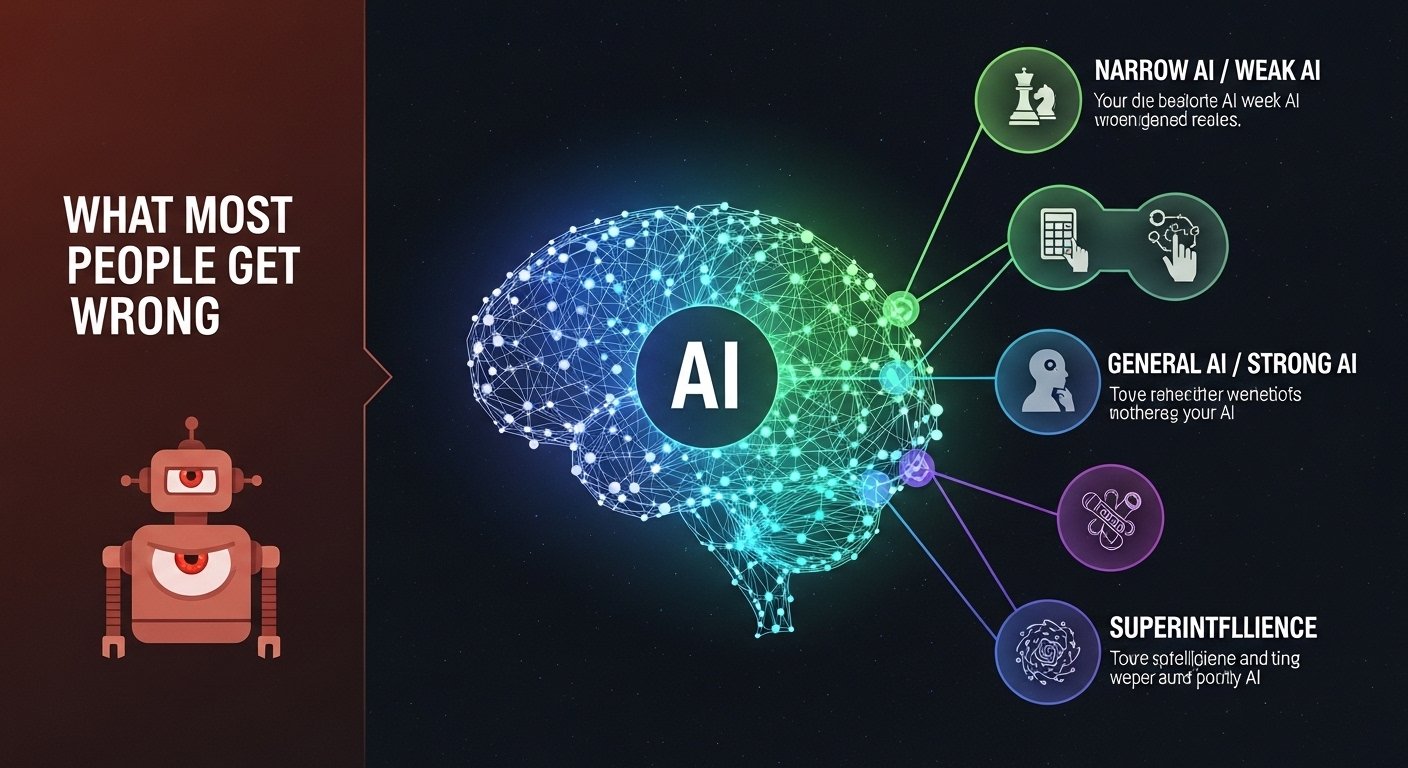
People in the research world usually split things into three buckets. Narrow AI, general AI, and super AI. Narrow is the only real one as of today. It handles one job, maybe two, and it does that job pretty well. General AI is the dream — a machine that reasons across any topic the way you or I can. Nobody has cracked that yet despite what some LinkedIn posts might suggest. And super AI? That is science fiction territory for now. A system smarter than every human combined. Makes for great movie plots but we are decades away. Maybe more. The thing people misunderstand is that narrow does not equal dumb. A narrow AI model can beat the world chess champion. It just cannot also cook you dinner after.
Types of AI Models — The Stuff Under the Hood
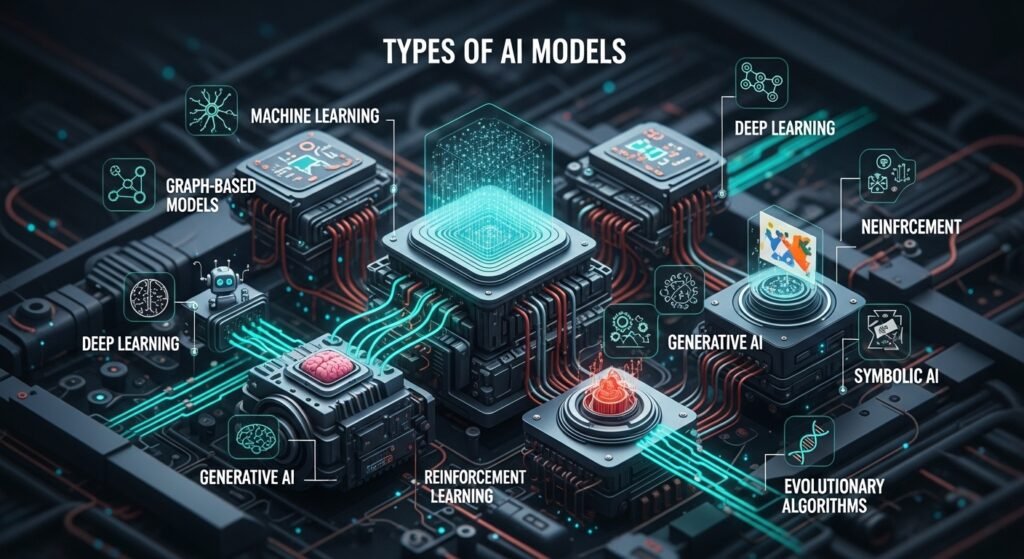
When someone says types of AI models they mean the actual technical setup. Think of it like car engines — there are different designs depending on what you need the car to do. Neural networks mimic how brain cells fire. Decision trees follow yes-no logic branches. Transformers, which are behind ChatGPT and similar tools, use something called attention mechanisms to process language. Then you have reinforcement learning where the system basically teaches itself through trial and error, kind of like how a toddler learns not to touch a hot stove. Each model type fits different problems. No single one does everything well. That is something a lot of people miss.
| Model | Quick Explanation | Good For | Example |
| Neural Networks | Layered nodes processing data | Images, speech | Google Photos |
| Transformers | Attention-based sequence processing | Text, translation | GPT, Claude |
| Decision Trees | Branching yes/no logic | Risk scoring | Loan approvals |
| Reinforcement Learning | Learn by reward and penalty | Robotics, games | AlphaGo |
Machine Learning — The Workhorse Behind Almost Everything
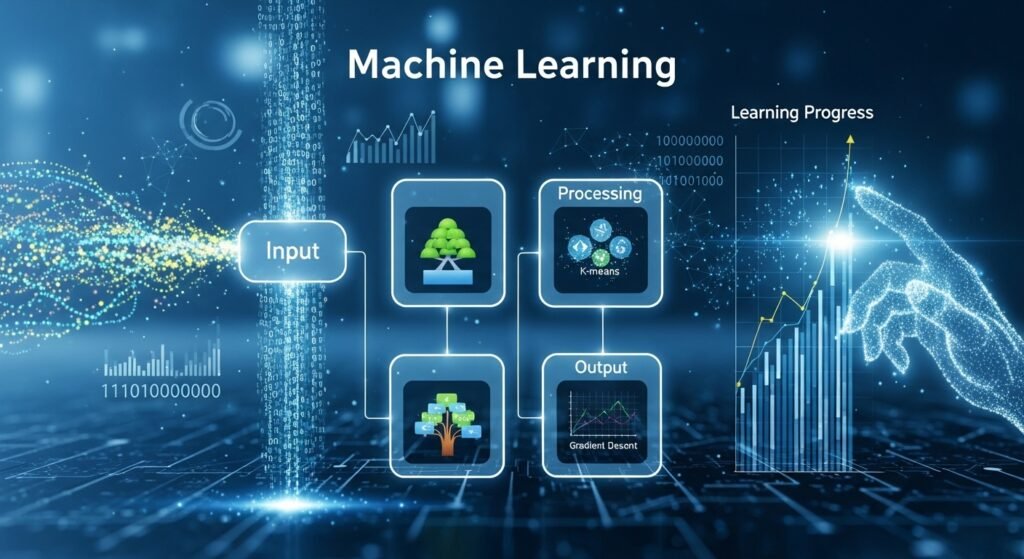
If AI is the big umbrella then machine learning is the rain keeping it relevant. Seriously though. Most of the AI products you touch use machine learning at their core. The idea is straightforward — you feed the system a pile of data and it figures out patterns on its own. No one hand-codes every rule. There are three main flavors. Supervised learning is when you label the data first. Like, here are a thousand photos tagged as dogs. Go learn what a dog looks like. Unsupervised learning is messier — no labels, the system clusters things on its own. And reinforcement learning lets an agent try stuff, get scored, and slowly improve. Each one works best in different situations and picking wrong wastes time and money.
Deep Learning — Machine Learning on Steroids
Deep learning is basically machine learning but with way more layers inside the neural network. The word deep refers to the number of processing layers, nothing philosophical about it. More layers means the system catches subtler patterns. This is what finally made things like real-time translation and self-driving car prototypes possible. The tradeoff is brutal though. Deep learning eats computing power for breakfast. Training a single large model can cost millions of dollars in server time. Small teams usually cannot afford to train their own deep learning models from scratch, which is why pretrained models and fine-tuning became so popular. You grab a foundation model someone else built, tweak it for your use case, and save yourself a fortune.
Types of Generative AI — Machines That Create Things
This is the category getting all the media attention right now and honestly, it deserves some of it. Generative AI does not just classify or predict. It makes new stuff. Text, images, music, code, video. The main players include large language models for writing, diffusion models for images, and specialized tools for audio and video generation. What sets generative AI apart from older systems is output. Traditional AI says this email is spam. Generative AI writes you a brand new email from scratch. Big difference. Companies everywhere are using it to draft marketing copy, prototype designs, generate test data, and a bunch of other tasks that used to eat up hours of human labor. It is not perfect. It hallucinates facts, misses nuance, and can produce bland generic content if you do not guide it properly. But the speed advantage alone makes it worth paying attention to.
Natural Language Processing — How Machines Get What We Say
NLP is probably the branch of AI that touches your daily life the most. Any time your phone autocompletes a sentence, a chatbot answers your question, or Google translates a webpage — that is natural language processing at work. Before around 2017 this stuff was pretty clunky. Old-school models struggled with context and long sentences. Then transformer architecture showed up and changed the whole game. Now NLP can handle sentiment analysis, document summaries, content moderation, legal review, and dozens of other text-heavy jobs. It is also what powers every chatbot you have talked to recently. The improvements in the last few years alone have been wild. What used to require a team of linguists now gets handled by a well-trained model in seconds.
AI Agents — When Software Starts Acting on Its Own
This one is still early but moving fast. An AI agent is not just a chatbot that waits for your input. It plans, uses tools, browses the web, runs code, and works through multi-step problems mostly on its own. Think of the difference like this. A chatbot gives you restaurant suggestions. An agent actually goes ahead and books you a table, checks your calendar first, and sends a confirmation to your phone. Right now agents mess up a fair bit. They misinterpret instructions, loop on tasks, or go off-track. But every month they get more capable. Companies like Anthropic, Google, and OpenAI are pouring resources into agent development because whoever cracks reliable autonomous agents basically owns the next wave of productivity software. That is the bet at least.
Data — The One Thing Every Type of AI Depends On
None of the stuff I mentioned above works without good data. Period. You can build the fanciest model in the world and it will still produce garbage if your training data is messy or biased. This part does not get enough attention honestly. Data collection, labeling, cleaning — that boring unsexy work is often where AI projects succeed or fail. Biased data creates biased results. Incomplete data creates blind spots. Noisy data creates unreliable outputs. If you are evaluating any AI tool, one of the first questions you should ask is what data it was trained on. That tells you more about quality than any marketing pitch ever will.
Common Mistakes and Honest Comparisons
Biggest mistake I see is people treating all AI like one thing. It is not. A rule-based chatbot and a large language model are worlds apart. Another one — overestimating what current AI handles. It is great at pattern matching and terrible at genuine reasoning. Also, people skip the data quality conversation way too often. On comparisons: traditional machine learning often outperforms deep learning on small structured datasets. Generative AI creates new content while predictive AI forecasts what happens next. Both useful, fundamentally different jobs. Knowing which tool fits which problem saves you from expensive mistakes.
FAQs About Types of AI
What are the 3 main types of AI?
Narrow AI which handles specific tasks and is the only kind that exists today. General AI which would match human thinking across all areas. And super AI which would surpass human intelligence entirely. The last two remain theoretical.
What is the difference between machine learning and deep learning?
Machine learning is the broader field. Deep learning sits inside it. It uses neural networks with many layers to pick up complex patterns in things like images and text. Think of machine learning as the toolbox and deep learning as one powerful tool inside it.
Is generative AI the same as regular AI?
Not quite. Regular AI typically classifies things or makes predictions based on existing data. Generative AI creates brand new content — text, images, code, music. Same family, different job description.
What do AI agents actually do?
They go beyond answering questions. Agents plan tasks, use external tools, and execute multi-step workflows with minimal human supervision. Still early technology but improving rapidly every quarter.
Why does everyone keep talking about data quality in AI?
Because the model only learns what you feed it. Feed it biased or incomplete data and the outputs reflect those flaws directly. Data quality is genuinely the make-or-break factor for any AI project, no matter how good the algorithm is.
Anyway, that is roughly where things sit with all these different types of AI. The field moves ridiculously fast so some of this might shift by next year. But at least now you have got the vocabulary and the mental map to keep up when it comes up in conversation or at work. Which, let us be real, is going to be pretty often from here on out.