
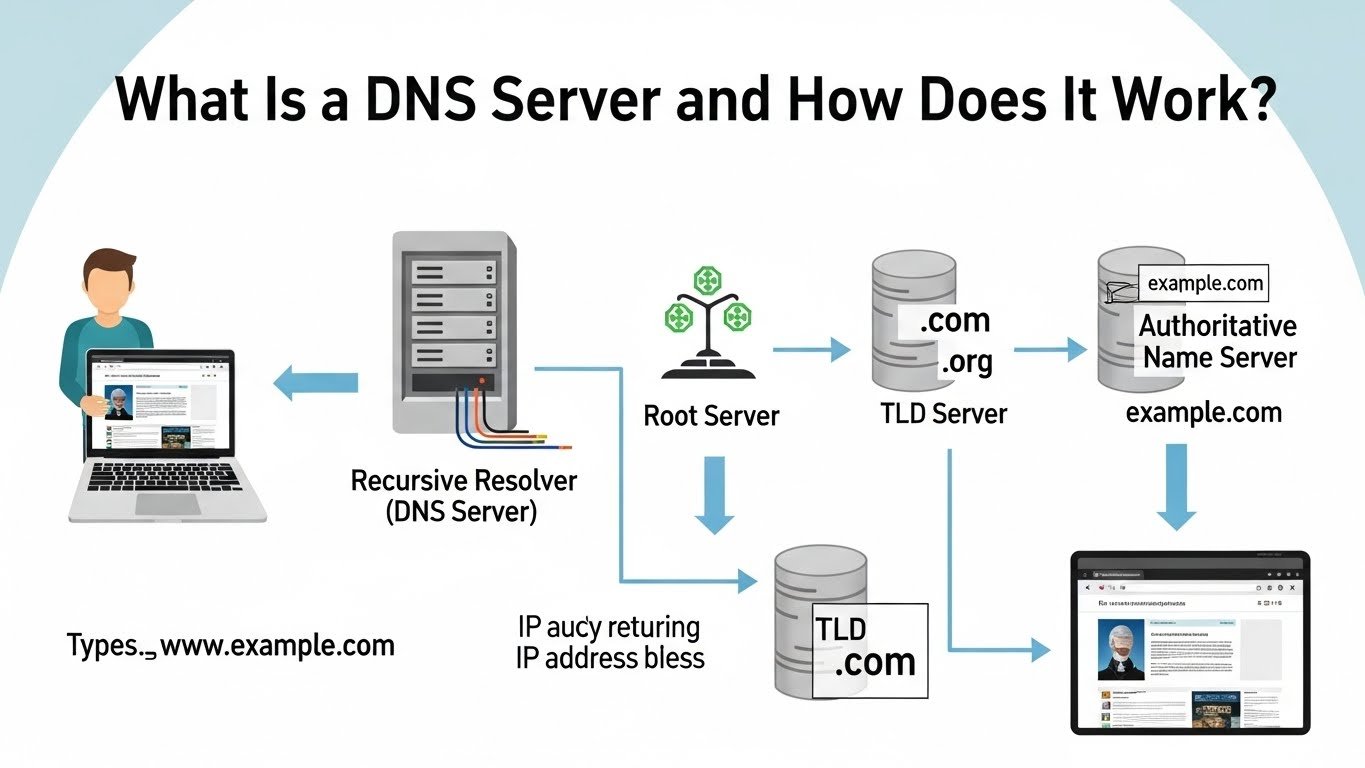
What is a DNS server is a question that few people will never ask until the internet stops working. Everything seems to be connected, but the pages won’t load. The system silently fails to translate a name into a place.
What Is a DNS Server and Why It Was Created
Fundamentally, a DNS server is the internet’s phone book. People tend to remember names, whereas computers don’t. When you enter a web domain in your browser, a DNS server translates that domain into an IP address, which is the only language computers understand. Without this translation, your request will have no destination. Then, the internet won’t just seem broken, but it will hardly be usable.
What Is the Purpose of a DNS Server
The DNS server didn’t have speed, security, or control as its primary functions. At first, it mainly served as a name resolver. However, it gradually took up more chores, but the core of its jobkeeping the internet user-friendly remains quite simple. It made the internet accessible to ordinary people rather than requiring everyone to remember the numbers of the websites.
What Is a DNS Server Used For in Daily Internet Use

Behind the scenes, almost every app, website, and service rely on DNS. Netflix, video games, e-mails, cloud tools: all of them start a DNS query first. It works so seamlessly and silently that you hardly get to notice it, but indeed the first step for all your clicks is the name lookup—something search visibility and routing systems quietly depend on as well. DNS is not in charge of delivering the data itself; it only indicates the direction to the destination.
What Is the Function of a DNS Server Behind the Scenes
The function of a DNS server is not AC to host content or to deliver web pages. It is to instantaneously answer a simple question: “Where is this?” After which, the rest of the system takes care of the tasks. That division is very important. For instance, how much the website contents manage to catch the interests of users is a matter of concern for that website only. Where it is located is what matters to the DNS. Being unbiased, making no difference to the contents of different websites is the feature that makes the system stretchable to billions of transactions.
What Is a DNS Name Server and How It Fits In
A DNS name server is a DNS server that only keeps records. These records help to find out the IP address against the domain name query. When a resolver poses a question, a name server greets it with authority. It neither asks for confirmations nor forwards questions to other servers. It answers because the data is considered its property. That particular detail is necessary to comprehend the movement of DNS queries over the internet.
What Is a Recursive DNS Server and Why You Use One
A recursive DNS server is the one which is directly connected to your device. This kind of server performs all the searches by itself. During a web request, the recursive server starts it by interrogating the others in turn. In this interaction, the root, TLD, and authoritative servers are involved. The entire operation is not made visible to you. You only realize it when the web page gets loaded—or it doesn’t.
What Is a DNS Server and What Does It Do for Speed
It is not the DNS that transports your content but it plays a role in how fast you get it. If a DNS server responds slowly, then everything else will continue to be delayed. So to name different DNS providers is something that people do here and there, not because the internet will become faster but more because the act of name resolutions become more efficient. Speed here is simply about losing no time before starting.
What Is a Good DNS Server and Why People Switch
A good DNS server responds quickly, reliably, and consistently. Google DNS and Cloudflare are two examples of public DNS services with global infrastructure that is so popular because they provide reliable service. The proximity of the servers leads to faster replies. Users alter DNS servers when webpages become too slow to load, services stop working, or when privacy is compromised. In fact, it is one of the few internet settings that a user can change even without having deep knowledge of the technology—similar to how people explore new ways search technology is evolving when performance or reliability becomes an issue.
What Is a Private DNS Server in Simple Terms
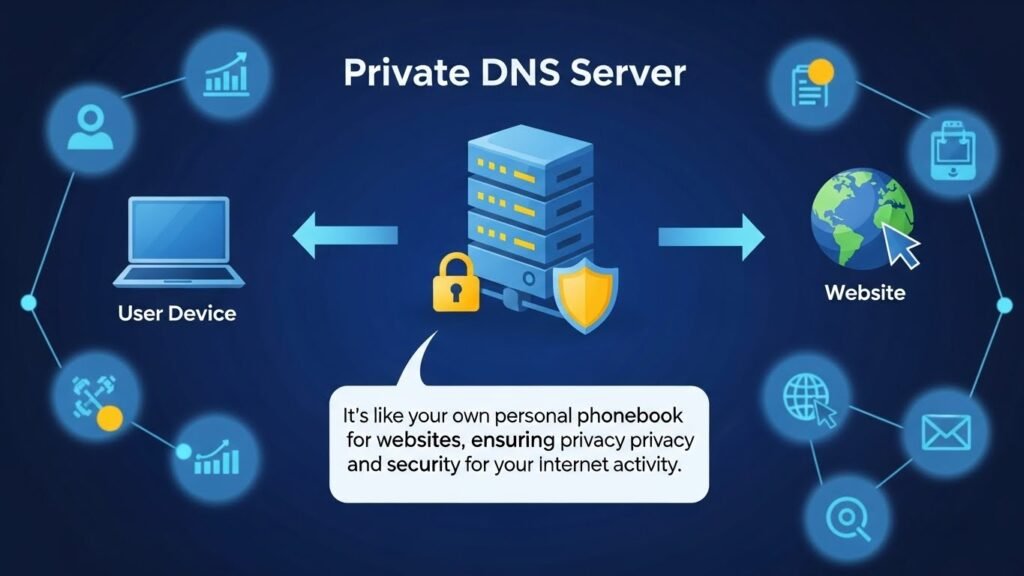
A private DNS server is essentially a DNS service that is not publicly available and is generally under the control of an enterprise. Some businesses only allow their workers to use the internal DNS services that are available through the office network. Private DNS can also be a device that a person owns and uses for filtering, or to maintain their privacy. The point is not to keep the information away from others but rather to have full control. Private DNS provides the possibility of setting rules, custom records, and private names that are not available through the public internet.
What Is the Purpose of a Secondary DNS Server
Purpose of a secondary DNS server is to provide the same services when the primary server is not available. It is not for speeding up the process but for preventing a service outage. DNS redundancy is primarily about reliability rather than speed. When systems are set up correctly, users will not be able to tell that a switch had taken place. Such invisibility is the objective.
What Is a DNS Server for Internet Connections at Home
Usually, when you connect to the internet at home, your router will automatically select a DNS server for you. It is very common that your ISP’s server is the one used. Occasionally, it could be public. In that case, that single DNS server will be serving as a translator for every device connected. Unless manually changed, they will all be using that same resolver: phones, laptops, smart TVs.
What Is a DNS Server for WiFi Networks
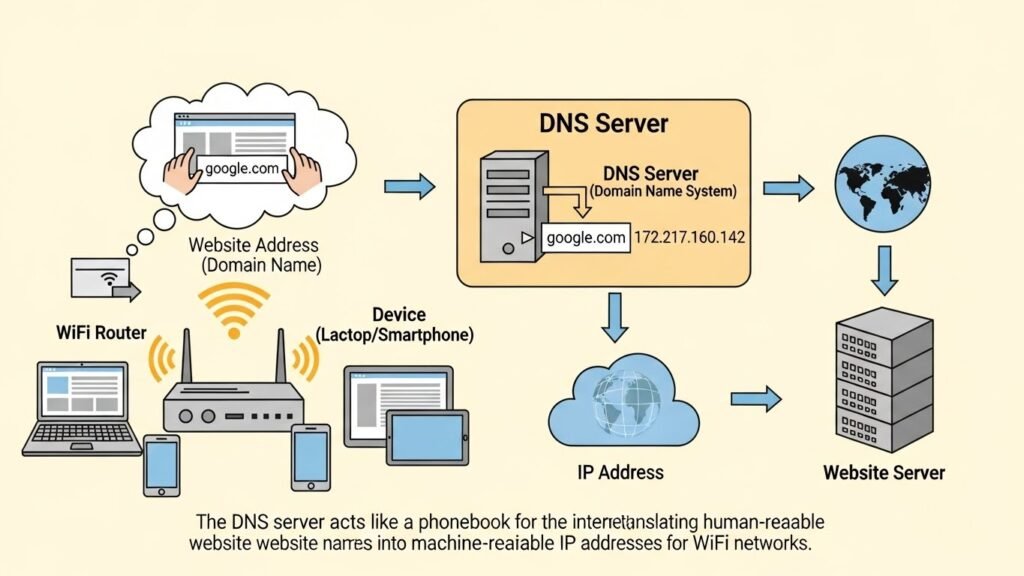
DNS server for WiFi probably looks more specific than it really is. What WiFi is to DNS is very much like what DNS is to the internet: just a delivery method. The mechanism of DNS resolution remains the same irrespective of whether the connection is through a wired or wireless network. The confusion probably arises when routers automatically assign the DNS settings through WiFi. Most of the time people tend to blame DNS as the reason why WiFi is malfunctioning when in fact it isn’t.
What Is a DNS Server on a Computer
Usually, the DNS server on a computer is not a physical or virtual server at all; instead, it is an IP address configured on the computer. A computer is normally set-up to know where to get an answer when it has a question. This is what a DNS server setting tells a computer. The overwhelming majority of people will not change these when ever working with their computers, but when problems occur in network configurations, the very first thing that is done in order to remedy the situation is the verification of the DNS setting.
What Is a DNS Server Error and Why It Happens
A DNS server error simply means that the translation didn’t happen. Not necessarily the internet, or even the website, is the issue, the matter is only with the lookup. The DNS server could have gone missing resulting in the non-response, it could have gotten confused and responded improperly, or simply it could not have found the record. These errors feel big because everything grinds to a halt. However, the real reason is usually nothing more than a timeout, a misconfiguration, or a brief outage.
What Is the Purpose of a DNS Server Error Message
DNS error messages are there to inform you at which point the chain was broken and not even the reason for your not being able to get the internet. Actually, they are small hints or diagnostic tools. By looking at them you can tell if the problem is in your device, DNS resolver, or the web you are visiting. Use them properly, and you will save yourself the trouble looking for problems in the wrong places.
What Is a DNS Server for Internet Gaming Consoles
In the context of gaming, DNS is pretty instrumental. In gaming especially, the foremost role of DNS is for online matchmaking, downloads or updates, digital gaming stores—the first step would always be name resolution. This is why when playing games, gamers are often recommended to check their DNS settings during setup or when troubleshooting. DNS does not provide better gaming experiences directly, however, if the DNS is poor, some services may fail to connect entirely.
What Is a DNS Server PS4 Users Commonly See
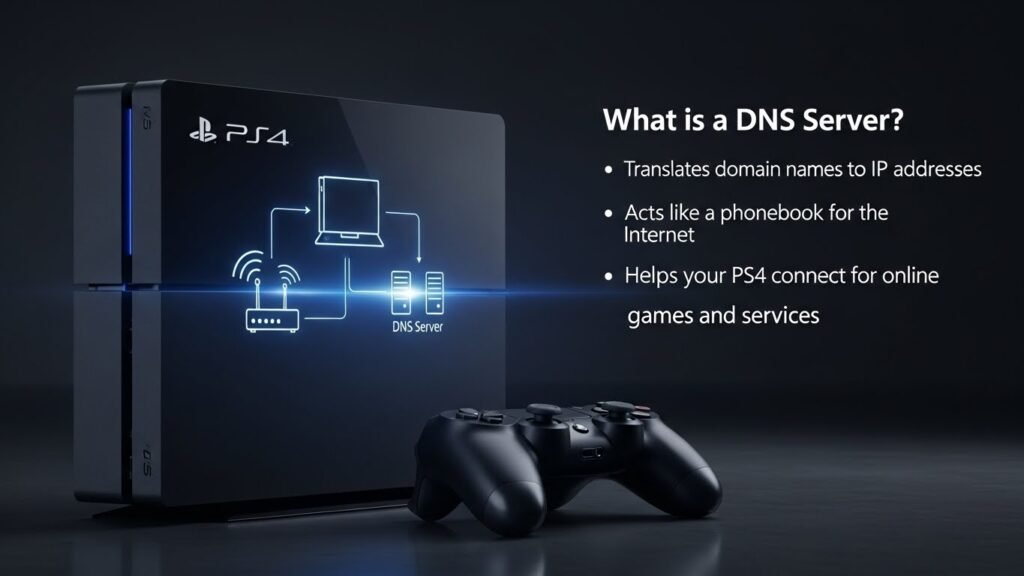
What is a DNS server PS4 appears as a question when network tests fail. The console will perform DNS checks right at the beginning. In case the resolution test turns out to be a failure, the services will be denied. To be more precise, changing DNS settings on a PS4 doesn’t improve performance directly. What it does, is it makes sure that the name resolution process to the Sony services and game servers will be reliable.
What Is a DNS Server PS5 and How It Differs
From a functional perspective It is no different from PS4. Both systems resolve domain names similarly. The differentiating factor is network complexity. More services. More background connections. DNS reliability becomes more obvious for such a scenario. As a result, when DNS fails, the effect on modern consoles is more discernible as compared to that on the old ones.
What Is the Functionality of a DNS Server in Security
DNS was definitely not meant to be used as a tool for security, but one cannot deny its involvement in this area nowadays: Filtering virus domains; blocking phishing sites; logging suspicious traffic. Some DNS providers offer protective layers. Of course, it is not said that DNS is a firewall; however, it does add a checkpoint at the very beginning. The protection is started before the content is even loaded.
What Is a DNS Server Used For in Business Networks
Enterprise DNS is critical for internal purposes. It is always running in the background and most users do not even have a clue about it. For example, file servers, email systems, internal apps, private domains. When DNS goes down at work, productivity will be the first to take a hit. Hence, the corporate DNS infrastructure is more focused on aspects like redundancy and monitoring rather than just speed only.
What Is the Purpose of a DNS Server in Cloud Services
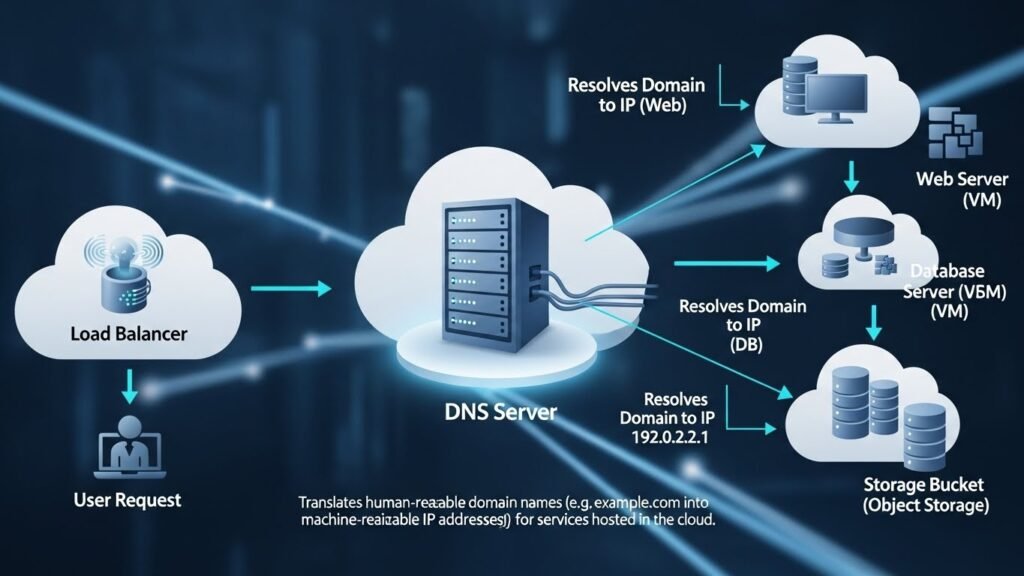
Cloud services and DNS have a symbiotic relationship. A service can both liberate itself from physical boundaries and scale up and down dynamically. While the IP addresses may change, sooner or later, the IP addresses will keep changing. Thanks to DNS, all these changes are totally invisible to us. Load balancers use DNS to allocate the workload to different servers. If it weren’t for DNS, the cloud infrastructure would have to be updated manually all the time. DNS allows for abstraction, which in turn allows for scaling.
What Is the Purpose of a DNS Server? Revisited
By reflecting further on the purpose of a DNS server, one comes to realize that it is a basic one. It does not produce innovation and doesn’t dazzle people. It just gets the job done or better said, everything else fails. That kind of sober dependability is perhaps the reason why DNS is seldom praised and why it is sorely missed when it breaks.
What Happens When DNS Goes Down
When DNS goes down, pages don’t just not load partially; they disappear completely. Applications cease to work in a most inconspicuous manner. Errors become more than one. It seems as if the entire internet had collapsed while actually, the data routes are still there. What DNS outages reveal is the extent to which nowadays, our lives are dependent on the process of name resolution, though most of the time we are unaware of it.
Why DNS Design Hasn’t Changed Much
The design of DNS has remained pretty much the same because it does the job very well. Also, it is scalable and decentralized. Speed, privacy, and security are the focus areas of the improvements rather than the structure. The simplicity of the DNS is the very thing that makes it so strong. If overengineered, it will become vulnerable. Here stability is preferred to novelty.
A Simple DNS Flow Snapshot
| Step | What Happens |
|---|---|
| User enters domain | Name request begins |
| Recursive server | Searches for answer |
| Authoritative server | Provides IP |
| Browser connects | Content loads |
The table looks simple. The procedure that lies behind it is as vast as continents.
Why Understanding DNS Still Matters
On a daily basis, very few people are required to configure DNS or even mess around with it. However, knowing how it works in the first place changes how you deal with problems. You can turn mysterious errors into issues that are solvable. You understand how merely changing one setting can result in several things being fixed. Here, knowledge mainly serves to alleviate the frustration side of things rather than increasing one’s ability to control.
FAQs — People Also Ask
What is a DNS server in simple words?
A DNS server acts as a translator for computer communication by converting domain names into IP addresses.
What is the purpose of a DNS server?
The main purpose of a DNS server is to translate the human-friendly domain names into the machine-friendly IP addresses.
What is a DNS server error?
A DNS error can be simply referred to as the failure of a system to resolve a domain name into an IP address.
What is a good DNS server to use?
Popular options like Google DNS and Cloudflare provide the best performance and reliability.
What is a private DNS server used for?
To run your internal/private networks or for better privacy and control.