



Machine learning sounds like something pulled straight from a science fiction movie. Complex algorithms, neural networks, training data — it can feel overwhelming before you even start. But here is the truth: machine learning is built on the same principle your brain uses every single day.
How a Child Learning the Alphabet Explains Machine Learning
Think about how a child learns the letter A.
You show them a printed A in a book. Then you show them a handwritten A on a whiteboard. Then a bold A on a cereal box. After seeing enough variations, the child can recognise any A — even one they have never encountered before. Nobody sat them down and listed every possible version. Their brain simply identified the pattern on its own.
Machine learning works the same way, except the “child” is a computer and the “brain” is an algorithm. You feed the computer thousands of examples, and it figures out the underlying pattern without being told exactly what to look for.
That is it. That is the core idea behind every machine learning system in the world.
Why Traditional Programming Falls Short
Before machine learning, giving a computer intelligence meant writing explicit rules for every possible scenario. Traditional software engineering relied on developers anticipating every edge case and coding for it manually.
Want your program to tell the difference between a cat and a dog in a photograph? You would need to code individual rules: check for whiskers, measure the snout length, assess the ear shape. Then someone uploads a photo of a hairless cat, and your carefully written rules break. Add another rule. Then a fluffy Pomeranian gets misclassified. Add yet another rule.
The fundamental limitation is clear: real-world problems have too many variables for any human to manually account for. Colour variations, angles, lighting conditions, breeds — the list of exceptions grows faster than anyone can write rules to handle them.
Machine learning eliminates that bottleneck entirely.
Instead of programming the rules yourself, you provide the computer with thousands of labelled examples — “this is a cat, this is a dog, this is a cat.” The algorithm analyses those examples, identifies the distinguishing patterns on its own, and then applies what it learned to images it has never seen before.
You are not writing the program that produces the answer. You are allowing the machine to discover the logic itself.
How Machine Learning Works: Three Stages Explained Simply
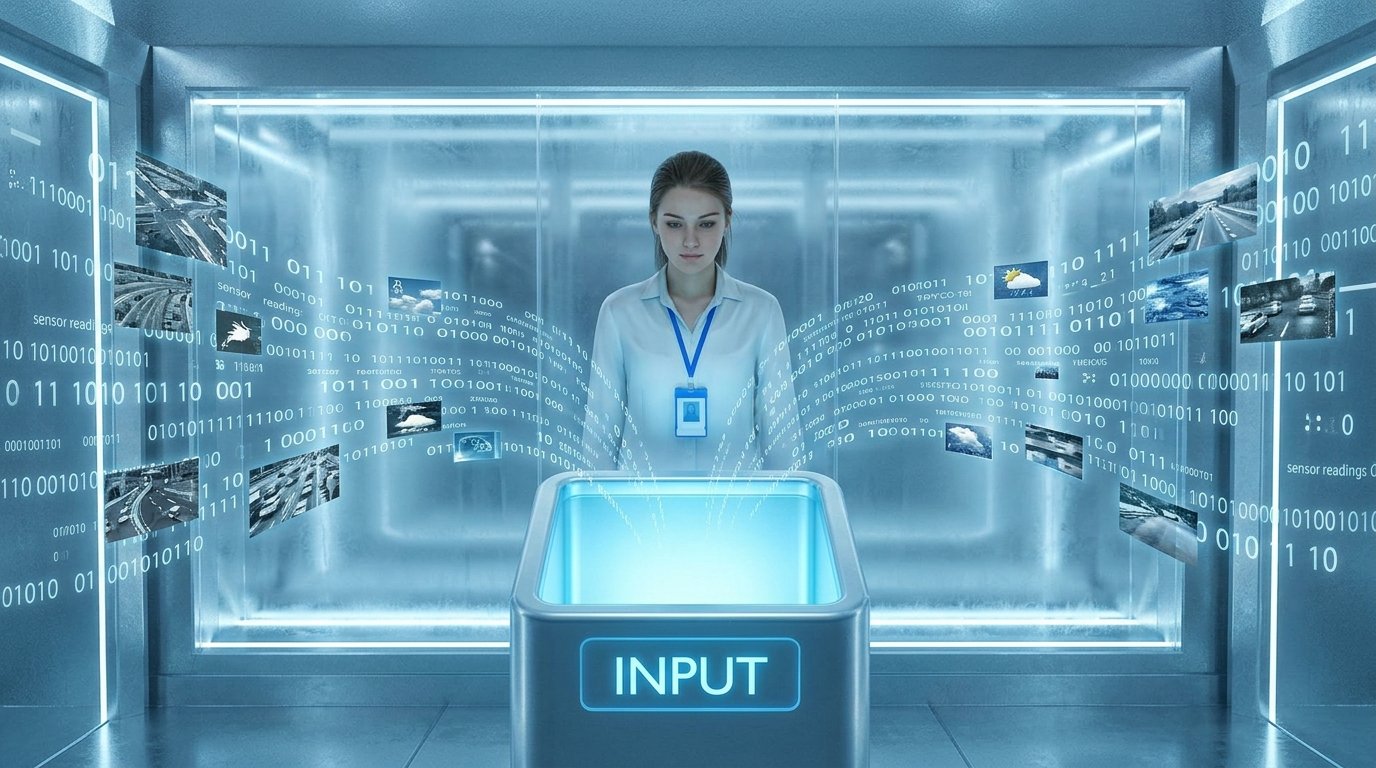
Despite the complicated reputation, machine learning follows a straightforward three-stage process.
Stage 1: Feed It Data
Everything starts with data — and plenty of it. If you want a machine learning model to identify cats in photographs, you need to provide it with thousands of cat images and thousands of non-cat images. The computer needs both positive and negative examples to learn what makes a cat a cat.
Data quality matters enormously here. Feeding the algorithm messy, mislabelled, or unrepresentative data produces unreliable results. The industry saying “garbage in, garbage out” exists for a reason.
Stage 2: The Algorithm Finds Patterns
This is where the actual “learning” happens. The algorithm processes the data repeatedly, adjusting its internal parameters each time based on whether its predictions were correct or incorrect.
Picture someone learning to throw darts. The first few throws land nowhere near the target. But with each attempt, they adjust their stance, grip, and release point. Eventually, they start hitting close to the bullseye consistently. A machine learning algorithm does essentially the same thing, except it makes these adjustments across millions of data points simultaneously.
Stage 3: Make Predictions on New Data
Once the algorithm has identified reliable patterns, you can give it completely new data it has never encountered before. It applies the patterns it discovered during training and produces an informed prediction.
The prediction will not be perfect every time, but it will be accurate enough to be genuinely useful. And here is the powerful part: the more quality data you provide, the better the predictions become.
Three Types of Machine Learning You Should Know
Machine learning is not a single technique. It branches into three distinct approaches, each suited to different kinds of problems.
Supervised Learning
The algorithm trains on labelled data where both the input and the correct output are provided. Think of it as learning with an answer key. Email spam filters, image recognition systems, and medical diagnosis tools all rely on supervised learning.
Unsupervised Learning
The algorithm receives data without any labels and must discover hidden structures or groupings on its own. Customer segmentation is a common use case — platforms like CRM software feed purchasing behaviour data into ML algorithms that identify natural customer clusters marketers would never spot manually.
Reinforcement Learning
The algorithm learns through trial and error, receiving rewards for correct actions and penalties for incorrect ones. This is how game-playing AI systems train themselves to beat world champions, and how self-driving cars learn to navigate complex traffic scenarios.
Real-World Machine Learning Examples You Use Every Day
Machine learning is not a futuristic concept waiting to arrive. It is embedded in tools and services you already interact with daily.
Email Spam Filtering
Your email provider was never manually programmed with every possible spam message. Instead, it trained on millions of emails to learn the patterns that distinguish spam from legitimate correspondence. When a new phishing attempt arrives, the filter recognises its similarity to known spam and blocks it automatically. Modern messaging security systems rely on these same ML-driven pattern recognition techniques. Endpoint malware protection tools also use machine learning to detect threats that signature-based scanning would miss. When the filter makes mistakes — flagging a legitimate email or missing a spam message — it learns from the correction and improves.
Streaming Recommendations
Netflix, Spotify, and YouTube do not employ teams of people to manually curate your recommendations. Their machine learning models analyse the viewing, listening, and browsing patterns of millions of users to identify correlations: people who enjoy crime documentaries and nature shows tend to gravitate toward mystery films. The system spots these patterns and tailors your feed accordingly.
Facial Recognition on Your Phone
When you set up face unlock, you are not providing your phone with a written description of your facial features. You are giving it visual samples. The machine learning model learns what makes your face distinct from everyone else’s, which is why it still works when you tilt your head, change your lighting, or grow a beard.
Predictive Text and Autocomplete
Your phone’s keyboard has analysed billions of text messages and written passages to learn which words typically follow other words. When you type “How are” and it suggests “you,” that is not a hardcoded rule. The model learned that pattern from observing language at scale.
Fraud Detection in Banking
Banks no longer rely solely on rigid rules like “flag any transaction from two countries within an hour.” Machine learning models learn what normal spending behaviour looks like for each individual customer. When a transaction deviates from your established pattern — even subtly — the system flags it for review. It adapts to your habits over time and catches anomalies that rule-based systems would miss entirely. This is one reason cyber security roles increasingly require ML proficiency.
Medical Image Analysis
Machine learning models trained on millions of medical scans can identify tumours, fractures, and abnormalities with remarkable accuracy. They do not replace doctors — they act as a second pair of eyes, helping physicians catch things faster and focus their expertise on the most complex cases.
Where Machine Learning Goes Wrong

Machine learning is powerful, but it is not infallible. Understanding its limitations is just as important as understanding its capabilities.
Biased Data Produces Biased Results
An algorithm is only as fair as the data it trains on. A widely reported case involved a hiring algorithm that systematically penalised female applicants. The cause was not intentional discrimination — the training data consisted predominantly of male candidates in those roles, so the algorithm learned a pattern that reflected historical bias rather than actual job qualification.
It Demands Enormous Amounts of Data
You cannot train a reliable machine learning model with a handful of examples. Depending on the complexity of the task, you may need hundreds of thousands or even millions of data points. Acquiring, cleaning, and labelling that data is expensive and time-consuming.
The Black Box Problem
Sometimes a machine learning model makes accurate predictions, but nobody — including the engineers who built it — can fully explain why. The model discovered a pattern that works, but the pattern is too complex to describe in human terms. That opacity is acceptable for movie recommendations. It becomes a serious concern when the model is deciding loan approvals or criminal sentencing.
Model Drift Is Real
Machine learning models are trained on historical data, but the real world changes constantly. A fraud detection model trained on 2023 spending patterns may become less effective as consumer behaviour shifts in 2026. Models need regular retraining with fresh data to stay accurate, and without active monitoring, performance can degrade silently.
Machine Learning vs Deep Learning vs Artificial Intelligence
These three terms get used interchangeably, but they describe different things.
Artificial intelligence is the broadest category — any system designed to simulate human intelligence. A chess program using hardcoded rules counts as AI. The field now extends into hardware too, with AIoT (Artificial Intelligence of Things) embedding ML models directly into physical devices and sensors.
Machine learning is a subset of AI where systems learn from data rather than following predetermined rules. Every machine learning system is an AI system, but not every AI system uses machine learning.
Deep learning is a subset of machine learning that uses multi-layered neural networks to process data. It excels at tasks involving unstructured data like images, audio, and natural language. The generative AI image generators, large language models, and voice assistants that have surged in popularity since 2022 are all powered by deep learning.
What the Future Looks Like
Machine learning is evolving rapidly. Models are becoming more efficient, requiring less data and computing power to achieve better results. Multimodal systems that process text, images, audio, and video simultaneously are moving from research labs into commercial products. The best AI tools in 2026 already leverage these advances across writing, design, coding, and data analysis.
At the same time, the technology is becoming increasingly difficult to govern. Questions around data privacy, algorithmic accountability, and environmental impact from training large models are driving new regulations worldwide.
The organisations and individuals who understand how machine learning works — its strengths and its blind spots — will be far better positioned than those who treat it as a black box or dismiss it as hype. If you are just getting started, an AI course for beginners is a practical next step.
Frequently Asked Questions
What is machine learning in simple terms?
Machine learning is a branch of artificial intelligence where computers learn patterns from data instead of following manually written rules. You give the system enough examples, it identifies what those examples have in common, and then it uses that understanding to make predictions about new data it has never seen before.
How does machine learning actually work?
The process follows three stages: first, you feed the algorithm a large dataset of examples. Second, the algorithm processes that data repeatedly, adjusting its internal settings to improve its accuracy. Third, you present it with new, unseen data and it generates predictions based on the patterns it discovered during training.
What are the three main types of machine learning?
Supervised learning trains on labelled data with known correct answers. Unsupervised learning finds hidden patterns in unlabelled data without any guidance. Reinforcement learning improves through trial and error, receiving rewards for correct decisions and penalties for incorrect ones.
How is machine learning used in business?
Businesses use machine learning for fraud detection, customer segmentation, demand forecasting, product recommendations, predictive maintenance, automated customer service, and dozens of other applications where pattern recognition at scale provides a competitive advantage.
Will machine learning replace human workers?
Machine learning automates specific tasks — particularly repetitive ones involving pattern recognition and data analysis — but it does not replace the need for human creativity, emotional intelligence, ethical judgement, and complex problem-solving. Most real-world implementations augment human capability rather than replacing it entirely. Building strong employability skills alongside technical literacy is the best way to stay relevant.
What are the biggest risks of machine learning?
The primary risks include biased training data that leads to discriminatory outcomes, lack of transparency in how models reach decisions, privacy concerns around the data used for training, and model drift where performance degrades over time as real-world conditions change.
Is machine learning the same as artificial intelligence?
No. Artificial intelligence is the broader field encompassing any system that simulates human intelligence. Machine learning is one approach within AI — specifically, the approach where systems learn from data rather than relying on explicitly programmed rules. All machine learning is AI, but not all AI is machine learning.