


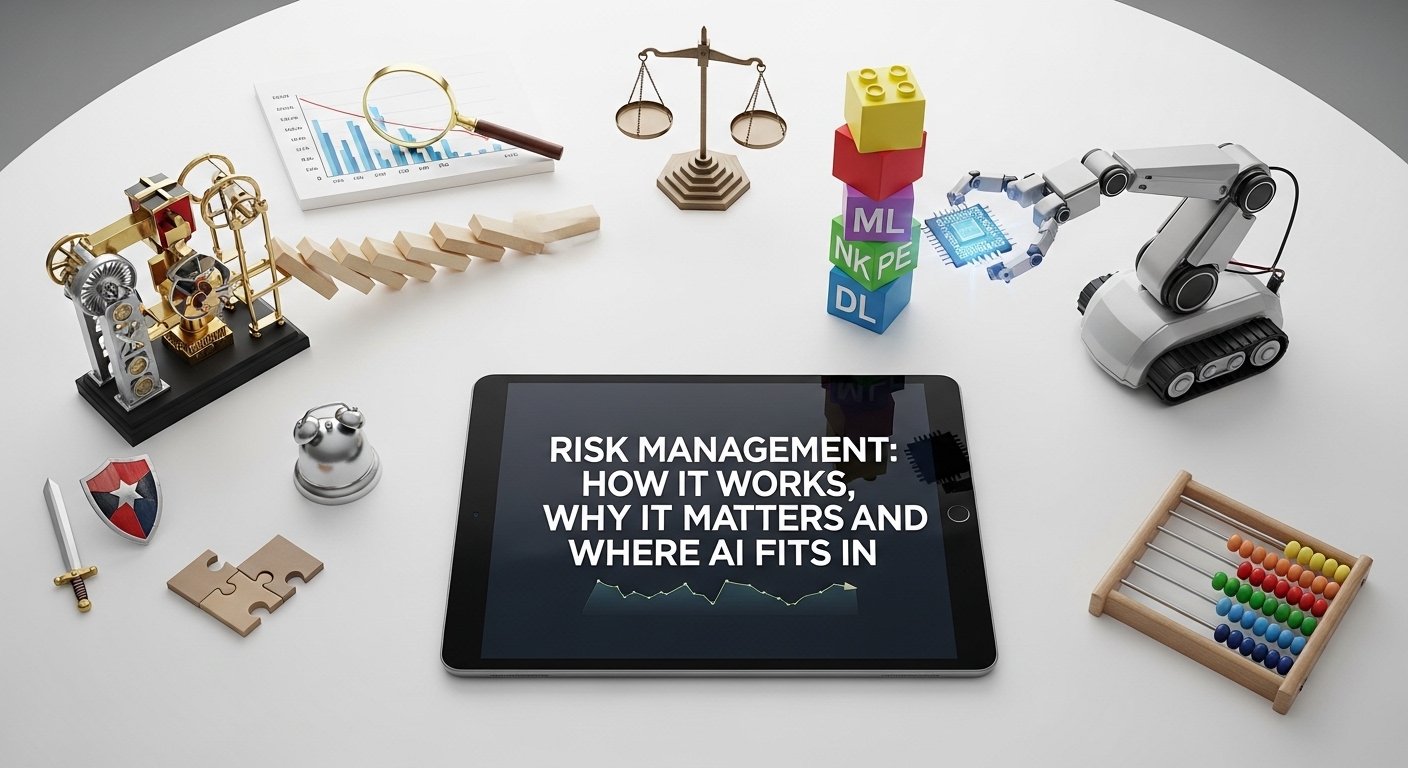

Stuff breaks. Sometimes you see it coming, sometimes it blindsides you on a Tuesday morning before your coffee kicks in. That’s the whole reason risk management exists. Not as some corporate checkbox exercise—but as a way to catch problems while they’re still small enough to handle without losing sleep, money, or both.
What is risk management? It’s how you figure out what could go sideways—whether that’s a project, a system, a business decision, or the whole company—and then decide what to do about it before it actually happens.
Is it worth it? I mean, yeah. It keeps costs from ballooning, stops small problems from becoming company-wide fires, and helps people think straight when pressure hits instead of just reacting.
How does it work? You look for things that could go wrong. You figure out how bad each one would actually be. You pick a response. You put a name next to it. And then you keep checking back, because risks don’t sit still.
The Risk Management Process
Here’s the thing nobody says out loud—this process isn’t meant to live in a binder that only gets opened during annual reviews. It’s supposed to be practical. Like, actually useful on a Wednesday afternoon when something weird happens.
A company starts by asking one uncomfortable question: what could hurt us? And that list gets long fast. Data breaches. Supply chain hiccups. A cyberattack nobody planned for. A bad hire. A vendor going under. Legal exposure nobody flagged. Or just a plain old human mistake—someone clicking the wrong button, sending the wrong file, skipping a step because they were rushing.
Then you study each one. Not in some abstract way. How likely is this, really? And if it does happen, what’s the actual damage? Is it a bruise or a broken leg?
After that, you decide. Some risks you shrink—better security, redundant suppliers, tighter processes. Some you hand off through insurance or contract terms. Some are so minor you just shrug and accept them.
The point isn’t pretending your business is bulletproof. It’s knowing exactly where the cracks are, how fast water could get through, and whose job it is to grab the bucket.
Risk Management Plan
All that thinking I just described? It’s worthless without structure around it.
I’ve watched teams where one manager treats every small hiccup like a five-alarm emergency while the person across the hall ignores warning signs that would make an auditor faint. Without a plan, that’s what you get—inconsistency. And inconsistency in risk management is basically just gambling with extra steps.
A proper plan spells things out. How do we spot risks? Who writes them down? What’s the scoring criteria? At what point does leadership need to hear about it? What kind of response matches what severity level?
And timing. Not wishy-washy “we’ll review quarterly” timing. Actual dates on actual calendars with actual people attached to them.
This is where most organizations quietly fail, by the way. They build a gorgeous plan. Formatting looks great. Charts and color codes, the works. Then it gets saved to a shared drive and nobody opens it again until something goes wrong.A plan that works shows up in places that matter—project kickoffs, vendor evaluations, software rollouts, hiring discussions, incident debriefs. If it only exists in a document, it’s decoration. Expensive, time-consuming decoration.
| Element | What it does | Why it matters |
| Risk identification | Lists possible threats | Helps teams see weak spots early |
| Risk assessment | Measures likelihood and impact | Makes priorities clearer |
| Risk response | Defines actions to reduce or handle risk | Prevents confusion during pressure |
| Ownership | Assigns responsibility | Stops risks from being ignored |
| Monitoring | Tracks changes over time | Keeps the plan useful |
Risk Management Frameworks
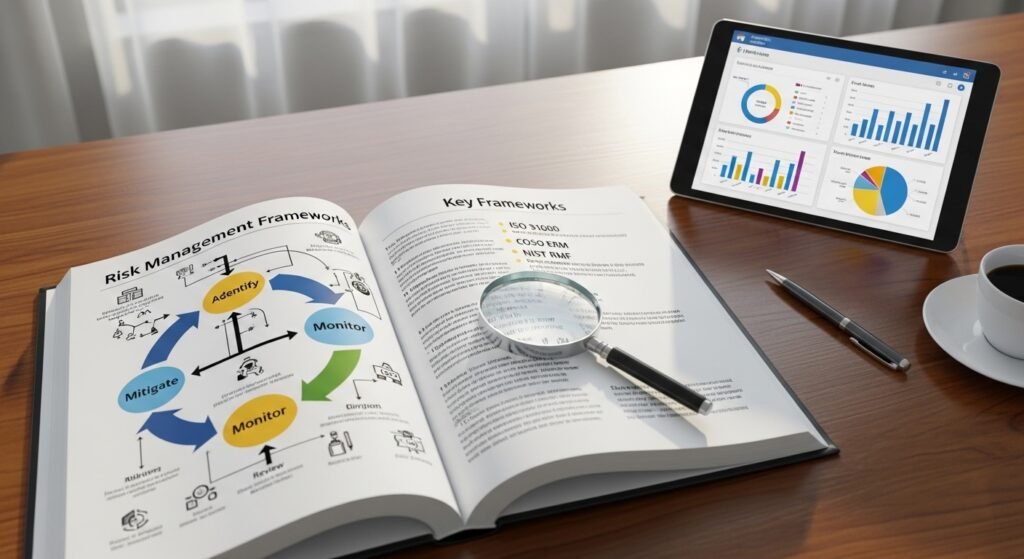
People throw around “risk management framework” a lot, and I get why it sounds like corporate jargon. But the actual idea behind it is pretty simple—stop making it up as you go.
A framework gives everyone the same playbook. Instead of one department handling risk one way and another department doing something completely different, you’ve got a shared structure. Here’s how we think about this. Here’s the language we use. Here’s how we compare one risk to another without it turning into an argument about whose problem is worse.
Most frameworks cover the same ground: governance at the top, identification somewhere in the middle, scoring criteria that everyone agrees on, controls that actually get enforced, reporting that reaches the right people, and reviews that happen on a schedule instead of whenever someone remembers.
It sounds dry. I won’t pretend otherwise. But it’s the kind of boring that prevents very expensive surprises.
Some companies build their own internal version. Others lean on formal standards like ISO 31000 or COSO. The right call depends on how big you are, what industry you’re in, and how tangled your operations get. A twelve-person startup doesn’t need what a multinational bank needs. But both of them need something they can repeat without reinventing it every time.
Risk Management Framework in Real Business Settings
A framework sitting in a policy folder isn’t a framework. It’s a PDF.
It becomes real when it shows up in actual work. Picture a software company about to launch a new platform. The product team is stressed about shipping on time. Security is worried about holes in the code. Legal is sweating over privacy compliance. Customer support is bracing for the chaos that always follows a launch.
Every single one of those worries is valid. But without a framework, they all get treated as separate fires. Nobody knows which one to grab the extinguisher for first.
A working framework pulls those concerns into the same room—literally or figuratively—and forces a conversation about what actually matters most right now. Not in theory. Right now, with this launch, at this stage, for these customers.
Same thing applies to a retail brand expanding into a new market. Or a hospital adopting a new digital tool. Or a logistics company that just realized eighty percent of its shipments depend on one supplier who’s been acting weird lately.
The framework doesn’t make uncertainty disappear. That’s not what it’s for. What it does is shrink the blind spots. It makes people ask the awkward questions earlier—the kind everyone’s thinking but nobody wants to say out loud. And sometimes that one uncomfortable question is the thing that saves a quarter. Or a reputation. Or a relationship with your biggest client.
AI Risks in Modern Organizations
This one’s getting harder to wave away because AI isn’t experimental anymore. It’s making real calls—or at least heavily shaping them.
Hiring filters deciding who gets an interview. Chatbots talking to your customers without a human in the loop. Fraud detection flagging (or missing) transactions. Recommendation engines nudging what people see and buy. Internal copilots drafting emails, summarizing documents, writing code.
These aren’t pilot projects tucked in a corner somewhere. They touch customers. Employees. Revenue. Trust.
And the tricky part—the part that separates AI risk from the old-school risks people are used to—is speed. A traditional process failure might take weeks to cause real damage. A broken AI system can scale its mistakes across thousands of interactions before anyone realizes something’s off.
Biased outputs reaching real users. Hallucinated answers stated with absolute confidence. Personal data leaking into places it shouldn’t be. Decisions nobody can trace back to a clear logic. Weak oversight because the team assumed the model “knows what it’s doing.”
I’ve seen teams deploy an AI feature to save twenty hours a week, then spend four months cleaning up errors because nobody stress-tested edge cases before going live. And that’s not a rare horror story. It’s a Tuesday for a lot of companies right now.
AI is useful. Nobody’s arguing that. But a tool that moves fast can amplify sloppy controls just as quickly as it amplifies productivity.
AI Risk Management Practices That Actually Help
When the conversation turns to managing AI risk, there’s this tendency to jump straight into governance language and policy frameworks and skip right past the stuff that actually prevents problems.
The basics are where protection actually lives. And the basics aren’t glamorous.
First—what data is the model trained on, and should it even have access to that data? That question alone catches more issues than most people expect.
Then there’s human review. Not token review where someone rubber-stamps outputs. Actual review, especially when the stakes are high. Finance. Healthcare. Insurance. Education. Employment decisions. These are areas where a confident-sounding wrong answer can ruin someone’s day, career, or health.
Documentation matters too. Not because anyone enjoys writing it. Because six months from now, when something breaks and your team needs to trace what happened, unclear systems turn into unsolvable puzzles. You want a paper trail not for bureaucracy’s sake—for sanity’s sake.
Testing helps more than people think. Throw bad inputs at the model. Feed it unusual scenarios. Try to misuse it on purpose. If your team can break it in a sandbox, your customers will definitely break it in production.
And escalation paths. This is the big one nobody builds until it’s too late. If an AI tool starts spitting out harmful, misleading, or just plain wrong outputs—who pulls the plug? Who investigates? Who tells the users? If those answers don’t exist before launch, you’re not managing AI risk. You’re just crossing your fingers and hoping the software behaves.
Common Mistakes That Weaken Control
The number one mistake? Treating every risk like it weighs the same. It doesn’t. A two-day delay on an internal report is not the same creature as a data breach exposing customer records. But I’ve sat in rooms where both got the same yellow dot on a risk matrix and the same shrug.
Second mistake—assuming risk management belongs to the compliance department and nobody else. Operations creates risk. Engineering creates risk. HR creates risk. Finance, procurement, leadership decisions—all of it shapes what the company is exposed to. Compliance can’t babysit everyone.
Then there’s the spreadsheet trap. Teams build these elaborate scoring sheets—likelihood times impact, color-coded cells, weighted averages—and never actually talk about context. A risk scored “medium” on paper can absolutely destroy you if it hits during a product launch, or right after a PR crisis, or when your biggest client is already unhappy.
And the classic. The one I see everywhere. Risks get identified, discussed, scored, assigned pretty colors, maybe even presented in a meeting. Then they get filed away. Nobody checks again. Nobody updates anything. Six months later, the exact same risk shows up again—except now it’s more expensive, more urgent, and everyone’s acting surprised even though it was literally written on a slide deck they all sat through.
Not dramatic. Not catastrophic. Just wasteful. And painfully common.
Comparing Traditional Business Risks and AI-Driven Risks
Traditional risks come from places businesses already have muscle memory for. Financial exposure, supply chain breakdowns, compliance violations, workplace safety incidents, vendors failing to deliver, servers going down. These aren’t fun, but most organizations have at least some playbook for them.
AI-driven risks overlap with all of those areas but layer on a kind of messiness that traditional frameworks weren’t designed to handle. The problems are harder to explain to non-technical stakeholders. They’re harder to monitor because the system’s decision logic isn’t always visible. And ownership gets genuinely confusing.
If a third-party model produces harmful output, whose fault is that? The vendor who built it? Your team who deployed it? Both? If biased training data leads to biased decisions that affect real customers—where exactly in the chain did the failure start? Was it a data problem, a design problem, an oversight problem, or all three?
These questions aren’t hypothetical anymore. They come up in real post-mortems, in real boardrooms, in real regulatory conversations.
So the comparison isn’t really “old risks versus new risks.” It’s familiar, predictable risks versus fast-moving, technically tangled risks that don’t always announce themselves clearly. That distinction shapes how you govern, how you monitor, and how quickly you need to respond.
FAQs
What are the five steps in the risk management process? Most approaches break it into identification, assessment, prioritization, response, and monitoring. Different organizations use different labels for those stages, but the underlying logic stays pretty consistent.
Why is a risk management plan important? Because without one, people improvise. And improvised risk management means one person escalates everything while another person ignores obvious red flags. A plan creates shared expectations so the response is consistent, not personality-dependent.
What is the difference between a framework and a plan? A framework is the overarching system—the rules, the structure, the philosophy. A plan is the specific document or approach you apply to a particular project, department, or business function within that larger structure.
What are common AI risks for businesses? Biased outputs, privacy violations, confidently wrong answers, weak accountability chains, security gaps in model infrastructure, poor governance around training data, and teams leaning on automated decisions without enough human judgment in the mix.
Who owns risk in an organization? Everyone contributes to it, whether they realize it or not. But ownership should be explicit. Leadership sets the tone and expectations, managers handle exposure within their teams, and specialists support analysis, controls, and reporting.
You don’t need a flawless system on day one. Almost nobody has one. What you need is something your team will actually use, something honest enough to reflect what’s really happening, and something you revisit often enough that it still matches reality. That’s usually where the real improvement kicks in—not in the policy document, but in the habit of paying attention.