


Moving to Australia on a work or skilled visa seldom happens as if it were a decision made only for oneself. In the majority of cases, it is about the partners. Children. And at times parents. Real lives that do not fit into neat boxes of the application forms. And that is why dependent entry approval becomes such a highly important yet quietly overlooked part of the process.
It is not just about formalities. It is about allowing your family to grow a life with yours. And it influences everything from housing to schools to future plans.
Dependent entry approval permits the family members of a primary visa holder to enter and stay in Australia under the same visa conditions. It covers partners and children who are associated with skilled, student, and permanent visas. Whether approval is granted depends on the evidence of the relationship, financial capacity, and meeting the Department of Home Affairs requirements, hence great preparation is a must for a hassle-free process.
Quick FAQ
What is dependent entry approval?
It is the government granting permission to eligible family members to join a primary visa holder in Australia.
Is adding dependents worth it?
In most cases, families do. It makes legal status and long-term settlement easier.
How does the process work?
Dependents are usually assessed together with or after the main applicant through the Department of Home Affairs.
How Dependent Entry Works Under Australian Immigration
The primary visa decides everything. Skilled migration. Employer sponsorship. Student pathways. Each of them has different rules but the core idea is the same. Whether someone applies through student visa Australia pathways or skilled migration programs, the Australian Department of Home Affairs attaches the files of dependents to the main applicant’s. They check relationships, financial support, and the ability of the parties to settle.
So, a person going for an employer-sponsored stream has the option to bring their spouse and/or children. Home Affairs Australia evaluates both the main nomination and dependent documentation at the same time.If dependents are filing the visa application subsequently, the department will re-evaluate the circumstances. That is the reason why timing plays a big part in this case.
Role of the Department of Home Affairs in Family Visas
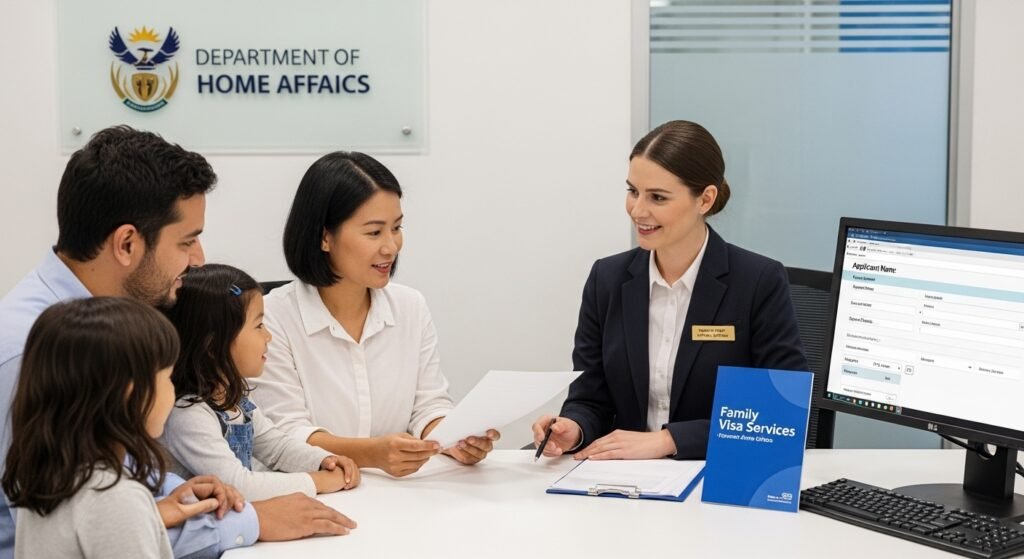
The Department of Home Affairs is the institution that decides all visa issues. The migration agents. The employers. The universities are not involved.
No one gets a dependent visa without going through the department’s system. The officers go through the personal identification papers, the past of the relationship, and the financial documents. They are also looking for unexplained gaps which could be different addresses, inconsistent dates, or absences that have not been accounted for. In today’s environment, where data breaches and online security risks are becoming more common, staying informed about issues like Gmail passwords data breaches can also be important when managing sensitive personal information. Knowing the department’s perspective can be very helpful if you want to avoid troubles.
Relationship Evidence: The Core of Approval
Most of the time, this is the part that people don’t realize how important it is.
Marriage certificates are helpful. However, they are just one piece of the puzzle. The officers try to make sure the couples truly share their lives together:
-
joint bank accounts
-
lease agreements
-
photos
-
travel records
-
communication history
De facto couples need to provide more evidence than married couples. Two years is a standard period but it is not compulsory at all times.Baby applications also need to have birth certificates, custody papers if necessary, and consent in the cases where it is needed.There are no shortcuts to that.
COE and Dependants for Student Visa Holders
Students sometimes ask how a COE impacts their family applications.
A Confirmation of Enrolment proves that the person is a student. It does not automatically mean that the dependents will be given rights. However, one cannot apply for dependents without it.Some educational institutions do not allow dependents’ sponsorship for very specific courses, while others do it without any conditions.Students should take into consideration whether they will realistically be able to meet the needs of their dependents once they start their course based on its structure.
Dependent Entry Approval in Skilled and Employer-Sponsored Visas
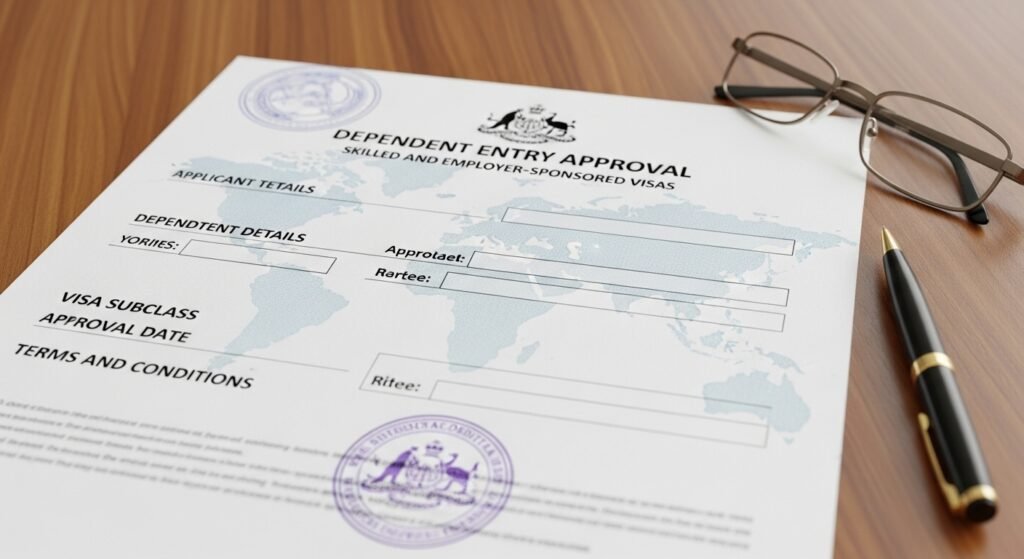
Dependents are quite usual for skilled migrants and sponsored workers.
At least, permanency is the major pathway supported by these professionals, for example, the 186 direct entry visa.The australia 186 visa direct entry requirements are a proof of continued employment, skills assessment, and employer nomination. The dependents are evaluated in that very context.When the visa is granted, the dependents have the same rights.That is important for their security.
186 Direct Entry Visa and Family Commitments
A 186 direct entry visa comes with a two-year work commitment to the employer. This is not always enforced by the law, but it is a strong expectation.That 186 visa 2 years commitment also impacts the dependents as well. It influences their location of residence, housing, schooling, and mobility.Families should critically think about this.
Benefits of Including Dependents Early
If dependents are included right at the outset, many potential complications are avoided.
They all get their visas at the same time. Everyone’s access to healthcare is coordinated. Getting in schools is less of a problem. Making plans for the future is a lot easier.In addition, it deters a separate application later on, which may attract greater scrutiny.Relocating alone is typically much harder emotionally than people suppose.
Real Examples from Migrant Families
Imagine a nurse in the Philippines who is sponsored through a regional visa and hence able to bring her husband and two children along from day one. Their documents are all aligned and so the approval process is essentially a walk in the park.
In another instance, an applicant postpones adding their spouse for two years. When they apply afterwards, the officers start wondering about the reason for the delay and more proof is required. Consequently, the processing becomes longer.They say it over and over again: the timing affects the impression that is being given.
Common Mistakes in Dependent Applications
One of the prominent errors is the poor quality of the documents. You have to provide enough to prove your case; don’t just submit the bare minimum and hope that it will be enough.
Another common fault is contradictory stories. The relationship facts are presented quite differently in different forms.Some people neglect to inform the Department of Home Affairs of changes in their family situation: these kinds of changes are births, marriages, and separations. Subsequently, a whole lot of problems can arise.And investment in money is yet another type of negligence. Having dependents means incurring more expenses. The officers know this because of the disparity between the funds and the reality.
Australia Visa Categories and Dependent Rules
Comparing Australia with Other Immigration Systems
- In comparison to Canada, Australia carries out more thorough scrutiny of the relationship.
- When put side by side with the UK, the documentation criteria are more comprehensive.
- Compared with the US, Australia’s dependents’ processing is more consistent in terms of predictability.
- There are pros and cons for every immigration system. Australia gives the priority to written evidence over live conversations.
Processing Times and Practical Expectations
The time taken to process dependent visas significantly differs.
If the application is made onshore it is likely to be processed faster than if it were made offshore. In the latter case, it could take up to several months. Additional checks such as background, medical, and document verification are often part of the process.Here is a broad stroke of the situation:
| Application Type | Typical Range |
|---|---|
| Onshore dependents | 3–6 months |
| Offshore dependents | 6–12 months |
| Complex cases | 12+ months |
Delays are normal. Silence does not mean rejection.
Financial Responsibility and Sponsorship
The main applicants have to prove that they have sufficient means to maintain their dependents.These proofs include pay slips, tax returns, savings, and employment contracts.If it is a sponsored visa, the credibility of the main applicant is indirectly influenced by the employer.A weak financial standing increases the likelihood of being scrutinized.
Emotional and Practical Realities
Filling out the forms is just half of it.Besides, families are faced with school changing anxiety, language barrier issues, career interruption for partners, and social solitude.A migration brochure hardly ever tells people that.However, it really does.So much indeed.
Dependent Entry Approval in Long-Term Settlement

Approval for dependent entry results in the family unit becoming a part of permanent residency pathways.Being able to spend more time together in Australia strengthens future applications, supports citizenship eligibility, and builds continuousness.Having fragmented family histories will complicate things later.
That is why the earlier you plan, the better.
When Applications Get Refused
Visas are refused. Mostly it happens due to insufficient evidence, lack of credibility, or incomplete disclosures.
There are appeal procedures. But they are both stressful and expensive.
It is far easier to stop an error from happening than to get it fixed later.
Working Rights for Dependents
In general, dependents have the right to work. The stipulations differ from one visa class to another.Partners of permanent residents have unrestricted rights. Student dependents face some limitations. Dependents of sponsored visa holders generally have the freedom to work.Knowing the conditions helps you to stay on the right side of the law.
Full FAQ Section
Who qualifies as a dependent in Australia?
A spouse, a de facto partner, and dependent children.
Can I add dependents after my visa is granted?
Yes, but you will undergo a further assessment.
Do dependents need to take English tests?
Usually not, but there are exceptions.
Is medical examination necessary?
Yes, for the majority of the applicants.
Can dependent children go to a public school?
Yes, although in some states there may be fees.
What if my relationship comes to an end?
It could have an impact on your visa status. Getting legal advice would be a good idea.
Does dependent entry influence PR eligibility?
In fact, it often helps to strengthen prospects for long-term settlement.
Most people don’t engage in the thought of this process until they have got deep into it. Forms get opened. Time limits are closing in. Documents are tossed in different folders.
Then it becomes something solid.
Not theoretical. Not abstract.
Simply… practical. Decisions. Evidence. Waiting. Planning again.
And somehow amidst all that, families slowly figure it out.
One piece of paper.
One approval.
One tiny step at a time.

