



Usually, people don’t start their day planning to learn about artificial intelligence. Opening their laptop may be the only thing they do with AI in mind. They look up something on the internet, write an email, ask a virtual assistant for help. And suddenly, AI is involved in their day.Data from search engines shows that DeepSeek vs ChatGPT discussion is rising.
The beginning of such debates is not in research labs or at tech conferences. Instead, it’s in moments so small and mundane that, when someone asks, “Which one should I actually use?” and realizes that the answer is not so straightforward, the question becomes real.
DeepSeek vs ChatGPT pits two advanced AI language models against each other, both of which are able to help with writing, research, coding, and other day-to-day activities. ChatGPT is more of a conversational intelligence model with high versatility, while DeepSeek was made to stress its technical reasoning and data-driven performance. As part of the broader shift toward AI and automation, the decision between the two often hinges on your work style, what you produce, and how much structure you want from an AI helper.
What is DeepSeek?
DeepSeek is an AI engine for reasoning, coding, and problem-solving in the technical field.
Is ChatGPT better than DeepSeek?
It depends on your needs. If you want a conversation, ChatGPT will help more. If you like to analyze, DeepSeek is better for you.
How do these tools work?
Both are large language models trained with vast datasets to produce human-like responses.
Understanding the Rise of AI Assistants
AI assistants have not come out of nowhere. They started as early-generation chatbots, then became search assistants, followed by writing aids, and finally evolved into collaborators.People use them for writing emails, homework, business planning, programming, creative writing, and even therapy-style conversations.Rapid adoption created rivalry. Numerous platforms emerged, each claiming better accuracy, faster response times, and smarter reasoning.Among them, DeepSeek and ChatGPT became the most popular.
How ChatGPT Works Behind the Scenes
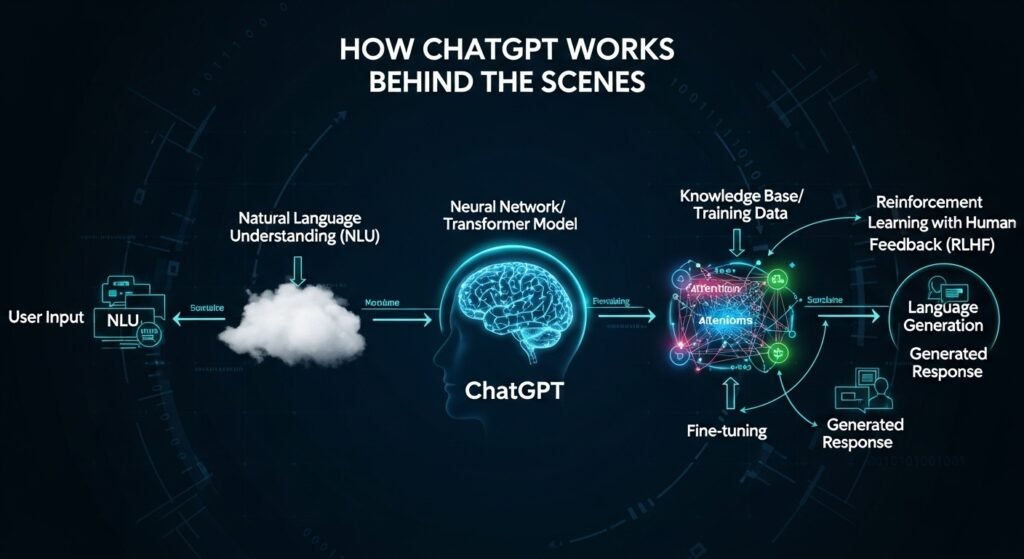
ChatGPT leverages large-scale language models created by OpenAI. It gains knowledge from immense datasets that include books, articles, conversations, and code.It does not “know” facts. Instead, it predicts the next best word based on context.Alongside tone, emotion, logic, and structure, the system learns conversational patterns. Over time, this enables remarkably natural dialogue.ChatGPT prioritizes fluid conversation. It feels like talking to someone who listens.
How DeepSeek AI Works Differently
DeepSeek focuses heavily on logical reasoning, mathematical accuracy, and highly structured outputs designed for technical precision. Its architecture prioritizes problem-solving efficiency, making it especially valuable for users working in programming, engineering, and data analysis. Many users describe its responses as direct, concise, and practical, with little unnecessary conversation. Unlike more conversational AI models, DeepSeek minimizes expressive language in favor of clarity and logic. This approach makes it highly dependable for professional and analytical tasks. Its design philosophy consistently reflects a commitment to accuracy and performance.
ChatGPT vs DeepSeek: Core Philosophies
The biggest difference between ChatGPT and DeepSeek lies in their underlying mindset and purpose. ChatGPT is designed as a multifunctional assistant capable of writing, brainstorming, teaching, explaining, and even providing emotional support. It adapts its tone easily and aims to create a natural conversational experience. In contrast, DeepSeek emphasizes precision, optimization, and technical clarity above all else. It behaves more like a research assistant than a conversational partner. Both models are effective, but they serve different user expectations and working styles.
Writing and Content Creation Performance
When it comes to writing and creative content, ChatGPT generally performs more effectively than DeepSeek. It understands storytelling, emotional tone, character development, and narrative flow, making it popular among bloggers, students, and marketers. Users can instruct ChatGPT to sound more human, casual, or professional, and it adapts accordingly—especially when working alongside strong messaging security systems that help protect sensitive communications in digital workflows.
DeepSeek, on the other hand, produces structured and fact-focused content that works well for reports and technical documents. However, it lacks creativity and expressive depth. For most creative tasks, ChatGPT remains the preferred option.
Coding and Technical Use Cases
DeepSeek demonstrates strong performance in coding and technical problem-solving scenarios. Developers frequently rely on it for debugging, algorithm explanation, and code optimization. Its responses are typically logical, systematic, and focused on efficiency. While ChatGPT is also capable of assisting with programming tasks, it sometimes prioritizes readability and simplicity over performance. This can be helpful for beginners but less ideal for advanced developers. For professionals seeking precision and speed, DeepSeek functions like a specialized technical tool. It is especially useful in complex engineering environments.
Learning and Education Support
Both ChatGPT and DeepSeek support learning, but they do so in different ways. ChatGPT excels at adapting explanations to various learning levels, ranging from simple beginner concepts to advanced academic discussions. Students can request customized explanations and practice questions. DeepSeek provides thorough and accurate explanations but often uses more formal and technical language. This may be helpful for advanced learners but challenging for beginners. As a result, new learners tend to find ChatGPT more approachable. DeepSeek is better suited for structured academic or technical study.
Is DeepSeek Better Than ChatGPT?
There is no single winner.
DeepSeek excels at:
-
Technical research
-
Programming
-
Mathematical reasoning
-
Structured outputs
ChatGPT shines at:
-
Writing
-
Conversation
-
Learning
-
Creativity
-
Business content
Your workflow decides.
DeepSeek vs ChatGPT Reddit Discussions
Discussions about DeepSeek and ChatGPT are widespread on Reddit and other online forums. Many DeepSeek users praise its productivity benefits and technical reliability. However, critics often describe it as cold, rigid, or lacking personality. ChatGPT users appreciate its conversational tone and versatility but sometimes question its technical depth. A growing number of users report using both platforms together. Typically, ChatGPT handles brainstorming and planning, while DeepSeek manages execution. This combined approach is becoming increasingly common among professionals.
DeepSeek ChatGPT in Professional Workflows
In professional environments, AI tools rarely replace human expertise and instead function as supportive assistants. Writers often use ChatGPT for drafting content, while editors refine and finalize it. Developers rely on DeepSeek for planning and technical guidance but still conduct testing manually. Managers use ChatGPT to prepare presentations and meetings, while DeepSeek assists with data analysis. This division of tasks increases efficiency and accuracy. When used together, both tools enhance productivity without reducing human oversight. Their complementary roles strengthen modern workflows.
User Interface and Accessibility
ChatGPT offers a clean, intuitive, and beginner-friendly interface that allows users to start quickly with minimal learning. Its conversational layout feels familiar and welcoming, even for first-time users. DeepSeek, in comparison, provides a more functional and minimal interface focused on utility rather than design. While it lacks visual polish, it delivers efficient access to technical features. Users who value aesthetics and ease of use generally prefer ChatGPT. Those who prioritize performance and simplicity often choose DeepSeek. Interface preference depends largely on personal workflow.
Pricing and Availability Models
Both ChatGPT and DeepSeek offer free and paid subscription models to meet different user needs. ChatGPT’s premium plans provide access to advanced models, faster responses, and additional features. These plans are popular among individuals and small businesses. DeepSeek, meanwhile, focuses more on enterprise-level pricing and API-based services. Its structure appeals to companies that require large-scale automation and analytics. Casual users typically favor ChatGPT’s flexible subscriptions. Organizations often prefer DeepSeek for long-term technical integration.
Data Privacy and Security Considerations
Data privacy and security are major concerns for users of both platforms. ChatGPT provides clear documentation regarding data usage, storage, and user controls. It emphasizes transparency and accessibility in its policies. DeepSeek places greater focus on enterprise compliance and regulatory standards. This makes it attractive to organizations handling sensitive information. Users dealing with confidential data should carefully review both platforms’ terms of service. AI systems process and store information, making responsible usage essential. Informed decision-making helps protect personal and professional data.
Common Mistakes Users Make
-
Expecting perfection
-
Copying without verification
-
Relying on only one tool
Smart users treat AI as support, not replacement.
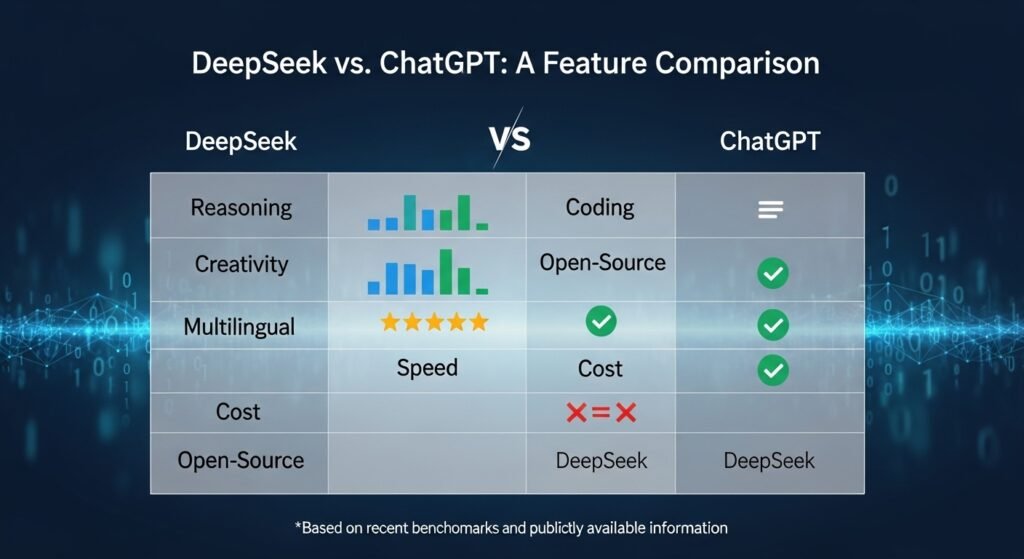
Comparison Table: DeepSeek AI vs ChatGPT
| Feature | ChatGPT | DeepSeek |
|---|---|---|
| Conversation | Excellent | Moderate |
| Coding | Good | Strong |
| Creativity | High | Low |
| Learning | Strong | Moderate |
| Interface | Friendly | Functional |
| Technical Focus | Medium | High |
DeepSeek AI vs ChatGPT for Businesses
Key factors:
-
Reliability
-
Scalability
-
Cost
ChatGPT suits marketing, HR, support.
DeepSeek suits analytics and engineering.
Most companies use both.
Long-Term AI Development Trends
AI is evolving rapidly:
-
Larger context windows
-
Better memory
-
Multimodal features
Differences may narrow.
Competition benefits users.
Ethical and Social Considerations
Artificial intelligence has a growing influence on how people think, learn, and solve problems. While AI tools improve efficiency and access to information, excessive dependence can weaken critical thinking and independent reasoning skills. When users rely too heavily on automated responses, they may stop questioning accuracy or developing their own ideas. Both DeepSeek and ChatGPT raise important ethical questions related to authorship, originality, and accountability. Despite technological advancements, moral responsibility remains with human users. Ethical use requires awareness, balance, and continuous evaluation.
Choosing the Right Tool for Your Needs
Ask yourself:
- Do I write more than code? → ChatGPT
Do I analyze more than create? → DeepSeek
Do I want flexibility? → ChatGPT
Do I want precision? → DeepSeek
No tool is perfect.
Future Outlook: Collaboration Over Competition
Instead of “versus,” the future looks like “and.”
People will use multiple AI systems for different tasks.
Toolkits will expand.
Specialization will grow.
Full FAQ Section
Is DeepSeek free to use?
Some features are free. Advanced options may require payment.
Can ChatGPT replace programmers?
No. It supports humans, not replaces them.
Which is better for students?
ChatGPT is generally easier.
Is DeepSeek more accurate?
Yes, in technical contexts.
Can I use both together?
Yes. Many professionals already do.
Final Thoughts
Most people will not commit exclusively to a single AI platform over time. Different tasks require different approaches, and user needs change from day to day. Some situations call for conversation, creativity, and emotional understanding, while others demand calculation and precision. AI is no longer about choosing sides between competing platforms. It is about selecting the right tools for specific purposes. With thoughtful use and ongoing learning, users can develop stronger skills and achieve better results through AI collaboration.