



Artificial intelligence tools are getting smarter, but the quality of their output still depends heavily on one thing: the prompt you give them.
That is exactly why prompt generators are becoming more popular among writers, marketers, students, developers, business owners and content creators. Instead of wasting time figuring out how to ask an AI tool the “right way,” a prompt generator helps structure your request so the AI understands your intent more clearly.
Whether you use ChatGPT, Writeless AI, Claude, DeepSeek or another AI platform, better prompts usually lead to better results.
This guide explains what a prompt generator is, how prompt engineering works, the best use cases, mistakes to avoid and how these tools are changing AI content creation.
What Is a Prompt Generator?
A prompt generator is a tool that helps users create more effective prompts for artificial intelligence systems.
Instead of typing vague requests into an AI chatbot, prompt generators improve clarity, structure and detail so the AI can respond more accurately.
These tools are commonly used for:
- Blog writing
- SEO content
- Storytelling
- Coding help
- Marketing campaigns
- Academic writing
- Social media content
- Product descriptions
- AI image generation
- Business workflows
In simple terms, a prompt generator acts like an assistant that helps you communicate better with AI.
Also read: What Is Artificial Intelligence?
Are Prompt Generators Worth Using?
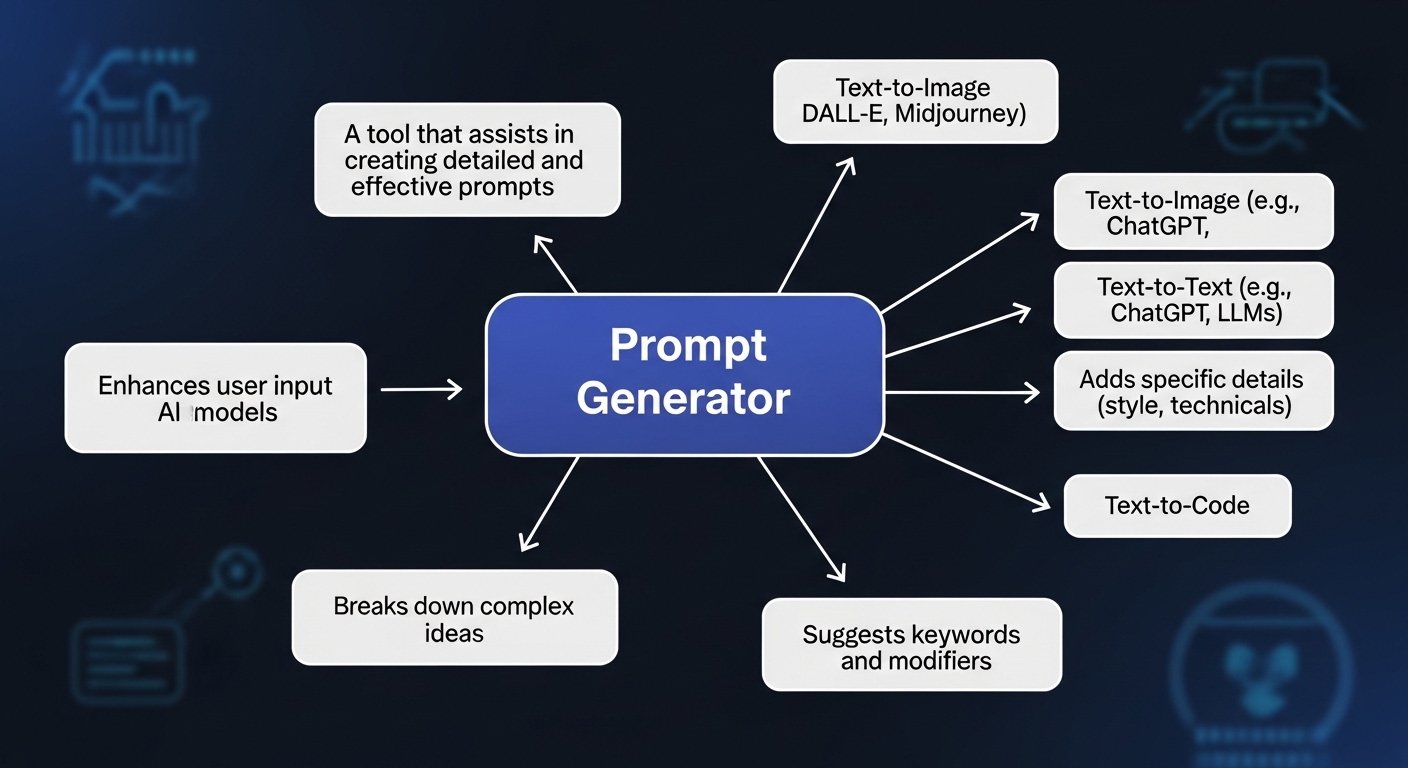
Yes, especially if you use AI regularly for content creation, automation or productivity.
Many people assume AI tools automatically produce excellent results. In reality, AI systems depend heavily on the quality of the instructions they receive.
A weak prompt often creates:
- Generic answers
- Repetitive content
- Incorrect context
- Poor structure
- Weak SEO writing
- Unclear outputs
A strong prompt improves:
- Accuracy
- Creativity
- Structure
- Relevance
- SEO performance
- Workflow speed
Prompt generators reduce the trial-and-error process and help users get stronger outputs faster.
How Does a Prompt Generator Work?
Most prompt generators follow a simple process.
Step 1: User Input
You enter a keyword, idea, question or goal.
For example:
- “Write a product description”
- “Generate blog ideas about AI”
- “Create a fantasy story”
- “Improve SEO content”
Step 2: AI Processing
The prompt generator analyses your request and expands it using AI logic, templates or prompt engineering frameworks.
Step 3: Optimized Prompt Output
The system generates a clearer, more detailed prompt designed to produce stronger AI responses.
For example:
Instead of:
“Write about AI”
A prompt generator may create:
“Write a 1,200-word SEO-optimized article comparing the best AI tools for content creators in Australia, including pricing, ease of use, productivity benefits and limitations.”
That extra structure gives AI significantly more direction.
What Is Prompt Engineering?
Prompt engineering is the process of designing prompts strategically so AI systems produce better responses.
A prompt generator helps automate parts of this process, but prompt engineering goes deeper.
It focuses on:
- Context
- Clarity
- Tone
- Structure
- Constraints
- Output formatting
- Examples
- Specificity
Prompt engineering matters because AI does not “understand” requests the way humans do. It predicts patterns based on wording and context.
The better your instructions, the better the output.
Also read: Prompt Engineering
Why Prompt Engineering Matters
A vague prompt often creates vague AI output.
For example:
Weak Prompt
“Write about AI tools.”
The AI may respond with generic information.
Better Prompt
“Write a beginner-friendly 1,000-word article comparing the best AI tools for Australian small businesses in 2026, including pricing, productivity benefits and ease of use.”
The second prompt gives:
- Audience context
- Word count
- Geographic targeting
- Comparison structure
- Specific goals
That usually produces much stronger results.
Best Prompt Generator Use Cases
Prompt generators are useful across many industries and content types.
| Use Case | Example |
| SEO blogging | Blog outlines, keyword prompts |
| Social media | Caption ideas, hook generation |
| Storytelling | Character ideas, plot prompts |
| Marketing | Ad copy, email campaigns |
| Coding | Debugging and code explanations |
| Education | Essay prompts, study questions |
| Business | Reports, workflows, AI automation |
| AI image tools | Midjourney or DALL·E prompts |
| Customer support | AI chatbot workflows |
Writeless AI and Prompt Generation
Writeless AI is one of the AI content tools often associated with prompt generation and AI-assisted writing.
It helps users:
- Generate blog ideas
- Improve prompts
- Create SEO content
- Structure articles
- Speed up writing workflows
What makes Writeless AI useful is not only content generation but also its ability to refine user input into stronger AI-ready instructions.
For example, if someone enters a simple request, Writeless AI may restructure it into a more detailed prompt that improves the final output quality.
Also read: Writeless AI
ChatGPT Prompt Generator Tools
ChatGPT is powerful, but it performs much better with structured prompts.
A ChatGPT prompt generator helps users:
- Create clearer prompts
- Improve AI writing quality
- Generate better ideas
- Reduce repetitive responses
- Improve workflow speed
ChatGPT prompt generators are commonly used for:
- Blog writing
- AI research
- SEO content
- Email creation
- Storytelling
- Script writing
- Business planning
- Productivity tasks
Also read: Claude vs ChatGPT and DeepSeek vs ChatGPT
Writing Prompt Generator Tools
A writing prompt generator helps users overcome writer’s block and create structured ideas faster.
These tools are useful for:
- Bloggers
- Copywriters
- Students
- Journalists
- Marketers
- Fiction writers
- Screenwriters
Examples include:
- Blog topic prompts
- Story starters
- Essay ideas
- Marketing hooks
- Social media concepts
- Product description prompts
A writing prompt generator is especially useful when creativity slows down or deadlines become overwhelming.
Story Prompt Generator Tools
A story prompt generator focuses more on creative storytelling.
These tools generate:
- Character concepts
- Plot twists
- Fantasy worlds
- Dialogue ideas
- Mystery scenarios
- Romance prompts
- Sci-fi concepts
Writers often use story prompt generators to:
- Start novels
- Build creative momentum
- Break writer’s block
- Explore unexpected ideas
Also read: Creative Writing Prompts
The Evolution of AI Prompt Generators
Prompt generators used to be very simple.
Early versions mostly:
- Added keywords
- Expanded sentences
- Suggested basic wording
Modern AI prompt generators are much more advanced.
Today’s systems can:
- Adapt prompts for specific AI models
- Create SEO-ready instructions
- Generate tone variations
- Build structured workflows
- Suggest formatting
- Add context automatically
- Understand user goals better
Some AI prompt tools now specialize in:
- Midjourney prompts
- SEO content prompts
- Business automation prompts
- AI coding prompts
- Video generation prompts
- Academic writing prompts
This evolution is making AI workflows faster and more accessible for everyday users.
Common Mistakes People Make with Prompt Generators
1. Being Too Vague
Weak prompts create weak results.
Example:
“Write a story.”
Better:
“Write a suspenseful short story set in Melbourne involving a missing journalist and AI surveillance technology.”
2. Overloading the Prompt
Too much information can confuse AI systems.
Keep prompts detailed but organized.
3. Ignoring Output Refinement
Even strong prompts still require editing.
AI-generated content should be reviewed for:
- Accuracy
- Tone
- SEO
- Readability
- Human flow
4. Expecting Perfect Results Instantly
Prompt engineering often involves testing and refining.
Small wording changes can dramatically improve output quality.
5. Copying Generic Prompts
Using overused internet prompts may create repetitive AI content that lacks originality.
Custom prompts usually perform better.
Best Prompt Generator Features to Look For
If you are choosing a prompt generator tool, look for:
| Feature | Why It Matters |
| AI-assisted suggestions | Improves output quality |
| SEO optimization | Helps content rank better |
| Tone customization | Useful for branding |
| Workflow templates | Saves time |
| Prompt history | Helps refine prompts |
| Multi-platform support | Useful for ChatGPT, Claude, Midjourney etc. |
| Content-specific modes | Better for blogs, ads or stories |
| Simplicity | Faster learning curve |
Prompt Generators and SEO Content
Prompt generators are becoming increasingly important in SEO workflows.
SEO professionals use them to:
- Build content outlines
- Create meta descriptions
- Generate title ideas
- Improve topical coverage
- Structure articles
- Create semantic keyword prompts
However, prompt generators alone do not guarantee rankings.
Good SEO still requires:
- Human editing
- Search intent matching
- Internal linking
- Originality
- Readability
- Experience-based content
Also read: AI Tools and Generative AI
How Prompt Generators Are Changing AI Workflows

AI prompt generators are shifting how people interact with artificial intelligence.
Instead of needing deep technical knowledge, users can now:
- Create content faster
- Build workflows
- Automate tasks
- Generate ideas
- Improve productivity
- Experiment creatively
This is especially important for non-technical users who want AI benefits without becoming developers or machine learning engineers.
Also read: LLM and How Does AI Work?
Final Verdict: Are Prompt Generators Useful?
Yes. Prompt generators are becoming one of the most practical AI productivity tools for writers, marketers, students, businesses and creators.
They help users communicate more effectively with AI systems and reduce the time spent fixing weak outputs.
However, the best results still come from combining:
- Prompt generators
- Prompt engineering
- Human editing
- Creativity
- Clear goals
AI tools are improving quickly, but strong prompts remain the foundation of high-quality AI content.
FAQs About Prompt Generators
What is a prompt generator?
A prompt generator is a tool that helps users create optimized prompts for AI systems like ChatGPT, writing tools and image generators.
How does a prompt generator improve AI output?
It improves clarity, structure and context so AI systems can generate more accurate and useful responses.
Can prompt generators help with SEO writing?
Yes. Prompt generators can help create blog outlines, keyword prompts, meta descriptions and structured AI content for SEO workflows.
What is the difference between a prompt generator and prompt engineering?
A prompt generator creates or improves prompts automatically. Prompt engineering is the broader practice of strategically designing prompts for better AI results.
Are prompt generators useful for storytelling?
Yes. Story prompt generators help writers create characters, plots, settings and creative scenarios.
Is Writeless AI good for prompt generation?
Writeless AI can help refine prompts and generate structured content, especially for blogging and content marketing tasks.
Can prompt generators be used for all AI tools?
Most modern prompt generators work with multiple AI systems including ChatGPT, Claude, image generators and AI writing tools.
Do prompt generators replace human creativity?
No. They support creativity and productivity, but human editing, judgement and originality still matter.