



A messaging security agent is a security tool that monitors, filters, and protects business communication from threats such as phishing, malware, spam, suspicious links, data leaks, and unauthorized access. It helps keep email, chat, collaboration platforms, and internal messaging safer before risky content reaches users.
Quick answer: A messaging security agent protects business communication channels such as email, chat, cloud collaboration tools, and internal messaging systems. It helps detect phishing, malware, spam, suspicious links, data leaks, and unauthorized access before users interact with risky content.
For small businesses, messaging security usually starts with email protection, MFA, malware scanning, and phishing awareness. For larger organizations, it may include cloud messaging security, data loss prevention, Microsoft Exchange protection, SIEM alerts, and centralized admin reporting.
For modern businesses, secure messaging is no longer optional. Teams now depend on email, cloud apps, customer support tools, CRMs, and remote communication every day. If these channels are not protected, one fake invoice, infected attachment, or compromised account can quickly create serious operational and security problems.
Editorial note: This article was reviewed by TheArticleSpot’s editorial team for clarity, source accuracy, and relevance. AI tools may have supported outlining, editing, formatting, or research organization, but final review and publication decisions are handled by a human editor. Security tools, product features, and platform requirements can change, so readers should verify important details with official vendor documentation before making a final decision.
What Is a Messaging Security Agent?
A messaging security agent is a software layer that protects digital messages as they move between users, systems, and business applications. Its job is to detect threats, enforce security rules, and reduce the chance of users interacting with harmful content.
In simple terms, it works like a security checkpoint for business communication. It checks messages, attachments, links, sender behaviour, and access patterns before allowing communication to continue normally.
A messaging security agent can help protect against:
- Phishing emails
- Malware attachments
- Suspicious links
- Spam campaigns
- Business email compromise
- Data leaks
- Unauthorized message access
- Unusual sender behaviour
This makes it especially useful for businesses that rely heavily on email, customer communication, cloud platforms, or hybrid work systems.
Is “Messaging Security Agent” a Specific Product Term?
In some contexts, “Messaging Security Agent” refers to a specific security component used with business email systems, especially Microsoft Exchange environments. For example, Trend Micro uses the term Messaging Security Agent in its Worry-Free Business Security documentation for Exchange server protection and security reporting.
This article uses the term more broadly to explain messaging security agents as a category of tools that protect email, chat, cloud collaboration, and business communication systems. If you are looking for a specific vendor product, always check that vendor’s official documentation for installation, licensing, server requirements, and supported platforms.
Why Messaging Security Agents Matter for Businesses
Attackers often target messaging systems because people naturally trust familiar senders, urgent requests, and known communication threads. A single compromised email account can spread malicious links, fake invoices, or stolen information across an entire company.
This is why messaging security is closely connected to wider cybersecurity practices such as malware protection and account safety. If a message reaches the wrong person at the wrong time, the result can be financial loss, data exposure, downtime, or reputational damage.
How Messaging Security Agents Work
Messaging security agents analyze incoming and outgoing communication to detect possible threats before they cause harm. They inspect message content, attachments, links, sender reputation, login activity, and user behaviour.
Most modern messaging security software uses a mix of rule-based filtering, threat intelligence, machine learning, and behaviour analysis. If a threat is detected, the agent may block the message, quarantine it, warn the user, or alert administrators.
For example, if an employee receives an email with a fake login link, the messaging security agent can identify the suspicious URL and stop the message before the employee clicks it.
Types of Messaging Security Agents
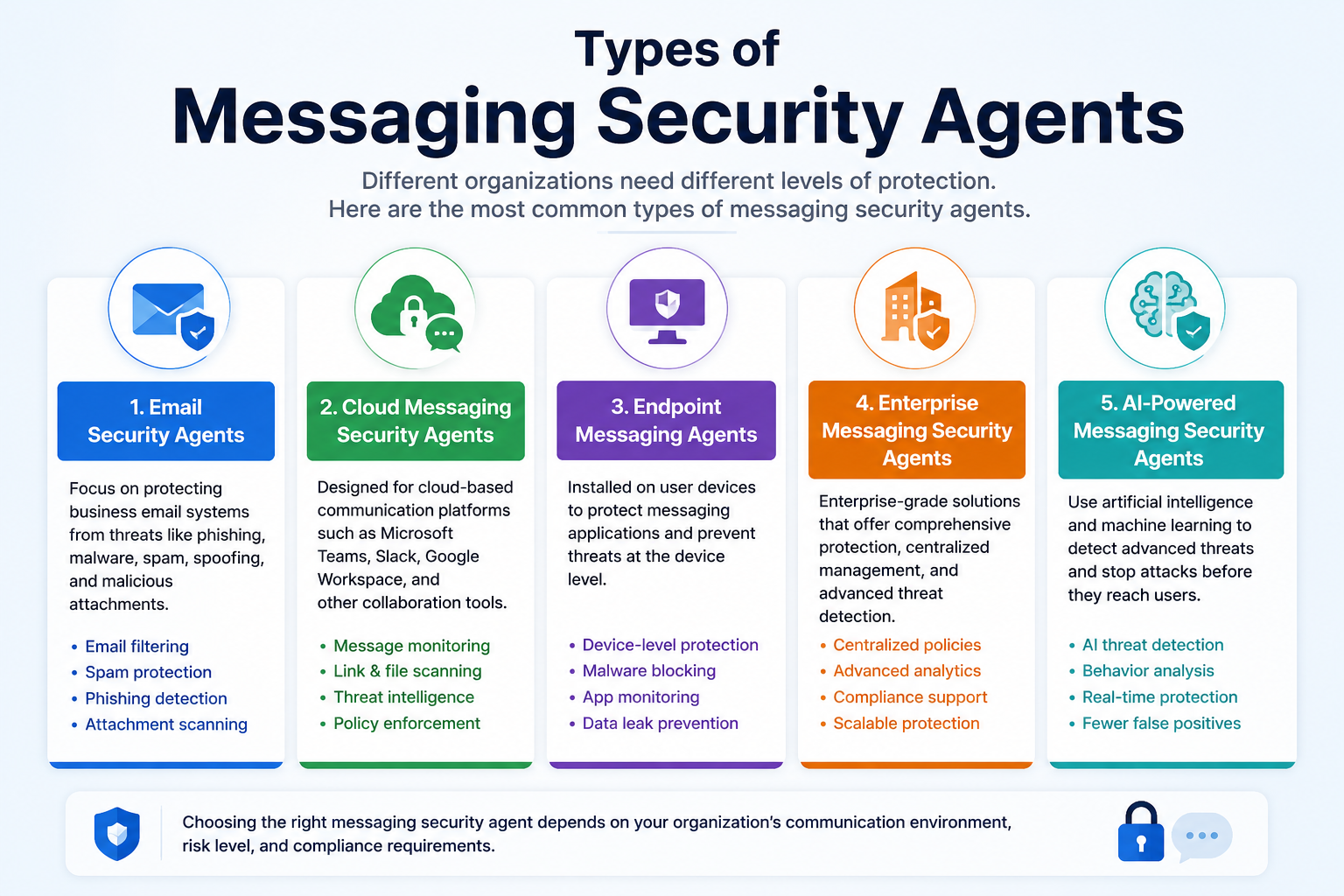
Different businesses use different types of messaging security agents depending on their communication systems, risk level, and compliance needs.
Email Security Agents
Email security agents protect inboxes from phishing, spam, malware, spoofing, and suspicious attachments. They are commonly used with business email platforms such as Gmail, Outlook, and Microsoft 365.
These agents are especially important because email remains one of the most common entry points for cyberattacks. You can also read about related risks in this guide on Gmail passwords and data breach.
Cloud Messaging Security Agents
Cloud messaging security agents protect platforms such as Slack, Microsoft Teams, Google Workspace, and other collaboration tools. They monitor conversations, files, links, and permissions inside cloud-based communication systems.
This matters because many businesses now work across shared drives, chat platforms, video meetings, and customer support apps instead of email alone.
Endpoint Messaging Security Agents
Endpoint agents protect the devices that send and receive messages. If a laptop, phone, or tablet is infected, messaging apps can become a channel for spreading malware or stealing data.
Endpoint-level protection helps confirm that devices are safe before they access sensitive communication.
Enterprise Messaging Security Agents
Enterprise messaging security agents are designed for larger organizations. They usually combine email protection, cloud messaging security, compliance monitoring, reporting dashboards, and centralized admin controls.
These systems are useful for companies managing many users, departments, locations, and communication tools at once.
AI-Powered Messaging Security Agents
AI-powered messaging security agents use artificial intelligence to detect unusual behaviour, reduce false alarms, and identify threats that traditional filters may miss.
For example, AI can notice when a sender suddenly changes language, sends unusual attachments, or contacts people outside normal patterns. This connects closely with broader developments in AI and automation.
Key Features of a Messaging Security Agent
A good messaging security agent should do more than block spam. It should provide layered protection across communication channels.
Important features include phishing detection, malware scanning, attachment inspection, suspicious link filtering, sender authentication, data loss prevention, encryption support, access control, reporting dashboards, and policy management.
The best systems also give administrators clear alerts instead of overwhelming them with noise. Security works better when teams can quickly understand what happened, who was affected, and what action is needed.
Messaging Security Agent vs Email Security Gateway
A messaging security agent and an email security gateway both protect communication, but they are not exactly the same.
| Feature | Messaging Security Agent | Email Security Gateway |
|---|---|---|
| Main purpose | Protects messaging across email, chat, cloud tools, and apps | Mainly protects email traffic |
| Scope | Broader communication security | Email-focused security |
| Deployment | Cloud, endpoint, or enterprise systems | Email server or mail flow level |
| Best for | Modern businesses using multiple communication tools | Businesses mainly focused on email protection |
| Protection | Phishing, malware, data leaks, app risks, access issues | Spam, phishing, malware, email filtering |
Email gateways are still useful, but messaging security agents are often better suited to modern workplaces where communication happens across many tools.
Real-World Example: How It Stops a Threat
Imagine a finance employee receives an email that looks like it came from a regular supplier. The message includes an urgent invoice and a link to confirm payment details.
Without protection, the employee may click the link and enter login details on a fake website.
With a messaging security agent, the system checks the sender, scans the link, compares it with known threat data, detects suspicious behaviour, blocks the message, and alerts the security team.
That one blocked message can prevent a business email compromise attack, stolen credentials, and financial loss.
Who Needs a Messaging Security Agent?
Any organization that relies on digital communication can benefit from a messaging security agent.
This includes:
- Small businesses
- Ecommerce stores
- Healthcare providers
- Finance teams
- Schools and universities
- Agencies
- Remote teams
- SaaS companies
- Enterprise organizations
Small businesses should not assume they are too small to be targeted. Attackers often prefer smaller companies because they may have weaker security systems and less formal oversight.
Businesses with remote or hybrid teams should be especially careful because employees often access messages from different devices, networks, and locations. This connects naturally with modern workplace trends such as remote work in Australia.
Common Messaging Security Mistakes
Many businesses rely too much on basic email filtering or antivirus tools. While these protections help, they are not enough on their own.
Common mistakes include ignoring employee training, failing to scan attachments properly, not using multi-factor authentication, allowing weak admin controls, ignoring suspicious login activity, and using outdated security policies.
Another mistake is treating messaging security as only an IT issue. In reality, secure communication affects customer trust, employee productivity, compliance, and business continuity.
Best Practices for Better Messaging Security
A messaging security agent works best as part of a layered security strategy.
Businesses should enable multi-factor authentication, train employees to recognize phishing, update security policies regularly, monitor suspicious message activity, review quarantined messages, and combine messaging protection with malware and endpoint security.
It is also important to understand the technical foundations behind secure communication. Concepts like domain routing, authentication, and DNS reliability matter more than many business owners realize. This guide on what is a DNS server explains the basics clearly.
Benefits of Using a Messaging Security Agent
The biggest benefit is prevention. A messaging security agent helps stop threats before they reach employees or customers.
It can also improve compliance, reduce downtime, support safer remote work, protect sensitive files, and give administrators better visibility into communication risks.
For businesses using customer platforms or cloud tools, messaging security also supports smoother operations. For example, teams using CRM systems and shared communication platforms can reduce risk by combining security controls with reliable tools such as cloud CRM.
How AI Is Changing Messaging Security
AI is making messaging security faster and more adaptive. Instead of only checking known threats, AI-supported systems can detect unusual patterns and respond to new risks more quickly.
This includes spotting suspicious writing styles, strange login behaviour, abnormal message volume, and risky attachments. AI can also help users decide whether a message looks safe before they click.
Still, AI should not replace human judgement. It should support faster decisions and reduce repetitive security work. To understand the basics behind these systems, read this guide on what is artificial intelligence.
For a plain-English explanation of the goal, tool, observation, and approval loop behind broader agent systems, see how AI agents work.
Conclusion
A messaging security agent is no longer just a technical add-on. It is an important layer of protection for any business that depends on email, chat, cloud tools, or customer communication.
It helps block phishing, malware, suspicious links, data leaks, and unauthorized access before they disrupt daily operations. More importantly, it reduces the damage caused by human error, weak integrations, and modern communication risks.
For businesses, the goal is not to make communication harder. The goal is to make communication safer, more reliable, and easier to trust.
As digital workplaces continue to expand, messaging security will only become more important. The businesses that treat secure communication as a long-term investment will be better prepared to protect their people, data, and reputation.
Related Cybersecurity Guides
If you are improving messaging security, these guides may also help:
- Gmail Passwords Data Breach and Email Security Risks
- How Do I Know If My Email Has Been Hacked?
- Malware Protection Guide
- What Is a DNS Server?
- Managed IT Services Explained
What is a messaging security agent?
A messaging security agent is a cybersecurity tool that protects digital communication from phishing, malware, spam, suspicious links, data leaks, and unauthorized access. It monitors messages and applies security rules to reduce business risk.