



You have probably tried at least one of them by now. Maybe you started with ChatGPT when it first exploded onto the scene, dabbled with Google’s Gemini because it was right there in your browser, or heard a developer friend raving about Claude. Now you are staring at three tabs, three subscriptions, and one nagging question: which one is actually worth it? The Claude vs ChatGPT vs Gemini debate has become the defining question of the AI era, and in 2026 the answer is more nuanced — and more interesting — than it was even a year ago.
This is not a spec-sheet comparison. This is a practical, real-world breakdown of what each AI assistant does best, where each one falls short, and how to pick the right tool for the way you actually work.
Editorial note: This article was reviewed by TheArticleSpot’s editorial team for clarity, source accuracy, and relevance. AI tools may have supported outlining, editing, formatting, or research organization, but final review and publication decisions are handled by a human editor. Tool features, pricing, and availability can change, so readers should verify important details on the official provider website before making a final decision.
What Are Claude, ChatGPT, and Gemini?
Before diving into the comparison, a quick orientation for anyone who has been watching from the sidelines. If you are still wrapping your head around the underlying technology, our guide on what is generative AI is a solid starting point.
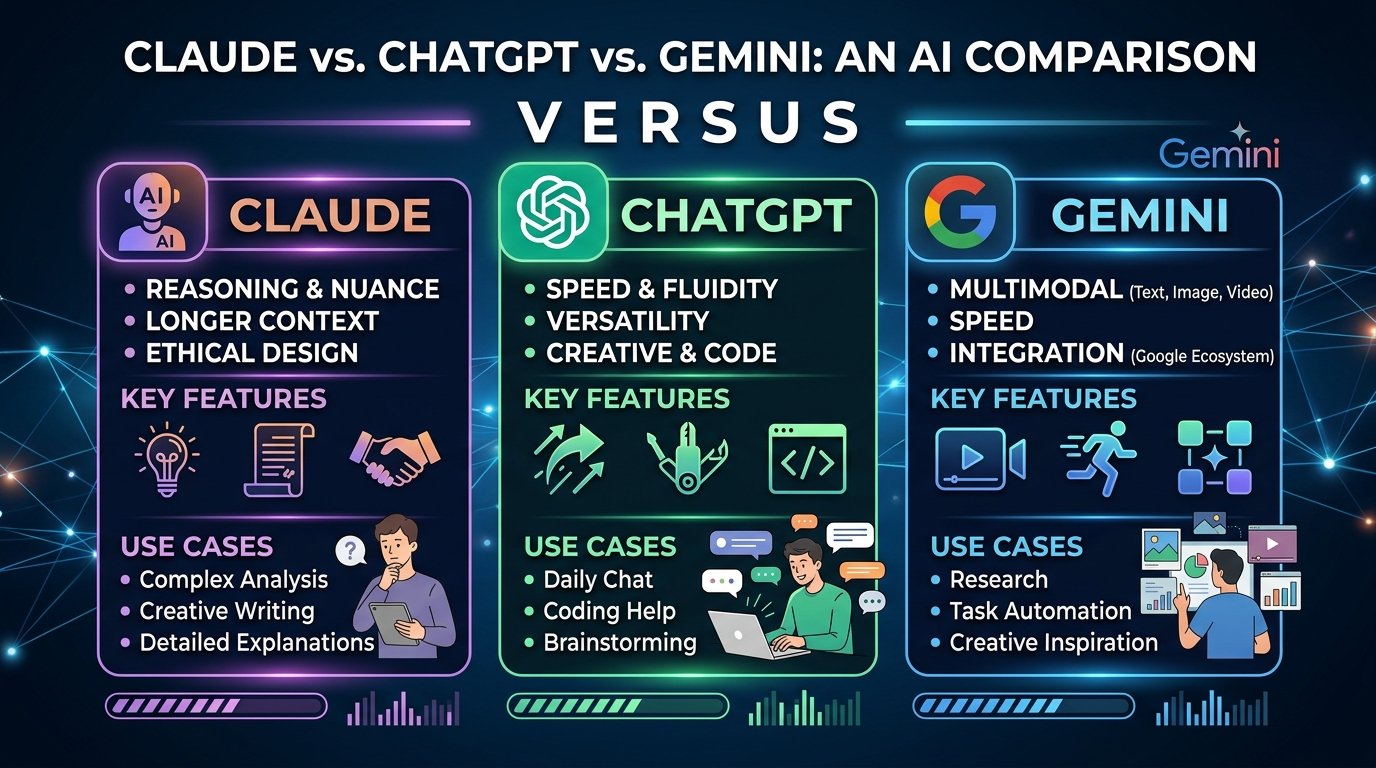
ChatGPT is OpenAI’s flagship AI assistant, currently powered by GPT-5.4. It launched in late 2022 and quickly became the household name for AI chatbots. It has the largest user base of any AI assistant, with hundreds of millions of weekly active users, a mature plugin ecosystem, and deep integration across third-party tools.
Claude is built by Anthropic, a company founded by former OpenAI researchers. Now running on Claude 4.6 (with Opus 4.7 arriving in 2026), it has earned a reputation for nuanced reasoning, exceptional coding ability, and the most reliable long-context processing in the industry.
Gemini is Google’s answer, deeply woven into the Google ecosystem — Workspace, Search, Android, and YouTube. Its standout feature is a massive context window and strong multimodal capabilities across text, images, video, and audio. All three are built on machine learning foundations, but their training approaches and design philosophies lead to very different user experiences.
All three cost roughly the same at the consumer level — around $20 per month for premium access — and all offer limited free tiers. For a broader look at the landscape beyond these three, check out our roundup of the best AI tools in 2026.
Why the Claude vs ChatGPT vs Gemini Debate Matters
This is not just a tech curiosity. For freelancers, business owners, students, marketers, and developers, picking the right AI assistant directly affects productivity, output quality, and even revenue. Australian businesses adopting AI tools are finding that the wrong choice means wasted hours rewriting sloppy outputs or debugging hallucinated code. The right choice means finishing in half the time.
The broader trend is clear: AI assistants are becoming as essential as email or spreadsheets. The question has shifted from “should I use AI?” to “which AI should I use?” That makes understanding the strengths and trade-offs of each platform genuinely important. In fact, AI proficiency is quickly becoming one of the core employability skills in Australia that employers actively look for.
How Each AI Performs Where It Counts
Writing and Content Creation
If your work revolves around writing — blog posts, marketing copy, reports, proposals — the differences are meaningful.
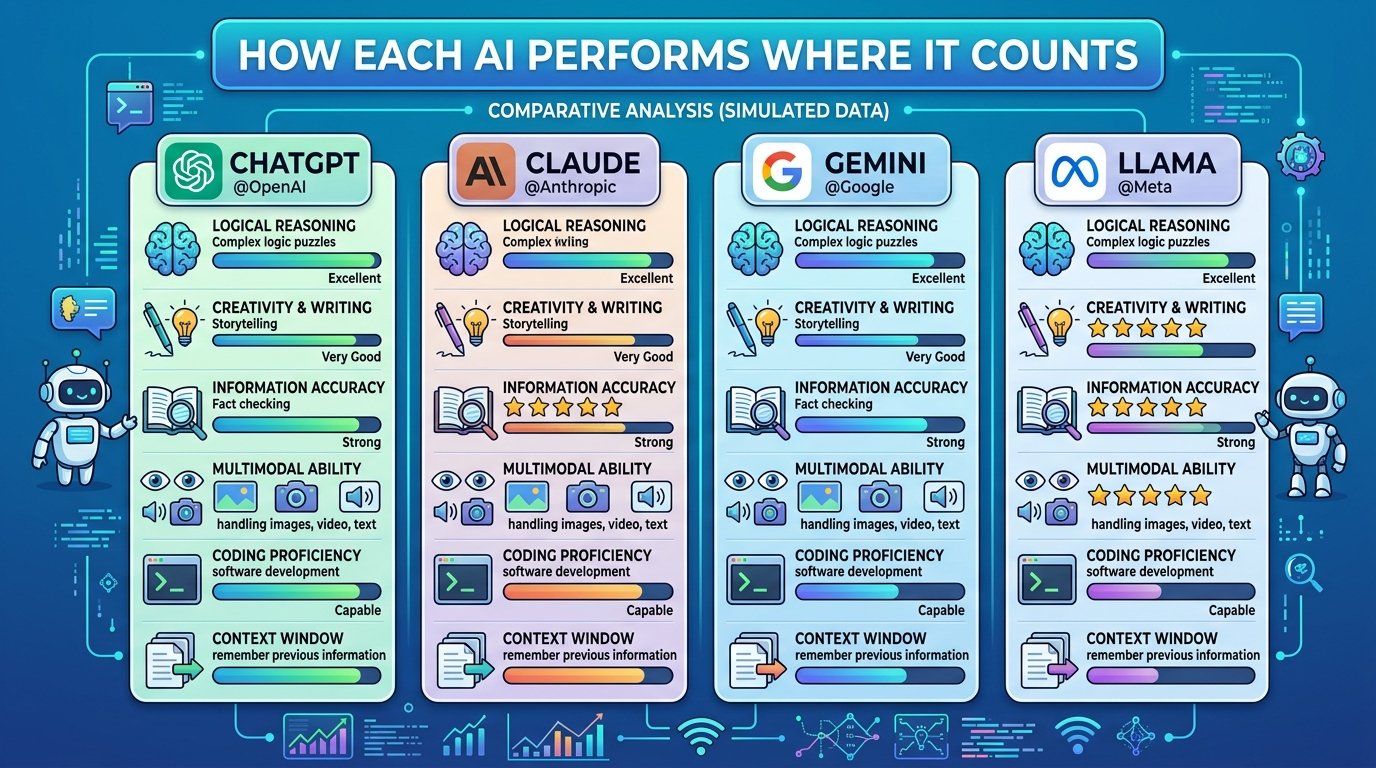
ChatGPT is the most versatile generalist. It handles everything from social media captions to long-form articles competently, though it can lean toward a recognisable “AI voice” that experienced readers spot quickly. It excels at brainstorming and generating ideas fast.
Claude produces the most natural, human-sounding prose. It follows nuanced instructions better, maintains tone consistency across long documents, and tends to push back constructively when a prompt is vague rather than guessing and producing filler. For professional writing tasks — client proposals, editorial content, detailed reports — Claude consistently delivers cleaner first drafts.
Gemini is capable but less focused on writing craft. Where it shines is research-adjacent writing: pulling in current information from the web, summarising multiple sources, and producing reference-heavy content. If your writing task involves synthesising lots of information quickly, Gemini handles that well.
Coding and Development
For developers and technical users, this category often determines the whole decision.
Claude has emerged as the strongest coding assistant, particularly for complex logic, full-file refactoring, and understanding large codebases. Claude Code, its terminal-based agentic coding tool, has become a favourite among professional developers who need more than autocomplete suggestions. If you are considering a career in this space, our guide to software engineering in 2026 covers how AI is reshaping the role.
ChatGPT remains excellent for quick scripts, data analysis with its built-in code interpreter, and breadth of language coverage. If you need a snippet in an obscure framework, ChatGPT’s vast training data usually delivers something workable.
Gemini’s advantage is speed and its enormous context window, which lets it process entire repositories at once. For developers working within the Google ecosystem — Firebase, Google Cloud, Android — Gemini integrates more naturally than the alternatives.
Research and Analysis
ChatGPT with browsing enabled is a strong research companion, pulling in recent web results and summarising them conversationally. Its memory features across sessions also help with ongoing research projects.
Claude handles long documents with unmatched reliability. Feed it a 200-page contract, a full codebase, or a stack of academic papers and it will maintain coherence throughout. Other models tend to lose track of details in genuinely long contexts, even when they technically support the token count.
Gemini leans into Google’s search infrastructure. For quick factual lookups and staying current with fast-moving topics, it benefits from being plugged directly into the world’s largest search engine. As AI increasingly merges with hardware and connected devices through AIoT, this kind of ecosystem integration becomes even more valuable.
Real-World Scenarios: Choosing the Right AI

Rather than abstract benchmarks, here is how the choice plays out in everyday situations.
You run a small business and need marketing copy. ChatGPT is the fastest path to decent ad copy, email sequences, and social posts. Claude is better if you care about the writing quality standing out from competitors also using AI. Gemini works if you want copy that references current trends or competitor analysis pulled from the web. And if you are also evaluating tools for managing customer relationships alongside your AI assistant, our explainer on what is CRM software is worth a read.
You are a developer building a SaaS product. Claude is the clear pick for complex architecture decisions, debugging, and sustained coding sessions. ChatGPT is a useful backup for quick prototyping and exploring unfamiliar APIs. If you are deploying on cloud infrastructure, our AWS Amazon Web guide covers the essentials.
You are a student writing a research paper. Gemini helps gather and synthesise sources efficiently. Claude is better for structuring arguments and producing polished academic prose. ChatGPT sits comfortably in between.
You manage a team and need to process long documents. Claude handles this better than any alternative. Drop in meeting transcripts, policy documents, or contract bundles and get reliable summaries without information loss.
Claude vs ChatGPT vs Gemini Comparison Table (2026)
| Feature | Claude | ChatGPT | Gemini |
|---|---|---|---|
| Developer | Anthropic | OpenAI | Google DeepMind |
| Best Known For | Long-form writing, reasoning, coding assistance | General-purpose AI assistant, creativity, coding, research | Multimodal AI, Google ecosystem integration, research tasks |
| Best For | Developers, writers, researchers, document analysis | Everyday users, businesses, content creators, developers | Google Workspace users, research-heavy workflows, multimodal tasks |
| Writing Quality | Excellent natural writing style and detailed explanations | Strong adaptable writing with multiple styles | Good writing with strong factual organization |
| Coding Ability | Strong for code review, debugging, and complex programming tasks | Strong all-round coding assistant with broad tools | Strong coding support, especially with Google developer ecosystem |
| Reasoning Ability | Excellent for complex analysis and step-by-step reasoning | Strong reasoning with advanced models and tools | Strong reasoning with large context capabilities |
| Long Documents | Excellent handling of large documents and summaries | Good document analysis and file handling | Strong long-context document understanding |
| Image Understanding | Available with vision capabilities | Strong multimodal image analysis | Strong multimodal understanding and image capabilities |
| Web Search | Available through supported ChatGPT features | Built-in search capabilities depending on plan/features | Integrated with Google Search ecosystem |
| Ecosystem Integration | Anthropic tools and developer platforms | OpenAI tools, GPTs, APIs, integrations | Google Workspace, Android, Google services |
| Enterprise Use | Knowledge work, coding teams, document workflows | Business automation, AI assistants, custom GPT solutions | Enterprise productivity and Google-based workflows |
| Coding Assistant | Best for deep code reasoning and reviews | Best overall balance of coding + general tasks | Good for Google Cloud and development workflows |
| Creativity | Strong storytelling and writing style | Strong creative generation and brainstorming | Strong structured creative assistance |
| Free Availability | Free and paid plans available | Free and paid plans available | Free and paid plans available |
| Ideal User | Developers, researchers, writers | General users, businesses, creators | Google users, students, enterprise teams |
Practical Tips for Getting the Most From Any AI Assistant
Regardless of which platform you choose, a few strategies make a real difference.
Write specific prompts. “Write me a blog post about marketing” produces generic output from any model. “Write a 1,200-word blog post for Australian small business owners about LinkedIn marketing strategies that don’t require a large ad budget, using a conversational but professional tone” gets dramatically better results from all three. If crafting prompts feels overwhelming, a prompt generator tool can help you get started.
Use the right tool for the right job. There is no rule saying you can only use one. Many professionals rotate between two or even all three depending on the task. A developer might use Claude for coding, ChatGPT for brainstorming product names, and Gemini for competitive research.
Test outputs critically. Every AI hallucinates occasionally — inventing facts, citing non-existent sources, or confidently stating something incorrect. Always verify important claims, especially in professional or published content. This is particularly crucial for sensitive areas like messaging security or legal compliance, where inaccurate AI output can cause real damage.
Take advantage of context windows. If you are working on a large project, feed the AI as much relevant context as possible. Claude’s massive context window makes it particularly effective for complex multi-document tasks, but even ChatGPT and Gemini perform better with more context.
Frequently Asked Questions
Which AI is best for everyday use?
ChatGPT is the strongest all-rounder for casual daily use. It handles the widest variety of tasks competently, has the most mature third-party integrations, and its conversational memory makes ongoing projects smoother. If you only want one subscription, ChatGPT covers the most ground.
Is Claude better than ChatGPT for writing?
For professional and long-form writing, Claude generally produces more natural, nuanced prose with better instruction-following. ChatGPT is faster for generating ideas and casual content. The gap is most noticeable in tasks requiring consistent tone, complex structure, or sensitivity to audience. If you are using AI to support a content business, our guide on ways to upload a blog and earn money covers the practical side of monetising your writing.
Which AI has the largest context window?
Gemini offers the largest raw context window, extending up to two million tokens in its Pro tier. However, output quality can vary at extreme lengths. Claude provides the most consistently reliable long-context processing, maintaining accuracy across its full context window.
Are these AI tools free to use?
All three offer limited free tiers. Premium plans for ChatGPT Plus, Claude Pro, and Gemini Advanced all sit at approximately $20 per month. API pricing varies, with Gemini Flash generally being the cheapest option for developers.
Which AI is best for coding?
Claude leads for complex coding tasks, large codebase understanding, and agentic development through Claude Code. ChatGPT is strong for quick scripts and data analysis. Gemini is fastest for straightforward tasks and works well within Google’s development ecosystem.
The Bottom Line
The Claude vs ChatGPT vs Gemini comparison does not have a single winner, and anyone telling you otherwise is oversimplifying. ChatGPT is the most versatile generalist with the biggest ecosystem. Claude delivers the highest quality output for writing, coding, and deep analysis. Gemini is the smartest pick for multimodal work and anyone already embedded in Google’s tools.
The practical move is to try all three with the kind of work you actually do, not synthetic benchmarks or hypothetical scenarios. If you are just getting started with AI, an AI course for beginners can help you build the foundational skills to get more from any of these platforms. Most professionals who take AI seriously in 2026 use at least two of these tools regularly, matching each to its strength. That flexibility — not blind loyalty to one platform — is what turns AI from a novelty into a genuine productivity advantage.